
Distinguishing fat, posture and a mass before choosing care
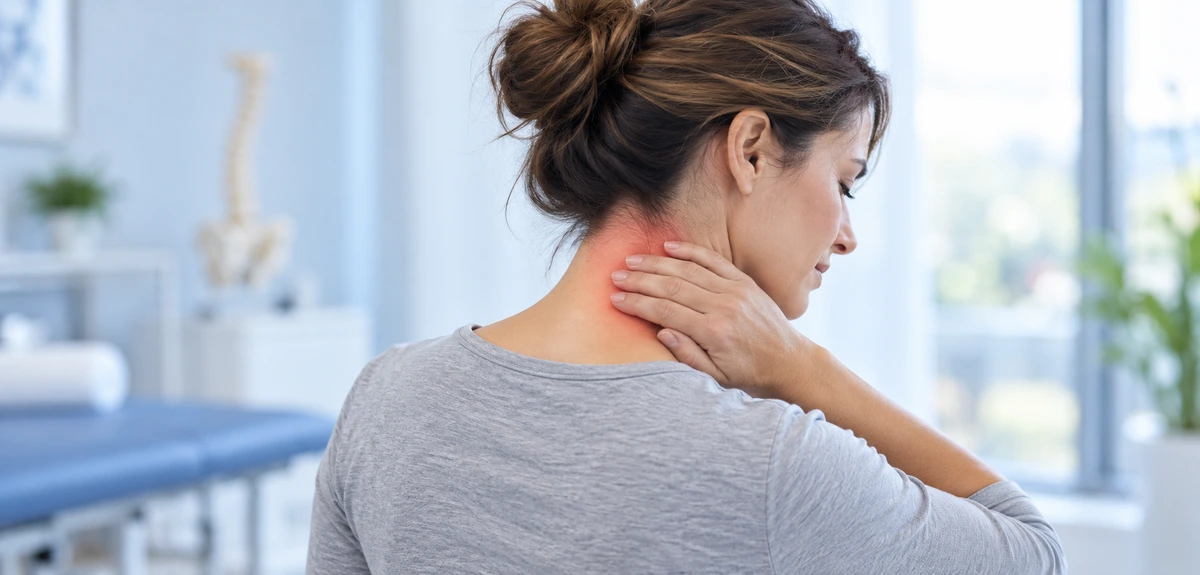
A prominence at the base of the neck is often noticed in a photograph or against a collar. It may cause worry, restrict movement or simply change appearance. However, the everyday term “buffalo hump” combines several different situations. A dorsocervical fat pad is an accumulation of fat beneath the skin; kyphosis is the curvature of the upper back. Both can coexist without sharing the same cause.
The priority is to identify what forms the prominence. Posture cannot establish a hormonal disorder, and a hump does not automatically mean Cushing syndrome. Medical assessment depends on its development, other symptoms and treatment history. Manual care may support associated musculoskeletal pain; it does not remove adipose tissue.

Understanding the dorsocervical region
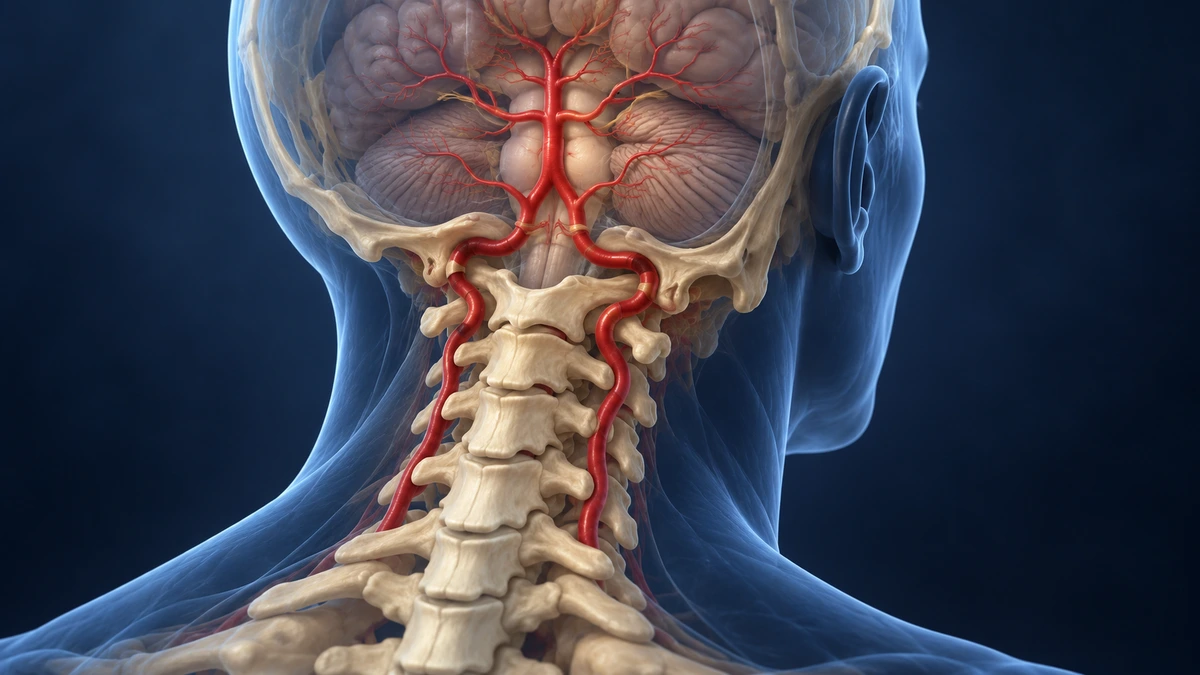
The cervicothoracic junction connects the lower neck to the upper chest. Skin and subcutaneous tissue cover muscles, including the trapezius, and deeper structures. A fatty prominence is therefore distinct from the vertebrae, discs and spinal cord. It does not mean that a vertebra has moved out of place.
A prominent vertebra, rounded back, diffuse deposit or clearly defined mass can look similar in a photograph. Head position changes the silhouette but does not establish the tissue type. Pictures taken from different angles cannot reliably measure worsening or disappearance. Examination helps distinguish these possibilities. [1] [6]
Which causes should be considered?
Fat distribution and general health
General adiposity can increase dorsocervical volume. Body fat distribution varies: two people of similar weight do not necessarily have the same silhouette. Local appearance cannot establish metabolic health or justify assumptions about habits. Weight changes sometimes explain a change, but should not automatically explain a new mass.
Cortisol excess and glucocorticoid exposure
Prolonged cortisol excess can change fat distribution. Endogenous Cushing syndrome is an endocrine disease; glucocorticoid exposure is another context to investigate. An isolated fat pad is nonspecific. Weakness around the thighs or shoulders, easy bruising and wide purple stretch marks make assessment more relevant, especially when several features progress together. [1]
Bring a complete treatment list to the physician, including creams, inhalers and injections. Reviewing it does not authorise changing a prescription independently. Long-term glucocorticoid treatment must not be stopped abruptly without medical guidance: withdrawal can cause adrenal insufficiency. This safety point matters even when appearance is the main concern. [3]
Lipodystrophies and lipomatoses
Lipodystrophy involves abnormal fat distribution, sometimes with fat loss elsewhere and metabolic complications. It is more than a hump. Some situations associated with HIV or its treatment history require specialist assessment. A fat deposit does not reveal someone’s infection status. [4] [9]
Rarer Madelung disease can produce multiple symmetrical deposits around the neck and upper trunk. It differs from general excess weight and an isolated lipoma. Patterns, possible causes and treatments differ; the same posture advice cannot address all these situations. [5]
Fat pad, kyphosis or lipoma: useful distinctions
| Presentation | Possible explanation | Appropriate next step |
|---|---|---|
| Diffuse, soft prominence | Fat accumulation | Assess development and medical context. |
| Rounded back, mainly bony prominence | Kyphosis or prominent vertebra | Assess mobility, pain and bone risk. |
| Distinct lump beneath the skin | Lipoma or another mass | Clarify its nature; imaging when indicated. |
| Prominence with progressive hormonal features | Possible endocrine cause | Targeted medical assessment, sometimes endocrinology. |
| Growing, deep or fixed mass | Lesion requiring clarification | Prompt assessment without massaging the mass. |
These pointers guide consultation; they are not a self-test. A lipoma is usually a benign fatty mass, but not every new lump is a lipoma. Absence of pain is insufficient reassurance when a mass grows. NICE recommends prompt ultrasound for an unexplained growing lump in adults. The actual pathway depends on the local healthcare system. [6]
When should assessment be prompt?
Recent onset, clear enlargement, marked asymmetry, fixation to deeper tissue or persistent pain warrants medical examination. Large size increases concern, but a small evolving mass also needs assessment. Do not wait for it to reach a particular size. Skin changes, fever or declining general health also make consultation a priority. [6]
New difficulty breathing or swallowing, progressive neurological weakness or sudden severe pain requires urgent assessment. These symptoms must not automatically be attributed to fat accumulation. Meanwhile, avoid repeated deep pressure over an unexplained area. Associated neck pain may have another cause independent of the prominence.
What does assessment involve?
History and clinical examination
The physician reviews onset, rate of change, weight changes, treatments and medical history. They distinguish diffuse thickening from a focal mass, examine the skin and look for associated features. Strength, mobility and neurological examination are adapted to the symptoms. An osteopath may document functional limitations and refer; they do not make the medical diagnosis of the mass.
Targeted investigations rather than routine testing
If Cushing syndrome is suspected, the physician chooses a validated test: late-night salivary cortisol, urinary free cortisol or dexamethasone suppression testing, as appropriate. A random blood cortisol measurement is insufficient for screening. Results require medical interpretation; an abnormal test alone does not establish the source of hormone excess. [1]
Ultrasound can help characterise a superficial mass. MRI is sometimes needed for a deep or uncertain lesion. Radiographs address a bony question, such as painful kyphosis with suspected fracture; they are not the routine investigation for a fat pad. Biopsy is not automatic and, when indicated, should be organised by the specialist team. [6]
Treatment depends on the cause
When the deposit accompanies general adiposity, an individual plan may combine nutrition, activity and appropriate follow-up. Local volume may change, without a guaranteed result or the ability to select exactly where fat decreases. Neck exercises mainly train movement and muscles: they are not an established treatment for the fat pad.
An endocrine cause or lipodystrophy requires specific management. Treating the cause protects health beyond appearance. In confirmed Cushing syndrome, the pathway depends partly on the source of cortisol excess. Relaxation advice or better posture cannot replace that care. [2] [4]
When might surgery be discussed?
Significant functional or cosmetic concerns may lead to surgical consultation once the cause is clarified. Liposuction and excision are different options, chosen according to tissue characteristics, extent and goals. A series of 34 patients and a cohort of nine people living with HIV describe favourable outcomes, but small samples and lack of comparison limit the conclusions. [9] [10]
A 2026 synthesis also examines these procedures. Evidence does not justify promising permanent correction for everyone. Scarring, contour irregularities, fluid collection, infection and recurrence are issues to discuss with the surgeon. The informed person makes the decision; cosmetic concerns do not make an intervention compulsory. [11]
Rehabilitation: improve function without promising to melt the hump
Once the region has been medically assessed, rehabilitation can target associated stiffness or hyperkyphosis. The SHEAF trial and a systematic review support targeted exercise for some measures of kyphosis in affected adults. These findings concern curvature and function, not disappearance of fat. They do not justify an identical programme for everyone. [7] [8]
Start with a useful activity: turning the head to drive, looking ahead or sitting comfortably. A professional may suggest gentle neck movement, progressive training of the back and shoulder muscles, then suitable whole-body activities. Dosage depends on tolerance, fitness and any fracture risk.
There is no need to force the head backwards or pull it with the hands. Increasing pain, unusual dizziness, tingling or weakness calls for stopping the exercise and reassessment. Regular position changes are often more realistic than maintaining a “perfect posture” all day.
What role can osteopathic care play?
Manual support may be considered for coexisting neck or thoracic pain after excluding situations requiring assessment. Goals should remain observable: more comfortable movement, better activity tolerance and participation in exercise. Feeling less tension does not prove that fat volume has changed.
There is insufficient clinical evidence that osteopathic care redistributes fat, treats hormonal excess or prevents fat pad formation. The mass should not be described as stagnation needing drainage. If care does not produce useful functional improvement, reassess the strategy rather than multiply passive sessions.
Follow-up and common questions
Is stress enough to explain the deposit?
No. Ordinary stress cannot establish Cushing syndrome. Supporting sleep and psychological health may help wellbeing, but is neither a hormonal test nor a specific fat pad treatment. Significant distress about body image deserves listening and, when needed, referral to a suitable professional.
How can changes be monitored without constant checking?
Record symptoms, actual changes and limited activities rather than taking daily photographs. If visual comparison helps follow-up, use the same angle and position. Agree the review schedule with the physician; report rapid changes before the planned appointment.
What progress should be tracked?
Track the nature and volume of the prominence separately from pain, mobility and quality of life. Someone may turn their head more easily without a change in silhouette. Conversely, painless volume changes still need follow-up if the cause remains uncertain. This distinction supports realistic expectations.
Key points
A dorsocervical fat pad is a sign to understand, not proof of poor posture. Assessment distinguishes fat, bony curvature and a localised mass. Treatment depends on that distinction. Activity and musculoskeletal care can support function; they do not replace assessment of an endocrine cause or an evolving mass.
References
- [1] Nieman LK et al. The diagnosis of Cushing’s syndrome: an Endocrine Society Clinical Practice Guideline. 2008.
- [2] Endocrine Society. Treatment of Cushing’s Syndrome: Clinical Practice Guideline. 2015.
- [3] Beuschlein F et al. Diagnosis and therapy of glucocorticoid-induced adrenal insufficiency. Joint guideline. 2024.
- [4] Brown RJ et al. The Diagnosis and Management of Lipodystrophy Syndromes: A Multi-Society Practice Guideline. 2016.
- [5] Łącka M et al. Madelung’s disease—a case series from a single-center experience. 2025.
- [6] NICE. Suspected cancer: recognition and referral. NG12, soft tissue sarcoma recommendations.
- [7] Katzman WB et al. Targeted spine strengthening exercise and posture training program to reduce hyperkyphosis in older adults: SHEAF randomized controlled trial. 2017.
- [8] Ponzano M et al. Exercise for improving age-related hyperkyphosis: a systematic review and meta-analysis with GRADE assessment. 2021.
- [9] Chen S et al. Clinical outcome after lipectomy in the management of patients with human immunodeficiency virus-associated dorsocervical fat accumulation: an observational cohort study. 2019.
- [10] Wang G et al. Liposuction to improve the dorsocervical fat pad in esthetic need: anatomical study and clinical case series. 2022.
- [11] Surgical Management of Dorsocervical Fibro-Lipodystrophy (Buffalo Hump): Systematic Review and Meta-Analysis. 2026.