

Identifying the tendon crossing and preserving thumb function
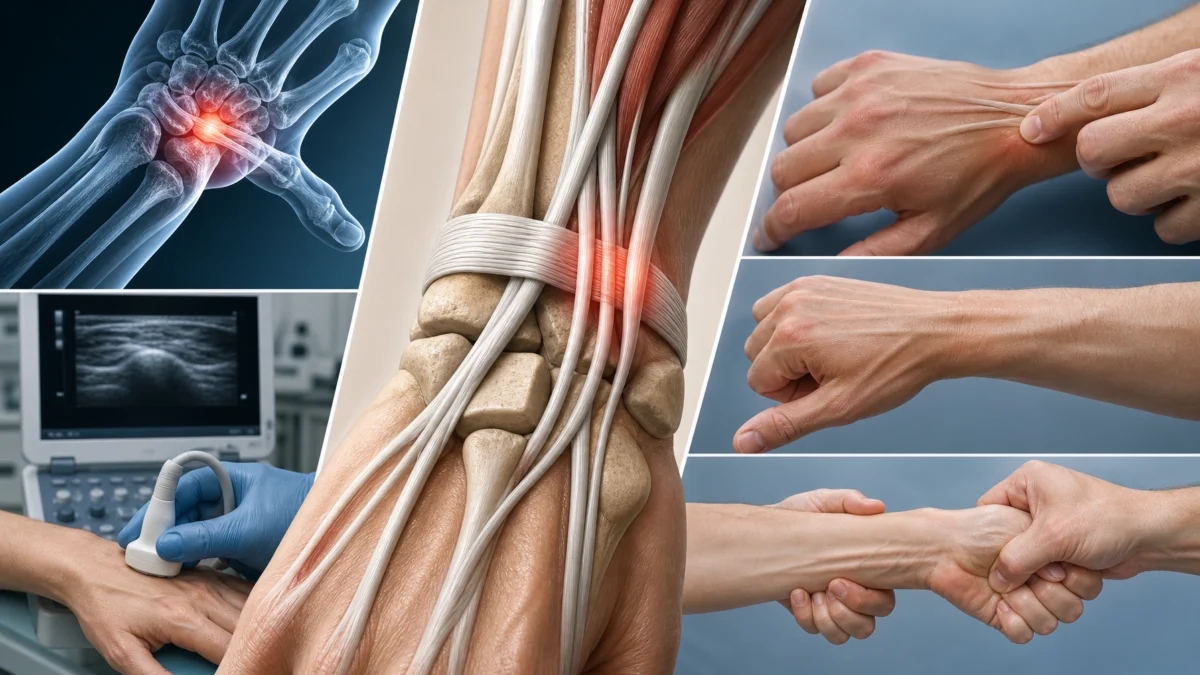
Pain on the back of the wrist near the base of the thumb is not always de Quervain tendinopathy. Distal intersection syndrome concerns a different crossing: the extensor pollicis longus tendon crossing the radial wrist extensor tendons. This rare condition may cause pain, swelling and sometimes crepitus. Precisely identifying the region involved helps guide examination and select appropriate measures [1, 5].
The aim is not to give an unusual name to every wrist pain. It is to check whether symptoms match this tendon crossing, look for possible associated injuries and protect thumb function. Available evidence mainly consists of small series, case reports and imaging studies. This limitation should accompany explanations and care decisions.
Understanding the tendon crossing
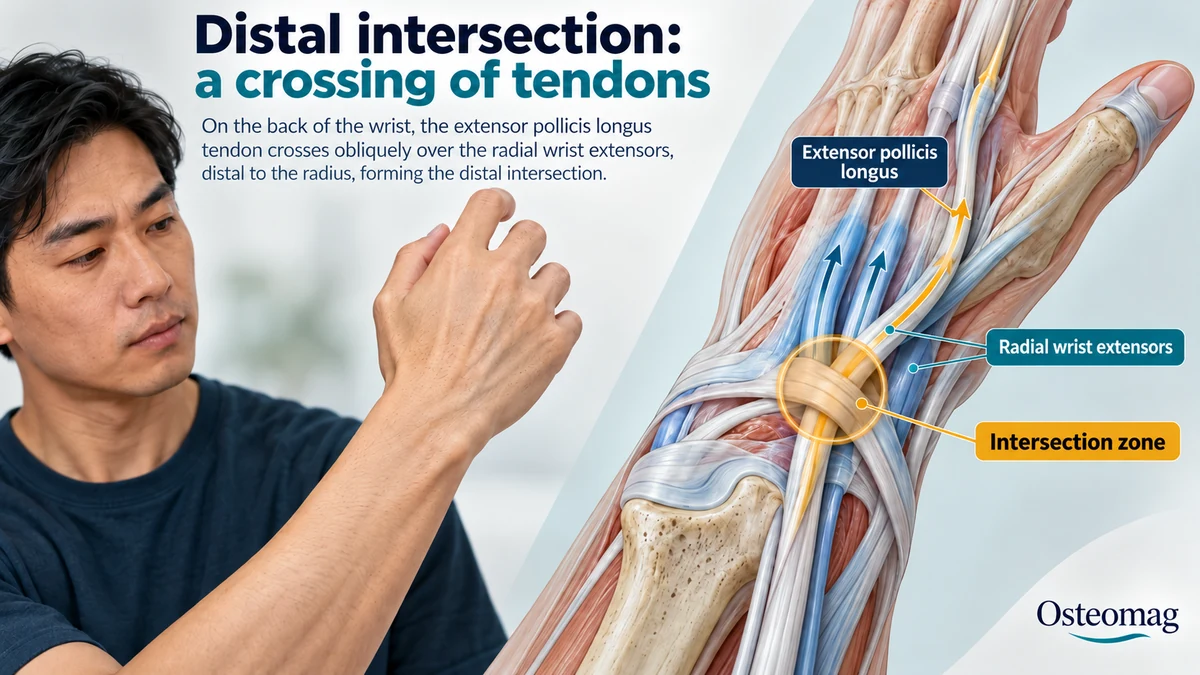
The extensor tendons pass over the back of the wrist within compartments that guide their course. Extensor carpi radialis longus and brevis occupy the second compartment. Extensor pollicis longus passes through the third compartment, changes direction near Lister’s tubercle and then crosses the tendons of the second compartment. The distal intersection therefore lies in a different anatomical region from the proximal intersection [1, 5].
Tenosynovitis means inflammation of the sheath surrounding a tendon. At the distal crossing, imaging may show fluid around the tendons and changes in neighbouring tissues. Local mechanical demands may contribute to symptoms, but the precise mechanism is not identical in every patient. Joint or bony abnormalities were also described in a small recent surgical series. Systematically attributing the condition to simple friction caused by repetitive movement would go beyond the evidence [1, 2].
This anatomical distinction has a practical consequence: pain several centimetres farther up the forearm does not necessarily represent the same condition. Proximal intersection syndrome involves a different crossing between the first and second compartments. Published ultrasound observations concerning that form should not be transferred wholesale to the distal form [7].

Symptoms that need precise localisation
Pain may occur during thumb movement, wrist extension or particular grips. Localised dorsal swelling and a sensation of crepitus are sometimes present. Their absence does not exclude the diagnosis, and their presence does not confirm it independently. A case report or imaging series describes a possibility; it does not supply a mandatory set of signs for every person [1, 5, 6].
The history explores recent changes in demands: manual work, training, tool use or an increase in repetitive tasks. It also clarifies any trauma, previous fractures and known joint problems. The purpose is to understand the context without assuming that an occupation or hobby automatically explains the pain.
Precise location helps distinguish several causes. Pain at the radial styloid may suggest involvement of the first compartment; pain after a fall may require investigation for a fracture. A mass, bony impingement or another tendon disorder may cause nearby discomfort. Reviews of hand and wrist tendinopathies emphasise the importance of making these anatomical distinctions [8, 9].
| Clinical reference point | Region or structure | Practical implication |
|---|---|---|
| Distal intersection | Extensor pollicis longus crossing the second compartment [1, 5] | Localise symptoms and assess thumb function. |
| Proximal intersection | A crossing farther up the forearm [7] | Do not confuse the two forms. |
| De Quervain tendinopathy | First compartment near the radial styloid [9] | Clarify which structure is painful. |
| Pain after a fall | Possible bony injury or another lesion [10] | Do not automatically conclude that it is tenosynovitis. |
| New loss of thumb extension | Extensor pollicis longus injury must be considered [3] | Seek prompt advice from a professional with hand expertise. |
Clinical guide — Osteomag. This table does not replace individual assessment.
When thumb function changes suddenly
A new inability to straighten the tip of the thumb requires prompt assessment by a professional with expertise in hand conditions. A published case described progression to extensor pollicis longus rupture in the setting of distal intersection syndrome. This event is a reason for vigilance; one case cannot establish its frequency or make rupture the expected course of the condition [3].
Significant pain after a fall, deformity, loss of sensation or an abnormally cold hand also requires prompt referral. A red, hot and very painful wrist accompanied by fever needs assessment for an urgent cause. In these situations, additional exercises or repeated movement tests do not replace investigation of the cause.
Examination and further investigations
Professional examination aims to relate the painful area to movements that load the tendons concerned. It assesses wrist mobility, thumb function and other structures that might explain the pain. Examination manoeuvres are adapted to tolerance; repeatedly provoking sharp pain does not necessarily provide useful additional information.
Ultrasound allows real-time examination of the tendons, their sheaths and their movement. It may identify fluid, thickening or other abnormalities depending on the question and the examiner’s expertise. General evidence on ultrasound of hand and wrist tendons helps explain the investigation, but does not guarantee accuracy in every rare presentation [4].
MRI can characterise the tendon crossing and investigate associated injuries more closely. Early descriptions of distal intersection syndrome identified characteristic MRI findings, and subsequent publications confirmed the usefulness of targeted investigation. Nevertheless, the choice between ultrasound, radiographs and MRI depends on the context, particularly trauma or suspected bone involvement. Not everyone needs every investigation [1, 5, 10].
An abnormal image must remain consistent with the symptoms. Fluid around one tendon does not automatically explain pain located elsewhere. Conversely, persistent discomfort with an initially uninformative investigation may justify clinical reassessment rather than a premature conclusion.
Adjusting demands without immobilising everyday life
When conservative management is appropriate, the first step generally involves reducing tasks that clearly maintain symptoms. General principles used for wrist tendinopathies may guide these adjustments. However, available publications do not define a universal protocol validated by large trials specifically for distal intersection syndrome [8, 9].
Relative rest may mean taking more frequent breaks, temporarily reducing forceful grips or changing how tasks are distributed. For example, someone who spends long periods using a tool may initially shorten each working period and alternate activities. The effects of these changes are then evaluated rather than changing every parameter at once.
A splint may be proposed when the professional considers it appropriate. Its purpose, duration of use and fit should be explained. Protection that causes numbness, painful pressure or increasing discomfort should be checked. No splint design or timetable automatically applies to every patient.
Tolerated tasks can be maintained to preserve reasonable independence. Mild, temporary discomfort differs from pain that increases with every repetition or remains clearly worse the next day. Monitoring should also include thumb function: new difficulty with extension changes the priority and requires reassessment, even when swelling seems to have decreased [3].
Rebuilding capacity rather than testing pain
When progress allows, rehabilitation may introduce controlled movements, followed by appropriate resistance and tasks resembling usual activity. Selection depends on tendon function, associated injuries and the recommendations of the responsible professional. Strength or gripping programmes must be adjusted if symptoms become persistently worse.
A simple progression can separate duration, required force and movement frequency. Resuming a task for longer while simultaneously increasing resistance makes it difficult to identify what caused a flare-up. Changing one variable at a time makes follow-up clearer and supports precise communication between the person and their care team.
These load-management suggestions are practical reference points based on general rehabilitation reasoning. They do not demonstrate that a particular exercise directly treats distal intersection syndrome. Presenting them as an established condition-specific treatment would overstate the available evidence.
The role of osteopathic support
Support may help analyse repetitive movements, prolonged positions and associated tension that makes activities more difficult. Cautious work directed towards comfort and mobility in neighbouring regions may be considered once the situation has been assessed and proposed interventions respect the care recommendations. The objective should remain functional and measurable.
There is no strong clinical evidence that osteopathy eliminates this tenosynovitis, prevents tendon rupture or corrects an anatomical conflict. Specific references mainly describe cases and imaging or surgical series. They do not validate an osteopathic protocol. This distinction avoids promising recovery on the basis of a merely plausible mechanism [1, 2, 3, 5].
A useful consultation may lead to a concrete objective: tolerating a task better, identifying excessive load or preparing a gradual return. It should also plan referral if progress is unfavourable. Pain that persists despite adjustments deserves reconsideration of the initial hypothesis, actual demands and possible associated injuries.
When specialist advice becomes relevant
A hand specialist’s opinion may be needed when symptoms continue to limit function, a structural injury is suspected or conservative measures do not allow progress. Interventions described in the literature address selected situations: exploration of an anatomical conflict, release or treatment of affected tissues according to findings. They are not a standard solution for every dorsal wrist pain [2].
The recently published five-case surgical series provides information about tendon injuries and associated joint problems. Its small sample and selection of operated patients limit conclusions. It cannot compare every option or guarantee the same outcome for another person [2].
Specialist discussion should clarify which findings are actually attributed to the distal crossing, the expected benefits and the restrictions or rehabilitation stages that would follow intervention. Decisions are based on experienced difficulty, function and identified risks, rather than on the rarity of the diagnosis.
Preparing a sustainable return
Return to work or sport is organised around the tasks required. A brief, slow activity with little resistance may be tolerated before a prolonged sequence or forceful grip. Recording duration, symptoms during the task and the later response is useful. These details help distinguish manageable progression from an overly rapid return.
Confidence matters too. Someone afraid to move the thumb may need explanations of permitted movements and signs requiring consultation. “Let pain guide you” is often too vague; a plan defining permitted tasks, adaptations and a reassessment date is more practical.
Distal intersection syndrome is rare, but its management can remain clear: identify the structures involved, preserve thumb function, adjust demands and measure progress. Recognising study limitations does not prevent action. It supports realistic objectives and prompt reassessment when the course differs from what was expected.
Osteopathic support plan: key points
- Clarify the location of the painful crossing and alternative diagnoses.
- Refer promptly if thumb extension changes suddenly.
- Reduce aggravating demands while maintaining tolerated tasks.
- Adapt exercises and any protection with the responsible professional.
- Address comfort and function without promising to prevent tendon rupture.
- Measure progress and reassess persistent or worsening pain.
References
- [1] Distal intersection tenosynovitis of the wrist: a lesser-known extensor tendinopathy with characteristic MR imaging features. PMID: 17177022.
- [2] Distal Intersection Tenosynovitis: Surgical Insights From Five Cases. PMID: 40142919.
- [3] Distal intersection syndrome progressing to extensor pollicis longus tendon rupture: a case report with sonographic findings. PMID: 28900524.
- [4] Sonography of tendon pathology in the hand and wrist. PMID: 34970442.
- [5] Distal Intersection Syndrome Between Second and Third Dorsal Compartments of the Wrist. PMID: 37128523.
- [6] Distal intersection syndrome: An unusual cause of forearm pain. PMID: 29627354.
- [7] The intersection syndrome: Ultrasound findings and their diagnostic value. PMID: 23396515.
- [8] Hand and Wrist Tendinopathies. PMID: 32115083.
- [9] Tendinopathies of the Hand and Wrist. PMID: 26510626.
- [10] Magnetic resonance imaging of the wrist and hand. PMID: 32999697.


