Forward head posture: understanding pain without fearing your posture
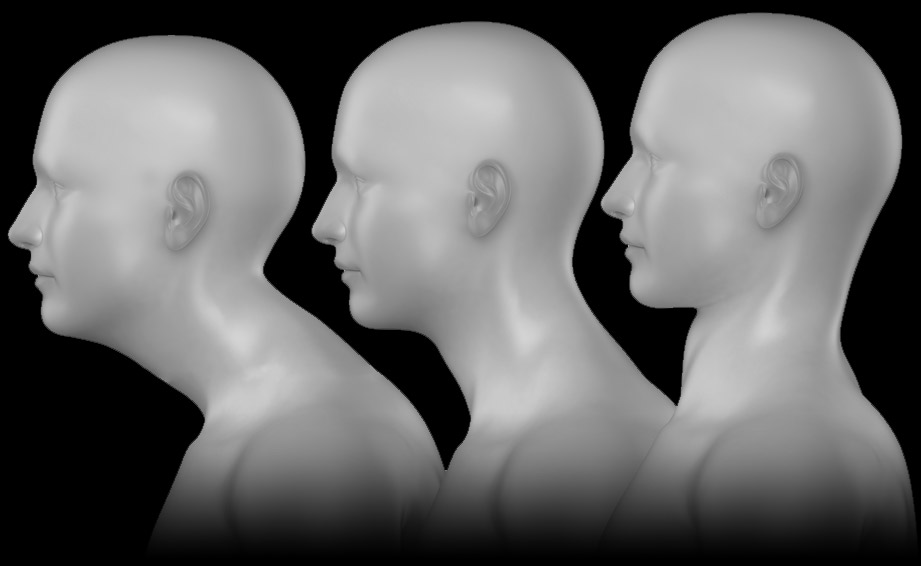
The head naturally moves forward to read, cook, look at a phone or examine an object. This position is not, in itself, a disease. Some people find it tiring when they hold it for a long time; others tolerate it very well. When pain develops, the useful aim is to understand what limits activities and regain comfortable movement rather than constantly monitor the alignment of ears and shoulders.
Research shows an association between a more forward head position and neck pain in some adults, but results vary with age and measurement methods. An association demonstrates neither a single cause nor inevitable deterioration. Studies in young phone users do not all confirm a link between observed posture and pain. [1] [2]

Why a position may become uncomfortable
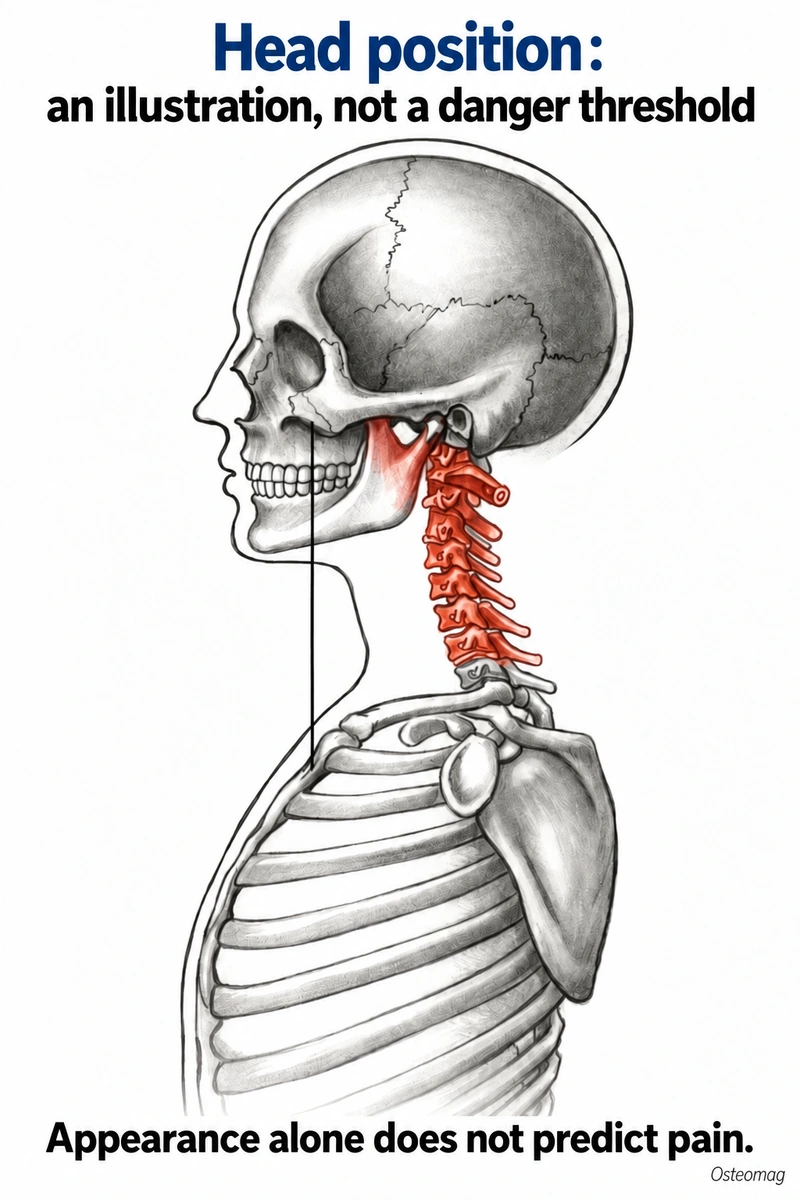
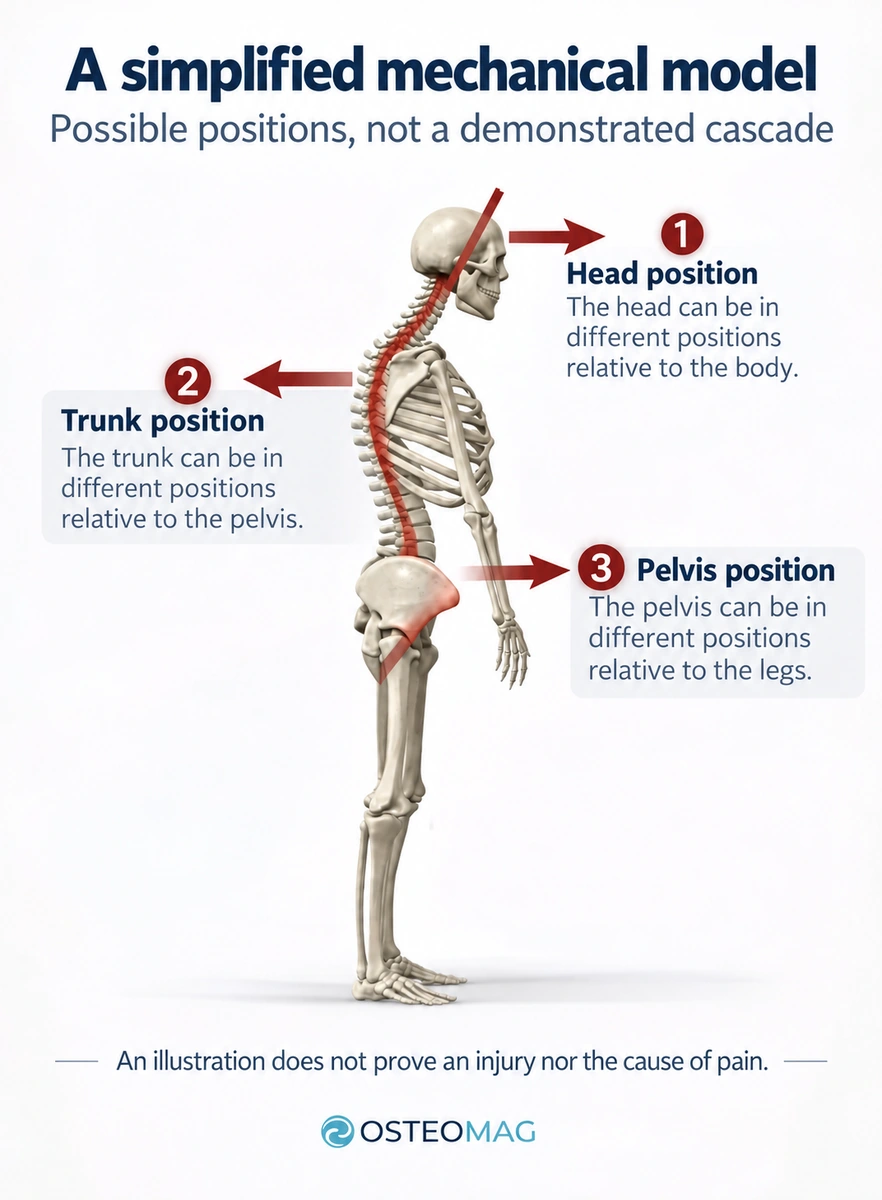
The neck supports and directs the head through a combination of muscles, joints and control mechanisms. Moving the head forward changes their demands. However, loads calculated in a mechanical model do not directly correspond to an injury in a person. A living body moves, adapts and distributes effort. Images showing a ‘domino effect’ illustrate a simplified mechanical hypothesis without proving an obligatory cascade of problems.
Duration, repetition, visual effort, lack of breaks and a recent increase in workload may contribute to discomfort. Sleep, worries and previous painful experiences also matter. Two people using the same desk may therefore have different needs. Looking for several modifiable factors avoids blaming posture for every symptom. [3] [9]
Which symptoms warrant assessment?
Common neck pain may involve local pain, stiffness or fatigue in the neck and shoulders. It often varies with tasks and movements. Pain that increases toward the end of the day does not prove that vertebrae are moving out of place. Conversely, persistent pain should not be dismissed simply because the person works at a screen.
Specific difficulties should be identified: turning the head while driving, reading, sleeping, carrying a child or working. Arm tingling, loss of strength, new headaches or balance problems change the assessment. These symptoms should not automatically be attributed to forward head posture. They may warrant a targeted medical examination. [4]
Red flags: when to seek help promptly
Neck pain after major trauma, or associated with fever, a marked decline in general health or a history of cancer, requires prompt medical assessment. Unusual pain that progresses without a clear relationship to activities also warrants consultation. An isolated sign does not always identify serious disease: its context and course are essential. [4]
Worsening weakness, new hand clumsiness, difficulty walking or recent changes in bladder or bowel control may suggest significant neurological involvement. Sudden onset with speech problems, facial asymmetry, double vision, limb weakness or an abrupt headache requires contacting emergency services. A posture programme is not appropriate in these situations. [4] [5]
Distinguishing possible causes
Non-specific neck pain is common: examination does not identify a single lesion explaining all the pain. Cervical nerve root irritation is considered when pain radiates into the arm, particularly with changes in sensation, strength or reflexes. Spinal cord involvement differs through other signs, including problems with walking or dexterity. [4] [5]
Pain from the shoulder may be felt near the neck. Migraine, tension-type headache or a jaw disorder may coexist with neck pain. Dizziness has many causes and cannot be diagnosed from a profile photograph. Chest pain or unusual breathlessness requires its own assessment. Clinical reasoning seeks an explanation consistent with the overall presentation. [3] [4]
A clinical examination focused on function
Examination matters more than appearance
| Observation or situation | Cautious interpretation and possible next step |
|---|---|
| A forward head position without limitation | Does not prove disease or a need for correction. |
| Pain associated with a repeated activity | Examine the dose, recovery and function. |
| Tingling or reduced strength | Assess possible neurological involvement with a competent professional. |
| Walking difficulty or progressive weakness | Prompt medical assessment, without attributing the presentation to posture. |
The interview clarifies when symptoms began, their course, possible trauma, triggering activities and strategies already tried. The professional asks what the person wants to regain. A simple measure of pain and abilities, repeated at follow-up, provides more useful markers than a constant search for symmetry. Daily-life limitations can be documented with a validated questionnaire.
Examination observes active neck movements, their range and tolerance. It may explore the shoulders, muscle endurance and tasks that provoke symptoms. When pain radiates, a neurological examination looks for differences in strength, sensation and reflexes. Tests are interpreted together. An area that is tender to touch does not, on its own, demonstrate the cause of pain. [3]

Measuring posture and choosing imaging
A standardized photograph can document the craniovertebral angle, but this changes with gaze, instructions and body position. There is no universal threshold separating a healthy neck from a diseased one. Repeating the photograph may sometimes help monitor a chosen goal; it should not become an assessment of the body’s worth or fragility. [1]
An X-ray or MRI is not routine for forward head posture or recent neck pain without concerning signs. Imaging is considered when trauma, neurological examination or suspicion of a particular disease may change management. An imaging abnormality must be compared with symptoms. Clinical assessment determines the question to ask of imaging, rather than the reverse. [4]
Adapting the workstation through trials
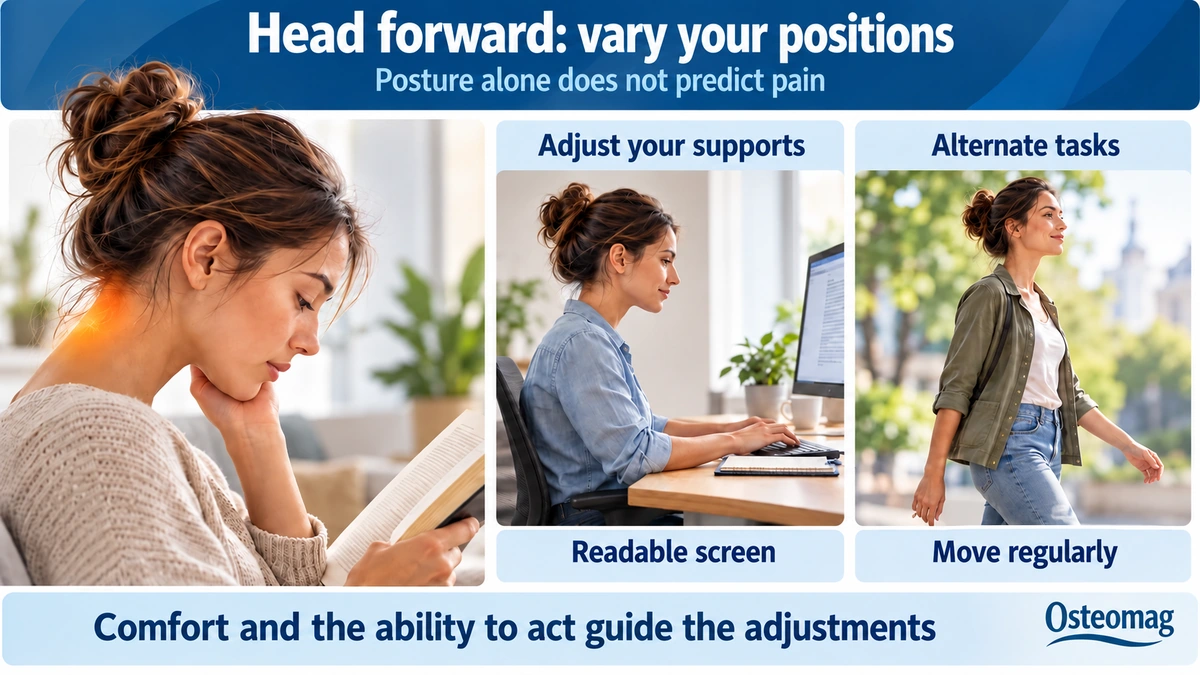
Starting with one specific difficulty is often simpler than reorganizing the whole desk. If text is difficult to read, increasing its size and bringing the screen reasonably closer may reduce visual effort. Forearm support, an accessible mouse and a comfortable backrest may reduce perceived effort. For prolonged laptop use, a separate keyboard allows independent adjustments.
These adaptations are comfort trials, not guarantees of prevention. Ergonomic studies show variable results depending on the intervention. Alternating tasks, briefly standing up or changing support may help avoid poorly tolerated prolonged positions. Break frequency depends on work demands and symptoms; no universal timer is compulsory. [8]

Resuming simple movements
If assessment finds no contraindication, begin with a few slow head rotations within a comfortable range. Keep the gaze horizontal, breathe normally and return to the centre without forcing the end of the range. A short set, for example five movements in each direction, allows observation of the response. This dose is an adaptable starting point, not a prescription for everyone.
A slight backward movement of the head can then be tried, as if gently bringing the chin closer to the neck, without compressing the throat or pushing with the hands. The aim is to explore a different position, not keep a double chin all day. Stop and seek reassessment if neurological symptoms, unusual dizziness or distinctly different pain develops. [3] [6]
Gradually developing strength and endurance
Exercise programmes for neck pain may combine neck endurance, shoulder work and general activity. A light resistance-band row with elbows near the body is one example of upper-back work. Resistance should allow controlled execution and free breathing. There is no need to forcefully squeeze the shoulder blades together or keep the shoulders lowered permanently. [6]
So-called corrective exercises may change some postural angles, but this does not prove that their benefit occurs only through realignment. Progress is also judged by tolerance of reading, work or sport. Increasing one variable at a time, such as repetitions or resistance, helps clarify the response and find a reproducible dose. [7]
Interpreting the response to exercise
Mild, temporary discomfort may be compatible with an appropriate return to activity. However, a substantial or sustained increase, disrupted sleep after every session or gradually declining ability suggests reducing the dose and reassessing the programme. The following day provides useful information: are usual activities still possible? Does discomfort return toward its pre-session level?
Walking, adapted cycling or an enjoyable activity can complement local exercises. A short programme that is actually practised is often more usable than a long list that is impossible to follow. A concrete goal, such as walking part of a journey again or reading for a few extra minutes, allows progress that matters personally to be measured. Goals should be able to change during follow-up.
Sleep, recovery and confidence
Sleep disorders and spinal pain are associated, with complex and potentially reciprocal relationships. Protecting a sleep routine and discussing persistent insomnia therefore belongs to a broader approach. This does not mean pain is imaginary: recovery influences how the body tolerates demands. [9]
For a pillow, comfort and sleeping position are practical guides. Studies do not identify one ideal model for everyone. A reasonable change can be tested without repeated purchases or seeking millimetre-perfect alignment. Observing several nights and waking symptoms is more informative than a single impression in a shop. [10]
Where does osteopathy fit?
Osteopathic support may contribute to education, activity adaptation and comfort for some people, within the practitioner’s competence. Relief after a session does not prove that a vertebra has been put back in place or that a postural chain caused the problem. Benefits should be assessed using useful and lasting criteria.
Evidence about exercise or ergonomics does not specifically prove the effectiveness of every osteopathic approach. Follow-up should support autonomy, incorporate active rehabilitation and provide medical referral when the presentation requires it. If several sessions improve neither ability nor comfort, reviewing the hypotheses and plan is reasonable rather than continuing indefinitely. [3] [6]
Preparing for a useful consultation
Bringing a short description of difficult activities makes a consultation more concrete. Explain what has changed recently: workload, equipment, sleep, sport or travel. It is also useful to mention which exercises helped and which worsened discomfort. The professional can then suggest a time-limited trial with a measurable goal and a reassessment date. A good explanation should answer three questions simply: what are we trying to improve, how will we check it, and in what circumstances should another opinion be sought?
Monitoring progress without watching every position
Two or three markers are enough: tolerated work duration, ease of turning the head and sleep quality, for example. Recording them once a week limits excessive monitoring. A temporary flare-up after an unusual day does not necessarily invalidate everything. Returning to the last well-tolerated level and then gradually progressing may be useful.
A slightly forward head position may remain visible while pain decreases and daily life becomes easier again. This is a valid outcome. Follow-up aims for a neck that can move and participate in desired activities, with a clear plan for new or persistent symptoms, rather than a fixed posture to defend all day.
Scientific references
- [1] Mahmoud et al. The Relationship Between Forward Head Posture and Neck Pain: a Systematic Review and Meta-Analysis. Curr Rev Musculoskelet Med. 2019;12(4):562-577. doi:10.1007/s12178-019-09594-y.
- [2] Damasceno et al. Text neck and neck pain in 18-21-year-old young adults. Eur Spine J. 2018;27(6):1249-1254. doi:10.1007/s00586-017-5444-5.
- [3] Blanpied et al. Neck Pain: Revision 2017. J Orthop Sports Phys Ther. 2017;47(7):A1-A83. doi:10.2519/jospt.2017.0302.
- [4] Loh et al. An approach to neck pain in primary care. Singapore Med J. 2024;65(6):348-353. doi:10.4103/singaporemedj.SMJ-2021-288.
- [5] Milligan et al. Degenerative cervical myelopathy: Diagnosis and management in primary care. Can Fam Physician. 2019;65(9):619-624.
- [6] Gross et al. Exercises for mechanical neck disorders. Cochrane Database Syst Rev. 2015;1(1):CD004250. doi:10.1002/14651858.CD004250.pub5.
- [7] Sheikhhoseini et al. Effectiveness of Therapeutic Exercise on Forward Head Posture: A Systematic Review and Meta-analysis. J Manipulative Physiol Ther. 2018;41(6):530-539. doi:10.1016/j.jmpt.2018.02.002.
- [8] Hoe et al. Ergonomic interventions for preventing work-related musculoskeletal disorders of the upper limb and neck among office workers. Cochrane Database Syst Rev. 2018;10(10):CD008570. doi:10.1002/14651858.CD008570.pub3.
- [9] Van Looveren et al. The Association between Sleep and Chronic Spinal Pain: A Systematic Review from the Last Decade. J Clin Med. 2021;10(17):3836. doi:10.3390/jcm10173836.
- [10] Chun-Yiu et al. The effects of pillow designs on neck pain, waking symptoms, neck disability, sleep quality and spinal alignment in adults: A systematic review and meta-analysis. Clin Biomech (Bristol). 2021;85:105353. doi:10.1016/j.clinbiomech.2021.105353.