Distinguishing attention, clinical hypnosis and osteopathic support
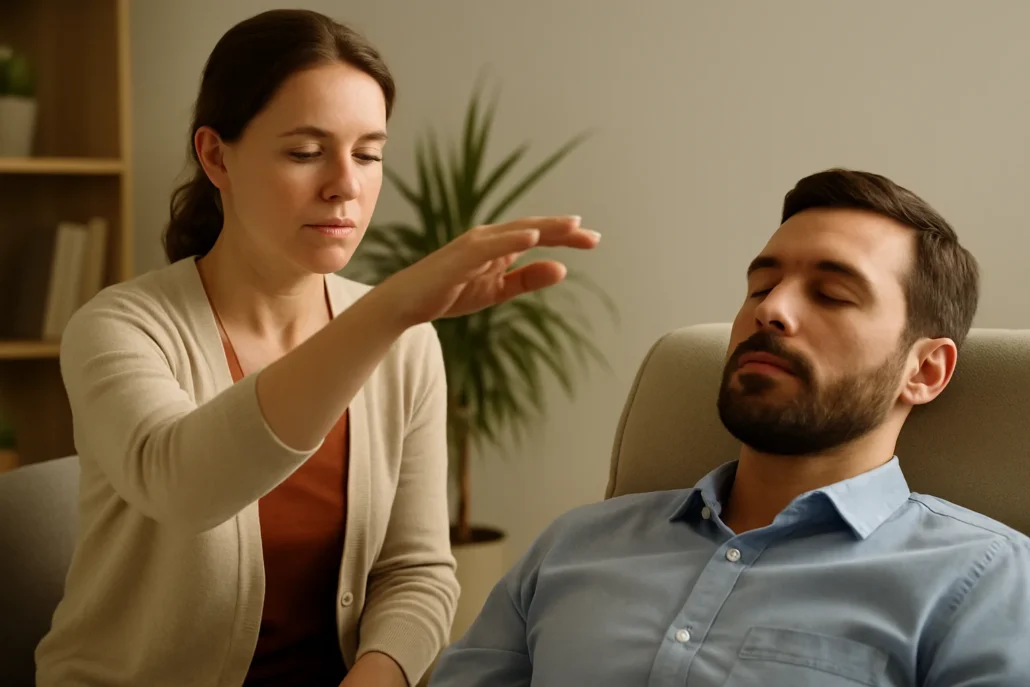
At first glance, osteopathy and hypnosis seem to belong to two different worlds. One primarily uses touch and movement; the other works with attention, imagination and suggestion. Yet both can change how someone perceives a sensation, anticipates a movement or responds to pain.
This functional overlap does not mean that an osteopath automatically practises hypnosis or that any relaxation achieved during manual treatment represents a ‘hypnotic state’. Possible mechanisms, professional competence and legal or ethical boundaries must be distinguished.
Recent scientific evidence suggests that hypnosis may reduce pain in some patients when used as an adjunctive intervention. But it is not a universal method, its average effect varies and the evidence is not always high quality. In osteopathy, its main relevance probably lies in better understanding the role of attention, expectations and imagery in the experience of pain.
What is hypnosis?
This definition aligns with the professional proposal by Elkins and colleagues. Research into its mechanisms discusses changes in attention and experience, with variable responses. It does not show that a practitioner accesses the unconscious through the hands [4] [5].
Hypnosis can be described as a state or process characterized by focused attention, a relative reduction in attention to certain surrounding elements and greater receptivity to suggestions that are relevant to the person.
It is not sleep, a loss of consciousness or control of the person’s mind by the practitioner.
The person remains able to hear, think and refuse a suggestion.
Why might hypnosis change pain?
The international definition of pain reminds us that it is a personal experience influenced by several dimensions; this does not make it any less real. Studies of structured psychological therapies concern a different field of intervention from osteopathic touch [6] [7].
Pain is not a direct measure of an injury. It results from complex processing that integrates bodily signals, attention, expectations, context, past experience and emotional state.
Hypnosis may act on several of these dimensions:
- directing attention;
- mental imagery;
- reinterpreting a sensation;
- reducing anxious anticipation;
- increasing a sense of control;
- changing some autonomic responses.
There is therefore no need to imagine that it physically ‘blocks’ pain nerves. It may change the experience without immediately changing the tissue.


What do recent reviews show?
A meta-analysis published in 2024 examined hypnosis used as an adjunct to other treatments in more than 6,000 adults with clinical pain [1]. The authors found an additional analgesic effect that was generally small to moderate depending on the context, but rated overall certainty of the evidence as very low.
Another meta-analysis focused on chronic musculoskeletal and neuropathic pain found a moderate reduction in pain after hypnosis, with more promising results when programmes included several sessions [2].
The 2025 meta-analysis of twelve randomized trials found benefit for acute pain, but no statistically significant benefit for chronic pain in the subset studied. This finding must be distinguished from earlier syntheses and does not support universal effectiveness in both contexts [3].
The reasonable conclusion is therefore that hypnosis may provide an adjunctive tool for some patients, without being a guaranteed treatment.
Hypnosis and expectations
Expectations influence pain. This does not mean that pain is imaginary. Expectations can change how the nervous system processes a sensation and prepares movement.
A suggestion such as ‘you can allow this area to become a little more comfortable’ may reduce anticipation of pain in some people.
But suggestions must remain realistic. Saying ‘you will have no pain at all’ or ‘your body will repair itself immediately’ creates excessive expectations.
What is the connection with osteopathic touch?
Touch naturally draws attention to an area. Slow contact may change body perception, reduce uncertainty and sometimes make an area feel less threatening.
This sensory modulation may resemble some aims of hypnosis, but it is not identical.
The practitioner should not call every situation in which a patient relaxes or closes their eyes ‘hypnosis’.
Can language during a session influence pain?
Yes. A professional’s words change how the patient understands their body.
A statement such as ‘your pelvis is completely blocked’ may increase a sense of fragility. Wording such as ‘this area is sensitive today, but we can test comfortable movements’ opens more possibilities.
The influence of language does not require a formal hypnotic state. Ordinary clinical communication already has contextual effects.
Formal hypnosis and therapeutic communication are not the same
A structured hypnotic induction generally includes focused attention, suggestions and sometimes specific imagery.
A reassuring conversation during an osteopathy session is not automatically an induction.
This distinction matters professionally. Clinical hypnosis requires appropriate training and must be used within the professional’s scope of practice.
Can hypnosis be used to treat psychological trauma?
Post-traumatic stress guidelines describe specific psychological interventions in a qualified setting. They do not validate searching for trauma through a bodily sensation. Referral depends on needs, consent and the professional’s actually authorized competencies [10].
This question requires a clear boundary. Using hypnosis to treat psychological trauma, depression, an anxiety disorder or other psychological conditions belongs in a psychotherapeutic setting when it directly targets those disorders.
An osteopath who is not authorized as a psychotherapist should not use hypnosis to search for memories, ‘release trauma’ or interpret unconscious content.
Musculoskeletal care must remain focused on pain, function, movement and bodily comfort.
The danger of suggested memories
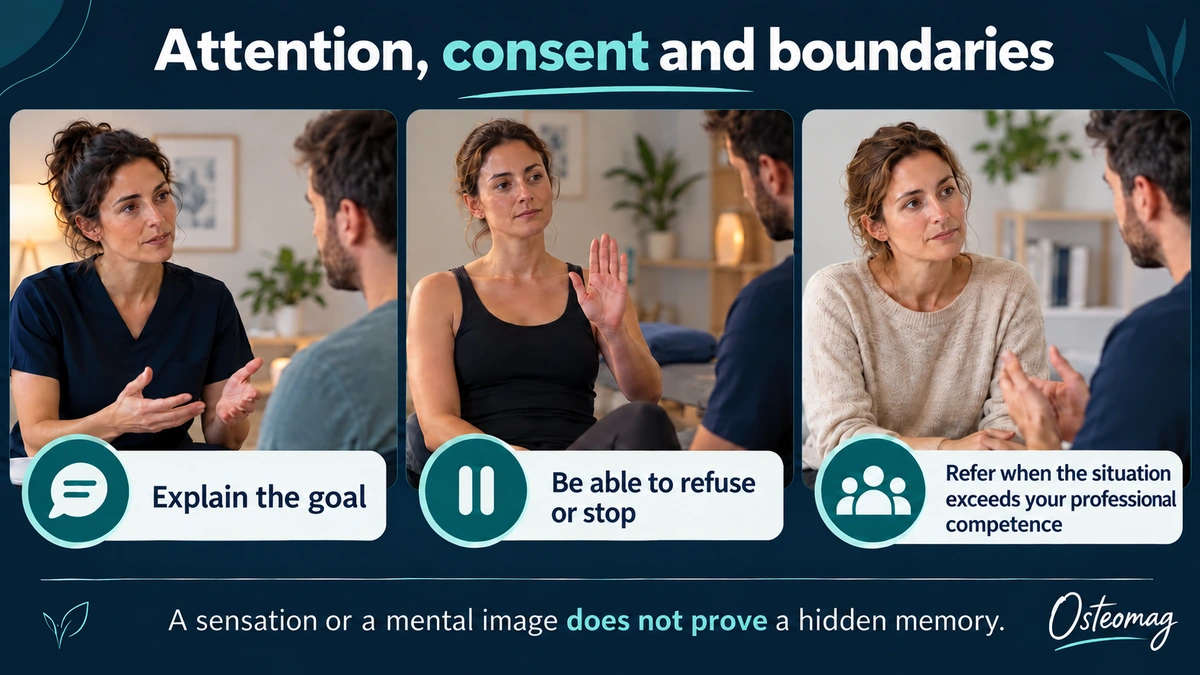
Hypnosis sometimes increases the sense of vividness or certainty associated with a mental image. This does not guarantee a memory’s historical accuracy.
It would therefore be unwise to ask a patient to ‘find the event that created the tension’ or to consider an image arising during a session a true memory.
The practitioner must avoid leading questions and never construct a psychological story from a bodily reaction.
Self-hypnosis and autonomy
Self-hypnosis can be taught as a self-regulation skill. It may include focusing on breathing, calming imagery or suggestions aimed at comfort.
Its potential value is that it does not depend on repeated passive sessions.
The patient learns a tool they can use themselves, much like an exercise or breathing strategy.
Again, however, the technique must suit the individual and must not replace necessary medical treatment.
Hypnosis and movement
Motor imagery has been studied separately from hypnosis, with very low certainty in a synthesis of musculoskeletal pain. Imagining an action is not proof of repair and should not replace an appropriate active return. Comfortable breathing may help some people, but a change in heart rate variability does not prove a hypnotic state [8] [9].
For some patients, fear of movement plays an important role. Hypnotic imagery may sometimes help mentally prepare a task before performing it.
For example, someone may imagine gently raising an arm without pain before making the actual movement. This strategy also resembles motor imagery used in rehabilitation.
The aim is to facilitate exposure to movement, not convince the patient that pain does not exist.
How can principles be integrated without practising hypnosis?
An osteopath can use several general principles without presenting themselves as a hypnotherapist:
- use non-alarmist language;
- direct attention toward observable positive changes;
- encourage comfortable breathing;
- ask the patient to imagine a movement before performing it;
- encourage a sense of control;
- avoid suggestions of fragility.
These elements belong to good clinical communication.
The risk of dependence on the practitioner
Hypnosis may sometimes reinforce the image of a practitioner with special powers. This representation should be avoided.
The patient should not believe that the therapist controls their nervous system or that they must be ‘put into a trance’ to improve.
The best approach strengthens the patient’s ability to use their own resources.
The role of consent
Distinct interventions and responsibilities
| Observation or situation | Cautious interpretation and possible next step |
|---|---|
| Clinical communication | Explain, offer realistic reassurance and let the patient choose. |
| Clinical hypnosis | Appropriate training, an explicit aim and revocable consent. |
| Manual treatment | Comfort and function within professional scope; not access to the unconscious. |
| Psychological trauma or significant psychological symptoms | Referral to a qualified professional; no searching for memories through palpation. |
A hypnotic induction requires explicit consent. Using structured suggestion techniques without informing the patient would be problematic.
The patient must know what is proposed, for what purpose and that they can stop the exercise at any time.
Transparency is particularly important when a technique changes attention or uses emotional imagery.
Hypnosis and acute pain
Hypnosis has also been studied during medical procedures, burn care and perioperative pain. Results sometimes suggest modest reductions in pain or anxiety [1] [3].
These contexts should not be directly transferred to an osteopathy session, but they show that modulating attention may complement other treatments.
Hypnosis and chronic pain
In chronic pain, the aim is not necessarily to eliminate every sensation. Improving the ability to manage a flare-up, reducing pain interference or facilitating sleep and movement may be more realistic.
This logic aligns with the modern approach to persistent pain: increase function rather than endlessly pursue a completely silent body.

Can manual treatment reinforce a suggestion?
Possibly at an experiential level. If a patient moves better after mobilization, the practitioner can draw attention to that change: ‘notice that this rotation is easier now’.
This wording is not psychological manipulation; it simply directs attention toward an observable finding.
By contrast, saying ‘I have just released your nervous system’ turns an observation into an unproven mechanism.
Retesting as a safeguard
Retesting protects against excessive explanations. If movement is easier, that improvement can be acknowledged. If it does not change, the strategy must be adjustable.
Hypnosis or imagery should not be used to convince a patient that improvement exists when they do not feel it.
When should someone be referred to a professional trained in clinical hypnosis?
Referral may be appropriate when a patient explicitly wishes to use hypnosis for persistent pain, a medical procedure or a problem within a psychological field beyond the osteopath’s scope.
The chosen professional should have recognized training and practise within a scope compatible with the treatment’s aim.
What osteopathy cannot claim
Manual treatment is not automatically hypnosis. An osteopath cannot claim to access a patient’s unconscious through touch, recover buried memories or treat psychological trauma through suggestion without practising in the appropriate professional setting.
They can, however, use reassuring communication, movement imagery and simple attention strategies to support function.

Conclusion
Osteopathy and hypnosis overlap primarily around a shared idea: bodily perception is not passive. Attention, expectations, context and the interpretation of a sensation can change the experience of pain.
Available evidence suggests that hypnosis may be a useful adjunctive intervention for some patients, but certainty of the evidence remains variable. Its use must remain clear, consensual and appropriate to the professional’s competence.
For an osteopath, the main lesson is probably not to turn every session into a hypnotic induction. It is to understand that words, attention and imagery can contribute to the care experience without their relative contribution being identical for everyone. Responsible manual treatment does not seek to take control of the patient; it helps them regain more control over their own movement and experience.
Scientific references
- [1] Jones et al. Adjunctive use of hypnosis for clinical pain: a systematic review and meta-analysis. Pain Rep. 2024;9(5):e1185. doi:10.1097/PR9.0000000000001185.
- [2] Langlois et al. Hypnosis to manage musculoskeletal and neuropathic chronic pain: A systematic review and meta-analysis. Neurosci Biobehav Rev. 2022;135:104591. doi:10.1016/j.neubiorev.2022.104591.
- [3] Yerzhan et al. The Use of Medical Hypnosis to Prevent and Treat Acute and Chronic Pain: A Systematic Review and Meta-Analysis. J Clin Med. 2025;14(13):4661. doi:10.3390/jcm14134661.
- [4] Jensen et al. Hypnotic approaches for chronic pain management: clinical implications of recent research findings. Am Psychol. 2014;69(2):167-177. doi:10.1037/a0035644.
- [5] Elkins et al. Advancing research and practice: the revised APA Division 30 definition of hypnosis. Int J Clin Exp Hypn. 2015;63(1):1-9. doi:10.1080/00207144.2014.961870.
- [6] Raja et al. The revised International Association for the Study of Pain definition of pain: concepts, challenges, and compromises. Pain. 2020;161(9):1976-1982. doi:10.1097/j.pain.0000000000001939.
- [7] Williams et al. Psychological therapies for the management of chronic pain (excluding headache) in adults. Cochrane Database Syst Rev. 2020;8(8):CD007407. doi:10.1002/14651858.CD007407.pub4.
- [8] Suso-Martí et al. Effectiveness of motor imagery and action observation training on musculoskeletal pain intensity: A systematic review and meta-analysis. Eur J Pain. 2020;24(5):886-901. doi:10.1002/ejp.1540.
- [9] Laborde et al. Effects of voluntary slow breathing on heart rate and heart rate variability: A systematic review and a meta-analysis. Neurosci Biobehav Rev. 2022;138:104711. doi:10.1016/j.neubiorev.2022.104711.
- [10] NICE. Post-traumatic stress disorder. NG116. Recommandations.