Supporting maternal comfort with realistic expectations
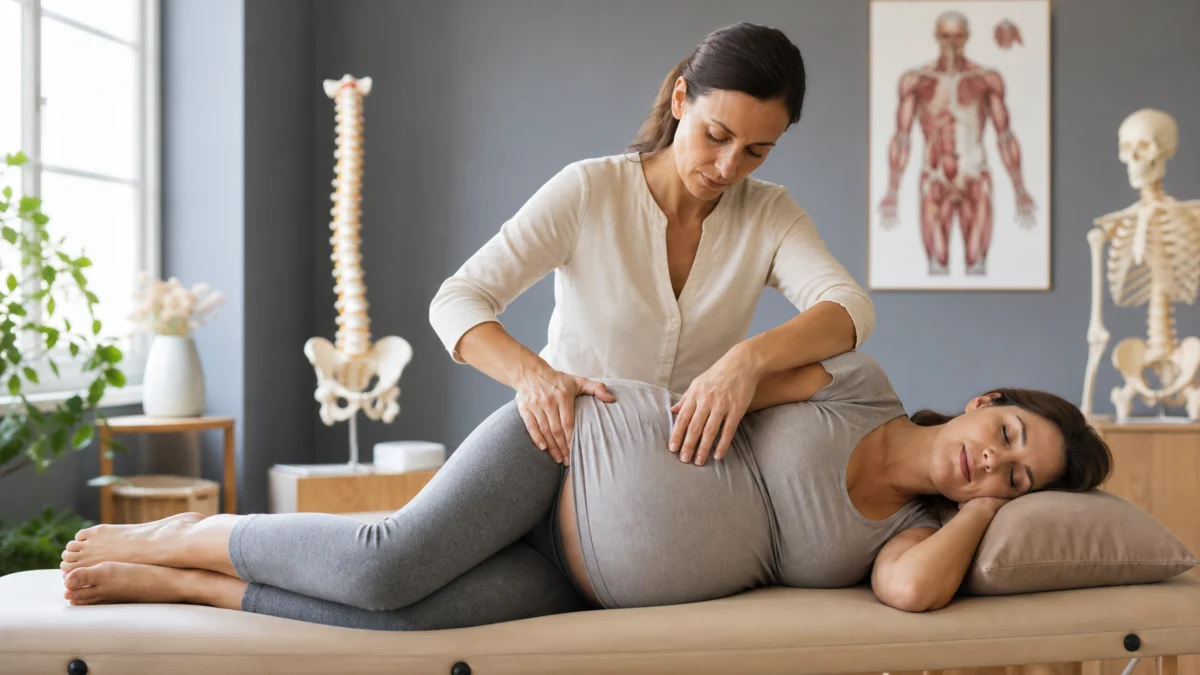
During pregnancy, back, pelvic or rib pain may make walking, sleeping and ordinary tasks more difficult. Some women seek osteopathic support to find comfortable positions and move more easily. This deserves clear objectives: improving a difficult activity, understanding possible adaptations and reviewing results. It forms part of prenatal care, which remains essential for maternal and infant health.
Studies of osteopathic care during pregnancy sometimes report improved comfort or less deterioration in function. However, they do not demonstrate a consistent specific benefit compared with a sham intervention. Relief can be real without proving that a structure has been “put back into place”. Listening, advice, the natural course of symptoms and the therapeutic context also contribute to the experience [1, 2, 3, 4].
Understanding pain without presenting pregnancy as an imbalance
Increasing abdominal size, changes in load distribution and evolving daily habits alter the demands placed on muscles and joints. Tissues adapt progressively. Some women change their gait or resting positions; others retain much of their usual activity. There is no mandatory posture or universal sequence of compensations explaining every pain.
Pelvic girdle pain may occur near the sacroiliac joints, in the buttocks or around the pubic symphysis. Climbing stairs, turning in bed or standing on one leg sometimes becomes difficult. It differs from low back pain, although the two may coexist. Assessment aims to reproduce symptoms and evaluate function rather than automatically attributing discomfort to a displaced pelvis [5].
Hormones contribute to pregnancy-related changes, but their role cannot be reduced to general weakening of the ligaments. A review of relaxin and pelvic pain found conflicting results and limited study quality. Sleep, repeated demands, previous pain and opportunities for recovery matter too. A useful explanation makes room for these factors without making the patient responsible for her pain [6].
Defining an objective visible in everyday life
Before selecting an intervention, clarify the difficulty: walking for ten minutes, getting out of a car, working while seated or sleeping long enough. Pain intensity helps monitor the situation, but is insufficient by itself. Improvement may mean easier movement, fewer breaks or greater confidence in an activity.
The practitioner asks about gestational age, symptoms and their course, medical history and relevant prenatal information. They also ask what helps, what aggravates symptoms and what the person wishes to avoid. Examination is adapted to comfort and performed with consent. Familiar, movement-related pain still requires consideration of another cause if its character changes.
The first consultation may lead to simple advice, physiotherapy referral or a request for advice from the prenatal team. Session numbers should not be prescribed as a trimester-related obligation. They depend on need, the observed response and available alternatives. Lack of improvement should lead to reconsideration rather than multiplying explanations about invisible restrictions.
What osteopathic trials actually show
A trial published in 2010, including 144 participants, examined osteopathic care during the third trimester. Back-related function deteriorated less in the treated group than in the group receiving usual care alone. Pain differences between groups were not statistically significant. The finding suggests a possible functional benefit without establishing certain improvement in every symptom [1].
The PROMOTE trial, involving 400 participants, provides an important distinction. Osteopathic care and placebo ultrasound produced comparable results; both performed better than usual care alone on certain measures. Comparison with a sham group helps distinguish a method’s specific effect from the attention received and therapeutic setting. Here, it did not confirm specific superiority of osteopathy [2].
A 2017 meta-analysis found favourable pain and function results, but included trials differed in their interventions and comparators. A review of manual therapies also emphasised the absence of convincing differences compared with sham care. A broader review in gynaecology and obstetrics considered the studies too heterogeneous to support robust clinical recommendations. These conclusions call for proportionate information [3, 4, 7].
Results from a particular protocol and setting cannot be extended to every technique, gestational stage or practitioner. They also do not demonstrate effects on fertility, infant growth or the course of birth. Support should therefore be presented as a possible comfort option for some people, with uncertain benefit and concrete reassessment.
Selecting adaptations according to the difficulty
The same advice does not suit every pain. Side-lying with pillows may ease perceived tension, while another person prefers additional support when sitting. For pelvic pain, temporarily reducing single-leg tasks may make the day more tolerable. These trials seek comfort without imposing prolonged inactivity or a position supposedly correcting the pelvis.
| Situation | Adaptation to try | When to reassess |
|---|---|---|
| Pain when turning in bed | A support pillow and a more gradual position change | Sleep remains substantially disturbed or new pain appears |
| Discomfort on stairs | Use the handrail, adjust the pace and reduce repeated trips | Walking becomes difficult or weight-bearing impossible |
| Discomfort at work | Alternate positions and schedule short breaks | Activity becomes increasingly restricted despite adjustments |
| Persistent pelvic pain | Physiotherapy advice, adapted exercise and possibly a non-rigid support belt | No improvement or unusual symptoms |
| Pain with a warning sign | Promptly contact the prenatal team or emergency services | Do not wait for an osteopathic consultation |
These suggestions guide comfort trials; they do not replace individual assessment.

A consultation adapted to pregnancy and consent
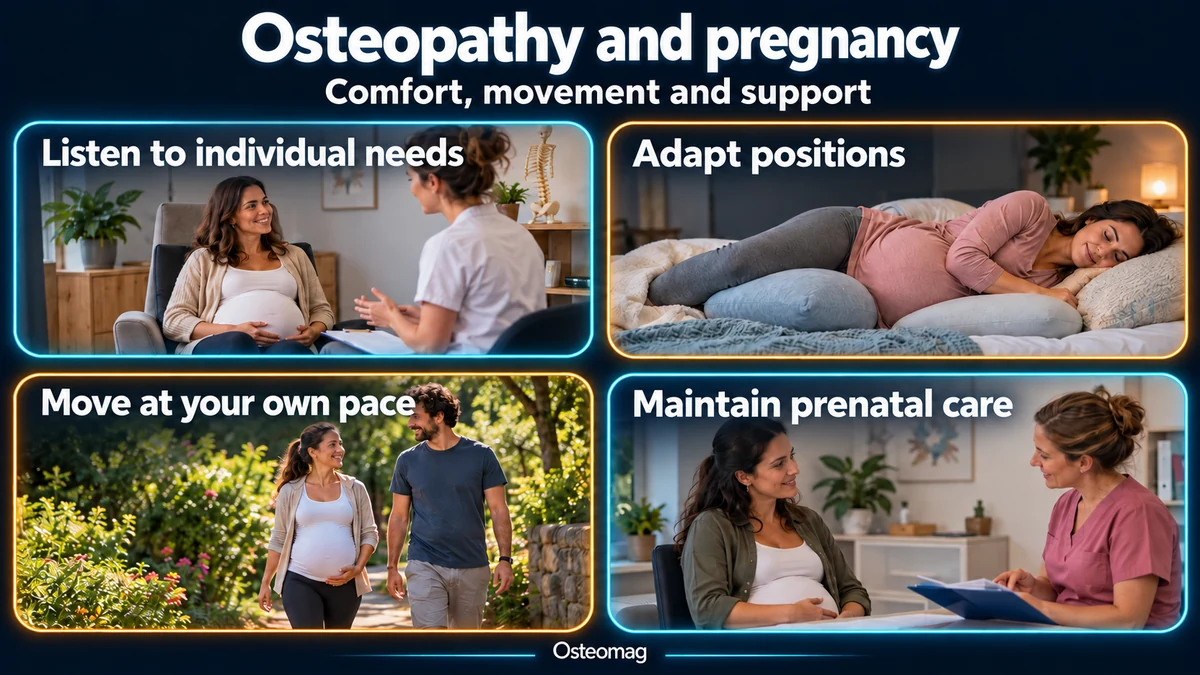
Positions should allow easy breathing and the ability to report discomfort. Side-lying, sitting or semi-reclining may be selected according to gestational stage and symptoms. Pillows can be used, and positions changed during the appointment. Faintness, nausea or unusual breathlessness requires stopping the intervention and reassessing the situation.
Consent concerns the proposed intervention, the region involved and expected comfort. The patient may refuse contact, request an explanation or stop at any time. Significant discomfort should never be described as a necessary step towards improvement. A reassuring experience does not replace symptom monitoring or coordination with other healthcare professionals.
A favourable change may be noticed afterwards, but it is better checked in the activity selected initially. Feeling relaxed immediately and walking more comfortably several days later are different observations. A sustained increase in pain, deteriorating function or a new symptom must not be dismissed as a normal treatment response.
Movement and physiotherapy retain a central role
For pregnancy without contraindications, Canadian recommendations advise at least 150 minutes of moderate-intensity physical activity weekly, spread over at least three days and combining different forms of activity. This guidance is adapted to the circumstances and prenatal team’s advice. Someone previously inactive may begin gradually, while substantial pain requires an adjusted programme [8, 9].
The objective is not to achieve a quota despite worsening symptoms. Shorter walks, simple exercises or a better-tolerated activity may maintain useful participation. Exercises are adapted to pain location and current capabilities. A recent review of physiotherapy interventions describes possible benefits from exercise programmes, although certainty of evidence is often low [10].
For pelvic girdle pain, NICE recommends considering physiotherapy referral for exercise advice and, according to need, a non-rigid lumbopelvic belt. Its evidence assessment found insufficient support to recommend manual therapies used alone. A belt is tried for its effect on a particular activity; it is neither mandatory nor proof of anatomical instability [11].
Recognising situations that change the priority
Severe or unusual pain during pregnancy should be discussed promptly with the prenatal team, particularly when accompanied by bleeding, fluid leakage, fever or concerning contractions. Reduced infant movements, a severe headache with visual disturbance, difficulty breathing or chest pain also requires a rapid response. These signs should not be treated as simple muscular tension [12].
Low back pain can sometimes relate to a urinary problem or another condition. New leg weakness, an unusual change in bladder or bowel control, or loss of sensation in the perineal region requires urgent assessment. Do not wait until pain becomes unbearable or the next comfort-focused appointment becomes available.
Pregnancy does not prohibit all imaging when investigation is necessary. Ultrasound and MRI are preferred in some circumstances, but an appropriate radiological examination should not be delayed solely through fear of imaging. Selection depends on the clinical question and is the responsibility of the assessing team. For familiar pain without concerning signs, imaging is not automatically useful [13].
After birth: reassessing needs
Symptoms do not always disappear immediately after birth. Carrying and feeding the infant, interrupted nights and recovery may change the activities that are difficult. Support begins again from the current situation rather than continuing a protocol decided during pregnancy. Persistent pain may require physiotherapy assessment, particularly when walking or pelvic functions remain limited.
Return to activity depends on the birth experience, symptoms and recovery. Comfort in a feeding or carrying position may improve with small changes in support. Any consultation is still judged by useful, lasting outcomes. It must not delay indicated treatment or become a prerequisite for the body’s capacity to adapt.
Key points
Osteopathic support during pregnancy may be considered for some discomforts, with functional objectives, clear consent and honest information about the evidence. Trials do not demonstrate consistent superiority over sham interventions. Adapted movement, physiotherapy when needed and prenatal care provide the foundation. Personal preferences and consent remain central throughout care.
Practical questions for reviewing the plan
- Which everyday activity is the main priority, and what would a useful improvement look like?
- Which positions feel comfortable now, and which need further support or a shorter period of use?
- Are the proposed movements consistent with advice already received from the prenatal team?
- Does any immediate relief carry over into walking, work, sleep or other chosen activities over the following days?
- Have pain, function or the character of symptoms changed in a way that needs reassessment?
- Would physiotherapy or further prenatal advice be more useful than continuing the same consultations?
- After birth, does the plan still match the current difficulties rather than those identified during pregnancy?
References
- [1] Licciardone et al. (2010). Osteopathic manipulative treatment of back pain and related symptoms during pregnancy.
- [2] Hensel et al. (2015). PROMOTE study : randomized controlled trial.
- [3] Franke et al. (2017). Osteopathic manipulative treatment for low back and pelvic girdle pain during and after pregnancy.
- [4] Hall et al. (2016). Complementary manual therapies for pregnancy-related back and pelvic pain.
- [5] Vleeming et al. (2008). European guidelines for pelvic girdle pain.
- [6] Aldabe et al. (2012). Pregnancy-related pelvic girdle pain and relaxin levels.
- [7] Ruffini et al. (2022). Osteopathic manipulative treatment in gynecology and obstetrics : systematic review.
- [8] Mottola et al. (2018). 2019 Canadian guideline for physical activity throughout pregnancy.
- [9] ACOG (2020). Physical activity and exercise during pregnancy and the postpartum period.
- [10] Mladenovic et al. (2026). The effectiveness of physiotherapy interventions for Pregnancy-Related lumbopelvic pain: A systematic review and meta-analysis of randomized controlled trials.
- [11] NICE (2021). Antenatal care, NG201 : recommendations and evidence assessment.
- [12] CDC. Urgent maternal warning signs.
- [13] ACOG (2017). Guidelines for diagnostic imaging during pregnancy and lactation.