Exploring sensation and movement without confusing a clinical hypothesis with demonstrated effectiveness
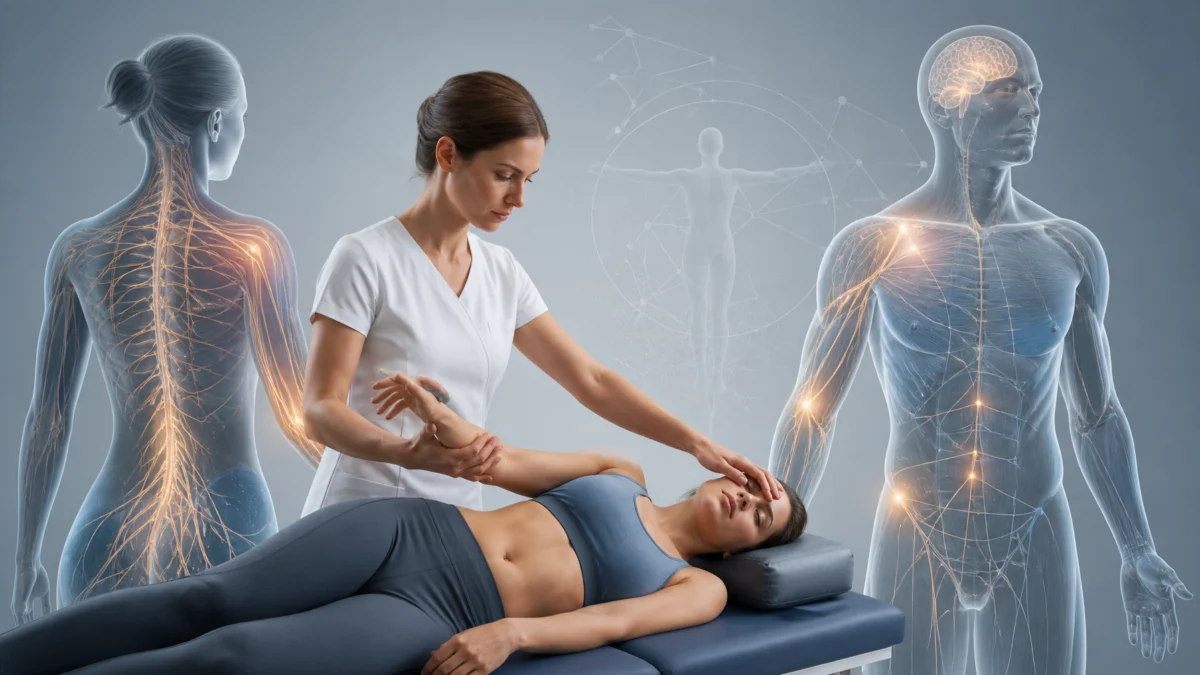
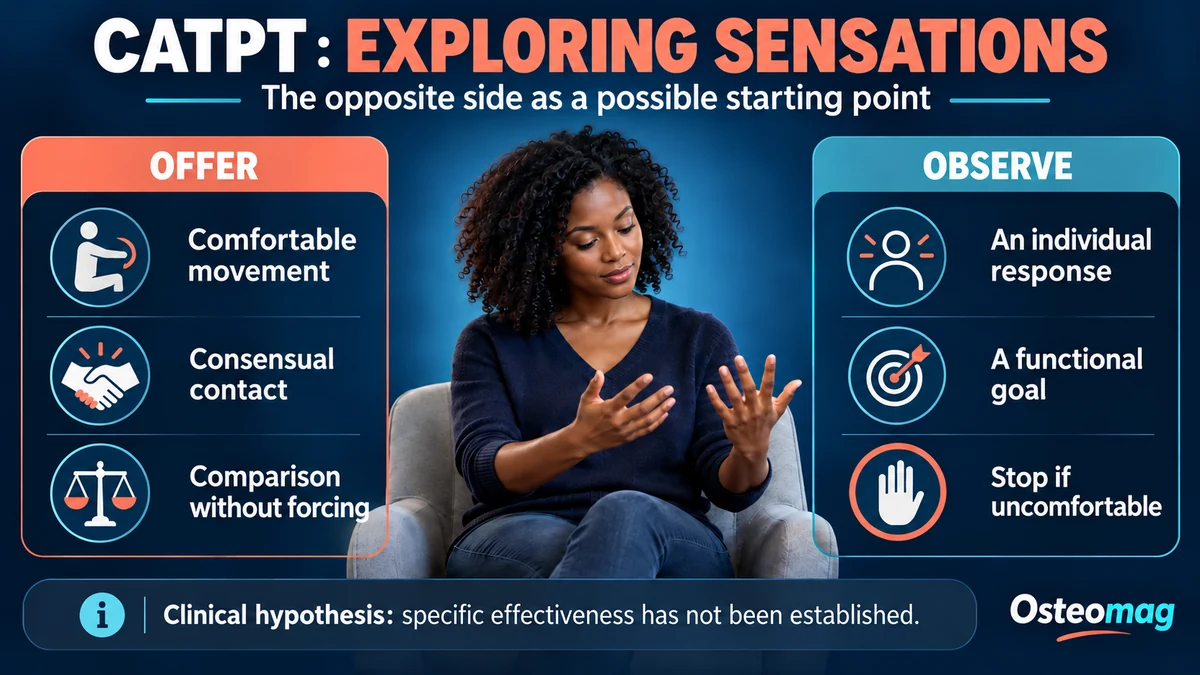
CATPT, described here as “Contralateral Activation Trigger Point Therapy”, proposes using the side opposite a painful region as a possible starting point for sensory and motor exploration. Contact, comfortable movement and comparison of sensations may play an important role. This describes a proposed clinical approach; it does not mean that comparative trials have established its specific effectiveness.
The general idea is understandable: when a shoulder poorly tolerates touch, beginning with a comfortable region may allow participation without repeating a distressing experience. However, observing a change does not prove that an opposite-side point caused the pain or that a particular brain circuit was “corrected”. Rigorous practice distinguishes what is felt, what is measured and what remains hypothetical.
Pain, nociception and bodily experience
The current definition of pain recognises a sensory and emotional experience influenced by biological, psychological and social factors [1]. This does not reduce pain to emotion or allow its cause to be inferred from a body region. Neck pain is not evidence of a rigid personality; low back pain does not automatically reveal conflict or excessive responsibility.
Nociception refers to the neural processes that detect and process potentially harmful events. It contributes to pain, but the concepts are not interchangeable. Context, expectations, sleep, injury or disease may influence the experience. Pain without an obvious imaging abnormality remains real. Conversely, changing sensations during a consultation does not exclude a condition requiring specific care.
This distinction encourages listening without imposing one explanation. It also avoids a common shortcut: recognising the nervous system’s involvement in pain does not demonstrate that a particular technique “reprogrammes” it. A plausible mechanism requires investigation, and clinical benefit must be assessed separately.
Proprioception: perceiving position and effort
Proprioception contributes to perception of position, movement and effort. Information from muscles, skin and joints is integrated with other signals to organise action [2]. We can approximately locate a hand without looking and adjust force when carrying an object. This ability varies with the task, fatigue, age and certain conditions.
Pain may change how someone moves or attends to a region. An unusual sensation, however, does not demonstrate an “erased” or disorganised brain representation. A simple position-reproduction test provides a functional observation with measurement limitations; it is not an image of the brain.
During an exploratory consultation, comparing two movements or noticing weight-bearing may help describe what feels comfortable. The objective is not perfectly symmetrical perception. Differences between sides are common, including those related to hand dominance, sporting history and everyday activities.
What contralateral training actually shows
Training one limb can increase strength in the opposite, untrained limb: this phenomenon is called cross-education [3]. Research explores associated neural adaptations, using varied protocols, populations and methodological quality [4]. The finding mainly concerns repeated training and measured muscle capacity.
It does not demonstrate that pressure on a left-sided point automatically treats right-sided pain. Strength, pain and perception are different outcomes. Training dose, task and timing matter too: a phenomenon observed after several weeks cannot be transferred without caution to a few minutes of touch.
CATPT may therefore draw on an interesting research question without claiming the results of every contralateral intervention. Establishing specific effectiveness would require a defined protocol, relevant comparisons and clinical outcomes monitored over time. A coherent explanation does not replace that stage of research.
Mirror therapy and motor imagery are distinct approaches
Graded motor imagery may combine laterality-recognition tasks, imagined movement and mirror work, depending on the programme. A synthesis reported encouraging findings for some persistent pain conditions, but based on few trials of limited quality [5]. These approaches are not synonymous with CATPT and do not apply indiscriminately to every pain.
For phantom limb pain, some meta-analyses suggest short-term benefit from mirror therapy [6]. A review restricted to placebo-controlled trials, however, could not establish effectiveness reliably [7]. Differences in study selection and methodological limitations partly explain these differing conclusions.
After amputation, sensations in an absent limb are a real neurological experience. They may coexist with residual-limb pain, skin problems or prosthetic difficulties. Any sensory exploration belongs within specialist rehabilitation. It must not distract from these causes or be presented as a universal solution.
Touch provides information, not a psychological reading
Touch supplies information about pressure, location and movement. Contemporary models of manual care describe several possible mechanisms interacting with the therapeutic context [8]. Recent research nevertheless highlights uncertainty about their clinical significance and precise causal role [9]. An immediate change in pain threshold is not equivalent to lasting recovery.
Contact may be offered as a reference point with consent. The person should be able to decline it, request lighter pressure or choose exercise without touch. A hypersensitive region does not need repeated stimulation to “overcome resistance”. Lack of change must be accepted without concluding that the person lacks trust or is obstructing treatment.
The term “trigger point” does not remove the need for clinical reasoning. A tender area on palpation does not necessarily identify a precise injury or the sole source of distant pain. The patient’s account and functional capabilities deserve as much attention as the search for painful points.
Before exploration: understanding the situation
The history clarifies onset, location, aggravating factors, trauma and symptom progression. The practitioner asks which activities are restricted, which investigations have been performed and what the person wishes to regain. Observing tolerated movements may then help select an objective within the practitioner’s scope.
Radiating pain, burning, electric-shock sensations or numbness may suggest a neuropathic component without confirming it. Assessment considers a plausible neuroanatomical distribution, sensory signs and the suspected condition [10]. A change in sensation after opposite-side contact does not exclude nerve injury.
Imaging is not a CATPT investigation. It is considered according to the clinical circumstances, particularly trauma, neurological deficit or suspicion of another condition. A psychocorporeal hypothesis must not delay an indicated investigation.
What can a response reasonably establish?
| Observation | Reasonable interpretation | What it does not demonstrate |
|---|---|---|
| An opposite-side movement feels comfortable | An activity option is available | That the painful side is free from injury |
| Pain decreases during the consultation | An immediate change was experienced | Tissue repair or a lasting specific effect |
| Sensations differ between sides | A difference should be described in context | A pathological asymmetry that must be corrected |
| Touch increases discomfort | The proposal should be adapted or stopped | Psychological resistance by the patient |
| Weakness progresses or sensation changes | Targeted assessment is needed | That continuing sensory exploration is sufficient |
| An everyday activity becomes easier over time | Functional improvement can be documented | The exact mechanism independently explaining that improvement |
Clinical guide: interpret findings alongside history and examination. No isolated criterion establishes a diagnosis. On a phone, scroll the table horizontally.
Warning signs and referral
Substantial new weakness, sudden difficulty walking, speech disturbance or facial asymmetry requires urgent care according to the circumstances. Spinal pain accompanied by loss of perineal sensation or new bladder-control disturbance also requires urgent assessment. These situations are not appropriate for an experiment in contralateral stimulation.
Fever, a red and hot joint, pain after substantial trauma, unexplained swelling or unusual persistent pain warrants appropriate referral. After amputation, a wound, discharge or residual-limb redness requires specific attention. New pain should not automatically be attributed to previously recognised sensitisation.
Psychological distress may also require suitable support. An osteopath can acknowledge the difficulty and suggest referral, but does not replace a psychologist or psychotherapist. Calling an approach psychocorporeal does not provide competence to interpret psychological trauma through touch.
A simple, consensual and measurable exploration
An example may start with a precise task: reaching a low shelf or moving a cup. After checking that the movement is appropriate, the person describes the initial difficulty. A comfortable opposite-side movement, slow comparison or light contact may then be proposed. Strong pressure and forced movement are unnecessary to test a hypothesis.
The original task is repeated without demanding improvement. The person may notice a difference, no difference or worsening. Worsening calls for changing or stopping the proposal. Repeating numerous tests until a favourable response appears increases the risk of selecting only observations that confirm expectations.
Follow-up then focuses on everyday life: activity duration, ease of movement, recovery and independence. Small immediate variations, particularly fluctuating ones, should be described modestly. Objectives agreed beforehand help determine whether the approach deserves continuation or the plan needs changing.

Integrating the experience into active rehabilitation
Sensory exploration may provide a step towards fuller activities if useful and well tolerated. It should not become an indispensable ritual before every movement. The programme may progressively include mobility, strength, endurance and meaningful tasks, according to the situation and adaptations recommended by the rehabilitation team.
Breathing remains free and comfortable. Encouraging someone to avoid unintentionally holding their breath may help, but no breathing pattern automatically reveals a hidden emotional state. Similarly, asking what changes in weight-bearing does not require monitoring every sensation throughout the day.
The person retains a choice of objectives and pace. Progress may mean resuming a leisure activity despite residual sensations rather than achieving perfect symmetry. If consultations provide only very brief relief without functional improvement, the strategy should be reconsidered.
The role of osteopathy and concluding points
CATPT can be presented in osteopathy as a proposal for exploration with transparent limitations. The ten references in this article document pain, proprioception or related interventions; they do not validate a CATPT protocol. The effects of contralateral training or mirror therapy must not be claimed as direct evidence for this method.
Cautious practice prioritises consent, absence of promises, functional goals and reassessment. Exploring what remains possible may help someone without requiring a psychological interpretation of their body. Clinical value must nevertheless be assessed in that person’s situation. Research is still needed to determine whether the method offers a specific benefit beyond its shared components.
Further reading: the distinction between a clinical model and evidence in Janda’s approach.
Scientific references
- [1] Raja et al. The revised International Association for the Study of Pain definition of pain: concepts, challenges, and compromises. Pain. 2020.
- [2] Proske et al. The proprioceptive senses: their roles in signaling body shape, body position and movement, and muscle force. Physiological reviews. 2012.
- [3] Manca et al. Cross-education of muscular strength following unilateral resistance training: a meta-analysis. European journal of applied physiology. 2017.
- [4] Manca et al. Neurophysiological adaptations in the untrained side in conjunction with cross-education of muscle strength: a systematic review and meta-analysis. Journal of applied physiology (Bethesda, Md. : 1985). 2018.
- [5] Bowering et al. The effects of graded motor imagery and its components on chronic pain: a systematic review and meta-analysis. The journal of pain. 2013.
- [6] Xie et al. Effectiveness of Mirror Therapy for Phantom Limb Pain: A Systematic Review and Meta-analysis. Archives of physical medicine and rehabilitation. 2022.
- [7] Guémann et al. Effect of mirror therapy in the treatment of phantom limb pain in amputees: A systematic review of randomized placebo-controlled trials does not find any evidence of efficacy. European journal of pain (London, England). 2023.
- [8] Bialosky et al. The mechanisms of manual therapy in the treatment of musculoskeletal pain: a comprehensive model. Manual therapy. 2009.
- [9] Keter et al. The mechanisms of manual therapy: A living review of systematic, narrative, and scoping reviews. PloS one. 2025.
- [10] Finnerup et al. Neuropathic pain: an updated grading system for research and clinical practice. Pain. 2016.