What fossils reveal about movement—and what they do not tell us about our pain
Comparing Homo habilis and Homo erectus helps us understand part of the history of our bodies. Limb proportions, body size, and locomotor capabilities changed over the course of evolution. But this history does not resemble a ladder in which each species is more perfect than the one before it. Fossils reveal diversity, coexistence, and knowledge that remains incomplete.[1] [2] [3]
For Osteomag readers, the key is to distinguish between three questions: how did our ancestors move, what hypotheses explain their adaptations, and how can we support someone in pain today? The answers are not based on the same evidence. A reconstruction of the past does not identify the cause of back pain or demonstrate the effectiveness of a treatment technique.
The key point
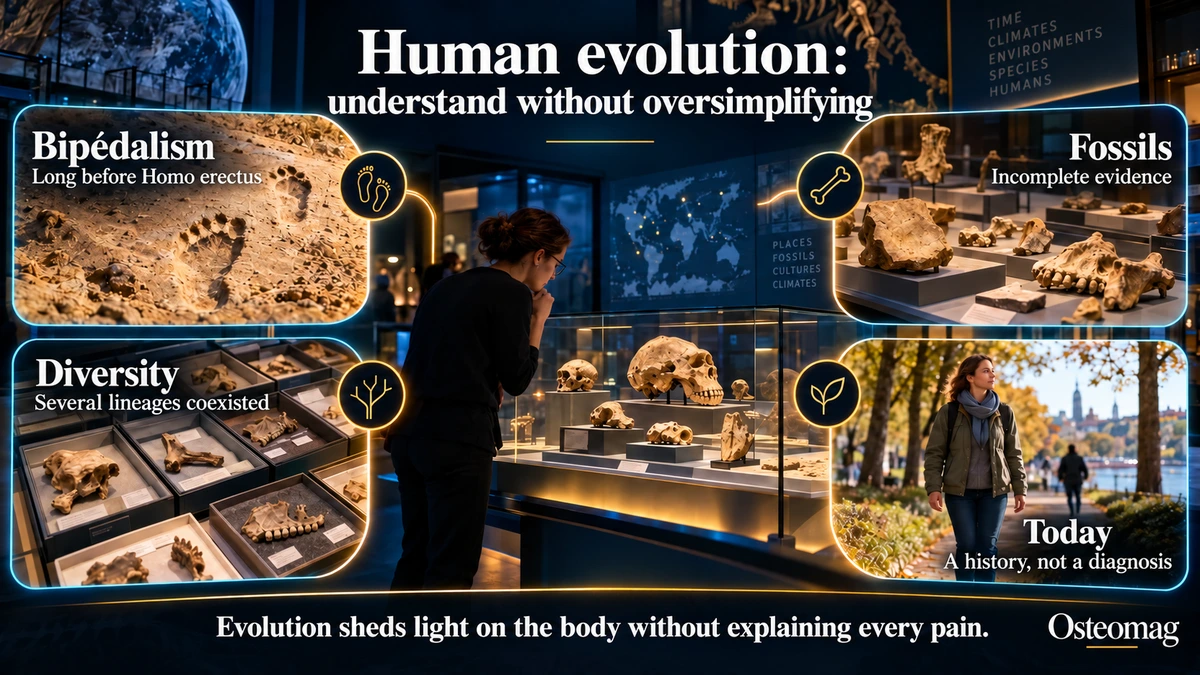
Bipedalism existed long before Homo erectus. Homo habilis and Homo erectus coexisted. Comparing them sheds light on adaptations and variations; it cannot diagnose current pain or define an ideal posture.
A branching history rather than an inevitable progression
Homo habilis is one of the earliest named members of the genus Homo. Fossils attributed to it come notably from East Africa. Homo erectus, in the broad sense, encompasses populations that lived over a very long period and across several regions of Africa and Asia. Some researchers distinguish the African forms under the name Homo ergaster. These classification choices are part of the scientific process.[1] [2]
The scenario in which habilis disappeared at exactly the same time that erectus appeared is inconsistent with discoveries from Ileret, Kenya. The fossils studied by Spoor and colleagues indicate prolonged coexistence. This does not resolve all questions about their evolutionary relationships, but it contradicts a strictly linear succession. Several ways of life and several morphologies may have shared similar environments.[3]
The dates assigned to a species describe its known presence in the fossil record. They do not necessarily establish the exact date of its first appearance or disappearance. A new fossil may extend this time range or change an attribution. Presenting approximate periods as reference points rather than absolute boundaries respects this uncertainty and makes updates easier to understand.
Walking on two legs predates both species
Bipedalism is documented in hominins that lived long before Homo erectus. Australopithecines already show evidence of movement on two legs. Footprints and bones provide complementary information: a footprint reveals contact with the ground, while a pelvis or femur suggests certain mechanical capabilities. No single piece of evidence provides a complete picture of walking.[4]
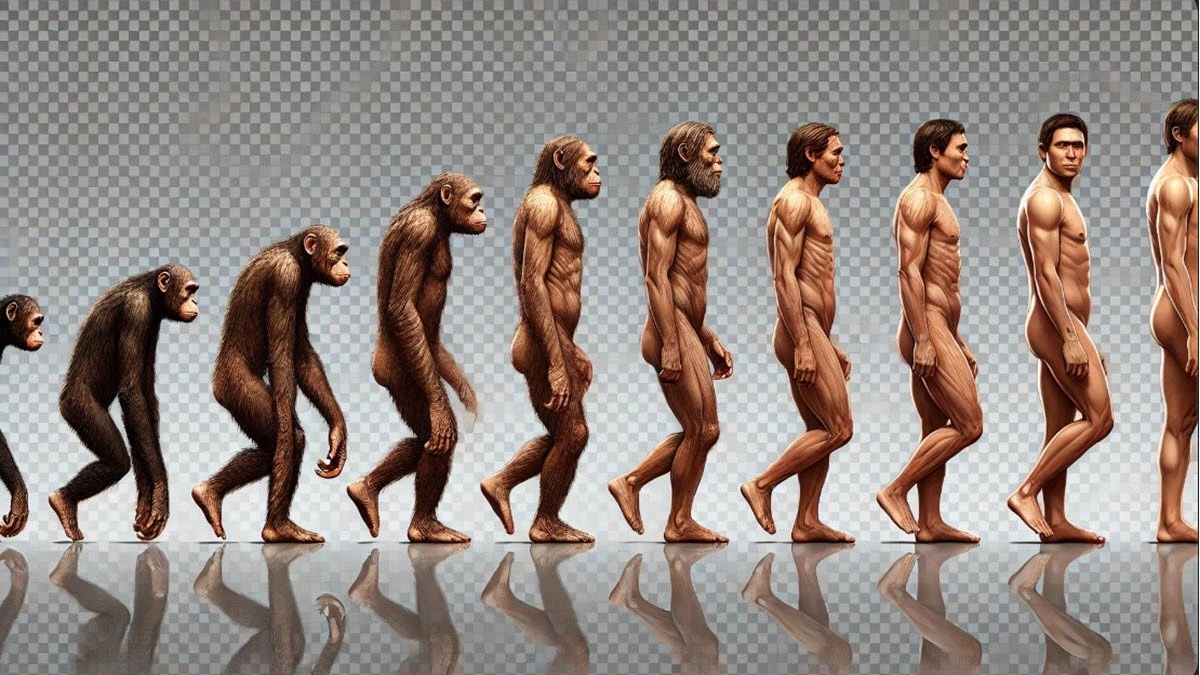
It is therefore misleading to portray habilis as a constantly hunched animal that learned to stand upright as it became erectus. The discussion focuses particularly on proportions, the extent of terrestrial life, and the possible role of arboreal activities. A slightly flexed posture in an artistic illustration is not a scientific measurement. Both species must be understood within a much older set of locomotor adaptations.[4] [5]
Body proportions: an incomplete puzzle
Erectus fossils generally show relatively long lower limbs within a body plan more similar to ours than that of many earlier hominins. This is relevant to the biomechanics of terrestrial locomotion. However, individuals vary: a species that existed across vast territories and for a long time cannot be reduced to a single silhouette or standard body size.[2]
In habilis, postcranial remains are rare and often fragmentary. Reconstructing the length of a limb from a bone fragment requires comparisons and introduces a degree of uncertainty. An analysis published in 2004 re-examined reconstructions of body proportions, demonstrating the importance of the models used. The debate therefore cannot be reduced to measuring two perfectly preserved skeletons.[5]
In 2026, Grine and colleagues described KNM-ER 64061, an approximately two-million-year-old partial skeleton attributed to habilis. The remains primarily include elements of the upper body and fragments of the pelvis. They support the existence of relatively long forearms and a combination of ancestral characteristics. The lower limbs are missing: this discovery enriches the comparison without providing a complete description of gait.[6]
Walking, running, and endurance: hypotheses that must be distinguished
Relatively long legs can contribute to stride mechanics and locomotion. However, locomotor efficiency also depends on body mass, joints, muscles, speed, and terrain. It would be impossible to infer the exact amount of energy expended by habilis or erectus from an illustration. Researchers combine anatomy, models, and comparisons with living organisms.
Bramble and Lieberman proposed that certain features of the genus Homo favoured endurance running and played a role in its evolution. This hypothesis draws on several anatomical and physiological traits. It does not mean that all erectus individuals ran constantly, nor that persistence hunting explains every human characteristic. A possible advantage and a directly documented behaviour represent two different levels of conclusion.[7]
The Ileret footprints, dated to approximately 1.5 million years ago, provide another type of evidence. Their morphology has been compared to a relatively modern foot and mode of locomotion. Their attribution to the hominins in question is based on context and comparisons. These tracks provide valuable evidence, but they do not allow all the habits of a species to be reconstructed from a single episode of walking.[8]
What can be compared with caution
| Question | Available evidence | Limit of interpretation |
|---|---|---|
| Evolutionary relationship between habilis and erectus | Dated fossils, similarities, and coexistence | A single direct succession has not been demonstrated |
| Body proportions | Reconstructed lengths and bone fragments | Small samples, variation, and missing bones |
| Locomotion | Anatomy of the pelvis and limbs, and footprints | Daily activities cannot be fully observed |
| Endurance | Anatomical and physiological comparisons | Functional hypotheses, without direct measurement in these species |
| Tools and fire | Objects and archaeological traces in context | The maker or user is not always identified |
| Modern pain | Current examination, history, and clinical data | An evolutionary narrative does not replace an individual assessment |

Tools and fire do not define a ladder of progress
The name habilis, associated with skill, reflects the history of its discovery and the idea of a connection with tools. It does not prove that this species was their sole inventor. The Lomekwi 3 tools, approximately 3.3 million years old, predate the earliest fossils commonly attributed to the genus Homo. The objects themselves do not directly identify their maker.[9]
Acheulean handaxes are often associated with early erectus, but technological traditions do not align neatly with species boundaries. As for fire, evidence of its presence must be distinguished from widespread, regular control aimed at cooking. The Wonderwerk study documented burned remains inside a cave dating to approximately one million years ago. It does not demonstrate that all erectus populations cooked from the time of their first appearance.[2] [10]
The pelvis and birth: a more complex debate
The “obstetrical dilemma” refers to a set of hypotheses about the constraints that influenced the human pelvis and childbirth. The shorthand explanation “a narrow pelvis for walking, and a large head that is difficult to deliver” poorly summarizes current knowledge. A study of living adults did not find the expected relationship between pelvic width and the energetic cost of walking or running.[11]
Other research has emphasized the energetic constraints of pregnancy. Reviews nevertheless support the relevance of evolutionary trade-offs, in a formulation more complex than the original model. The dimensions of the birth canal, growth, tissues, and human diversity interact. This scientific debate does not justify claims that manual treatment widens the pelvis or makes childbirth safer; obstetric needs require specific care.[12] [13]
Why evolution alone cannot explain back pain
The spine, knee, and foot contribute to locomotion that can support and move the body. They are not simply defective parts doomed by bipedalism. Current pain involves a person’s health status, physical demands, capacities, experiences, and life context. The fact that a structure has an evolutionary history does not explain why it becomes painful today.[14]
Pain is not a direct measure of “maladaptation.” Changes observed on imaging are also found in people without symptoms. Conversely, pain may be severe without any abnormality that alone explains it. This calls for examining signs, difficulties, and their progression rather than automatically attributing the problem to a curve or a supposed ancestral defect.[14] [15]
Useful applications, without promises of correcting the body
For osteopathy, evolution provides a framework for reflecting on the relationships between form, movement, and environment. It does not validate a palpation method, a remote diagnosis, or a particular technique. A change in sensation after manual contact does not demonstrate the correction of millions of years of evolution. Care decisions should be based on clinical evidence and the person’s goals.[16]
The best-supported practical implication is to promote appropriate opportunities for movement. Walking, varying activities, and progressively developing capabilities can contribute to health, without trying to recreate the presumed life of an ancestor. Current physical activity recommendations are based on studies of living people. They require neither a single gait nor a specific running practice imposed on everyone.[17]
Persistent or unusual pain warrants a contemporary assessment: circumstances of onset, impact, associated symptoms, and signs requiring referral. Trauma, progressive weakness, or a decline in general health should not be explained by evolution alone. The history of our species is fascinating; a person’s care is built around their current needs, understandable explanations, and clearly acknowledged limitations.
An interpretation that remains open
Fossils provide observations, models propose explanations, and clinical studies guide care. Keeping these three levels distinct makes it possible to appreciate human evolution without turning it into a narrative of inevitable fragility.
References
- [1] Smithsonian Human Origins Program. Homo habilis.
- [2] Smithsonian Human Origins Program. Homo erectus.
- [3] Spoor F et al. Implications of new early Homo fossils from Ileret, east of Lake Turkana, Kenya. Nature, 2007;448:688–691.
- [4] Smithsonian Human Origins Program. Walking Upright.
- [5] Haeusler M, McHenry HM. Body proportions of Homo habilis reviewed. Journal of Human Evolution, 2004;46:433–465.
- [6] Grine FE et al. New partial skeleton of Homo habilis from the upper Burgi Member, Koobi Fora Formation, Ileret, Kenya. The Anatomical Record, 2026;309:485–545.
- [7] Bramble DM, Lieberman DE. Endurance running and the evolution of Homo. Nature, 2004;432:345–352.
- [8] Bennett MR et al. Early hominin foot morphology based on 1.5-million-year-old footprints from Ileret, Kenya. Science, 2009.
- [9] Harmand S et al. 3.3-million-year-old stone tools from Lomekwi 3, West Turkana, Kenya. Nature, 2015.
- [10] Berna F et al. Microstratigraphic evidence of in situ fire in the Acheulean strata of Wonderwerk Cave. PNAS, 2012.
- [11] Warrener AG et al. A wider pelvis does not increase locomotor cost in humans, with implications for the evolution of childbirth. PLOS ONE, 2015.
- [12] Dunsworth HM et al. Metabolic hypothesis for human altriciality. PNAS, 2012.
- [13] Haeusler M et al. The obstetrical dilemma hypothesis: there’s life in the old dog yet. Biological Reviews, 2021.
- [14] Raja SN et al. The revised IASP definition of pain: concepts, challenges, and compromises. Pain, 2020.
- [15] Brinjikji W et al. Systematic literature review of imaging features of spinal degeneration in asymptomatic populations. AJNR, 2015.
- [16] Bialosky JE et al. The mechanisms of manual therapy in the treatment of musculoskeletal pain: a comprehensive model. Manual Therapy, 2009.
- [17] World Health Organization. Physical activity. Fact sheet, 2024.