Understanding sensory information without confusing mechanical stability with motor control
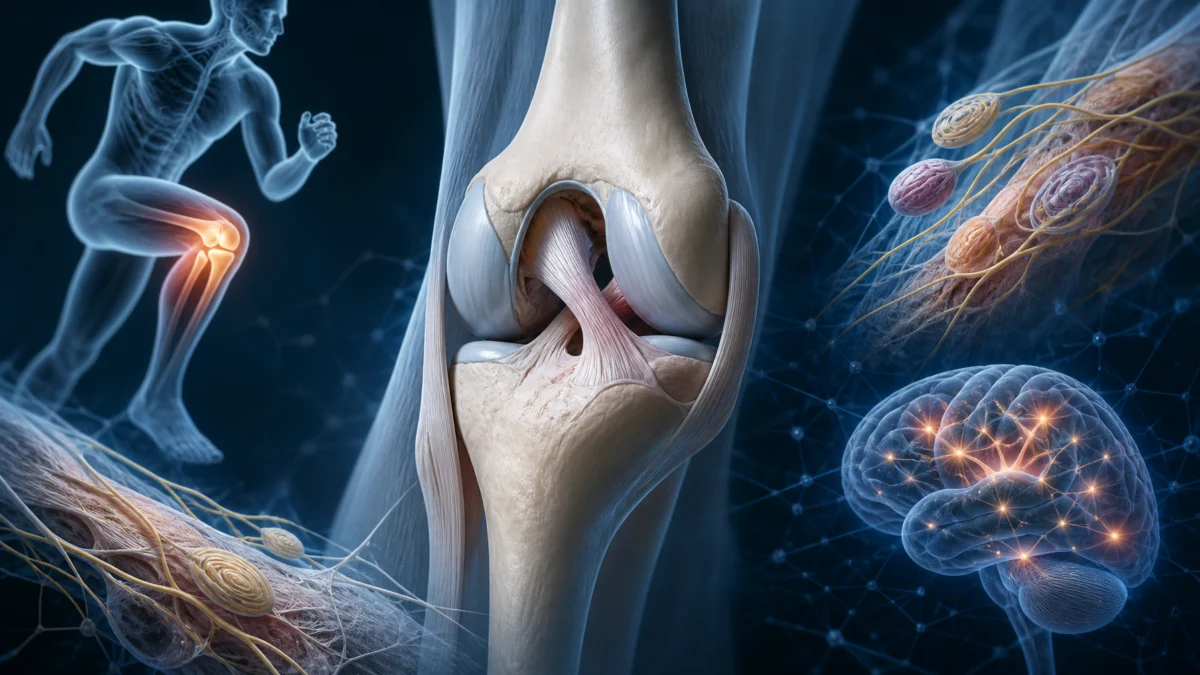
Ligaments are often described as simple fibrous bands that prevent a joint from moving too far. This description is incomplete. A ligament does provide mechanical stability, but it also contains sensory endings that can inform the nervous system about tension, position and changes in movement around a joint.
This sensory dimension helps explain why a sprain or ligament rupture causes more than pain or laxity. After an injury, awareness of joint position, the speed of muscle reactions and confidence in movement may also change. Recovery therefore involves more than waiting for collagen to heal: it also requires sensorimotor relearning.
For an osteopath, this subject is particularly interesting provided that extrapolations are avoided. Palpation cannot ‘feel mechanoreceptors’ or directly measure a ligament’s proprioception. Touch can contribute to assessment and comfort, but sensorimotor abilities must be assessed through movement, balance, strength and function.

What is a ligament?
A ligament is dense connective tissue that usually connects one bone to another. It consists mainly of collagen, water, cells and an extracellular matrix organized to withstand tensile loads.
Ligaments are not rigid ropes. They behave viscoelastically: their response depends on the intensity, speed and duration of loading. When tension is sustained, the tissue may gradually lengthen slightly, a phenomenon often called creep. After the load is removed, some of this deformation recovers.
These properties are normal and contribute to mechanical adaptation. They do not mean that a ligament ‘moves out of place’ or needs to be shortened manually.
Do ligaments contain sensory receptors?
The distribution of sensory endings varies with the tissue, methods and samples. An anatomical study of cadaveric knees did not find every receptor category in every structure. These observations do not allow a single receptor to be assigned a precise clinical measure of position. Muscle and skin afferents also contribute to proprioception [6] [7].
Yes. Anatomical studies have identified different types of mechanoreceptors in several ligaments. A review of the anterior and posterior cruciate ligaments describes Ruffini corpuscles, Pacinian corpuscles, Golgi-like organs and free nerve endings [1].
These structures do not operate as isolated sensors transmitting a perfect measure of joint angle. Instead, they contribute to a much broader sensory network involving muscles, tendons, skin, the joint capsule, vision and the vestibular system.
Proprioception is therefore a property of the system, not of a ligament alone.
What is proprioception?
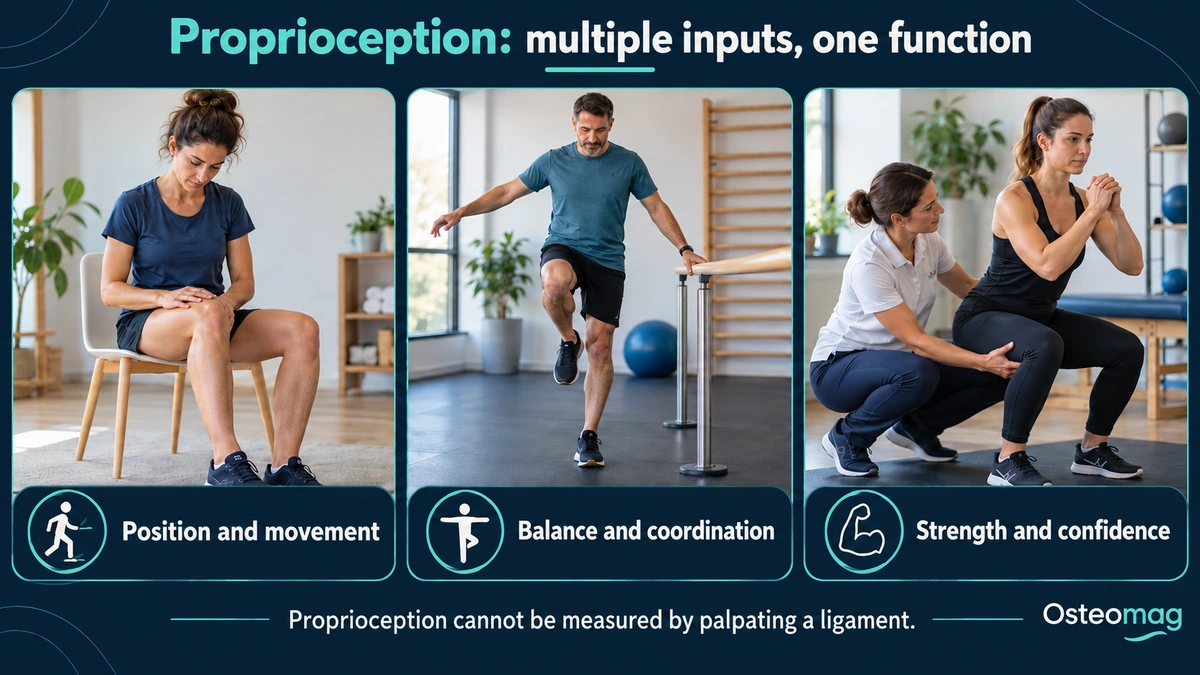
Proprioception is the ability to perceive the body’s position and movement without having to look at it constantly. It allows us, for example, to know whether the knee is bent, place a foot on a step or rapidly adjust balance after a disturbance.
It depends on several components:
- joint position sense;
- movement detection;
- force perception;
- reflex and automatic responses;
- central integration of all this information.
The brain combines these signals to build a sufficiently accurate estimate of body position and prepare motor responses.
Do ligaments really contribute to muscle control?
Reviews also discuss the limitations of the hypothesis of a simple protective ligament reflex. An experimental or anatomical observation does not prove that manual contact restores this circuit in a patient [2] [3].
Experimental research has shown that activating ligament afferents can influence muscle activity and spinal or supraspinal circuits [2] [3]. This idea is sometimes described as the sensorimotor contribution of ligaments.
In the knee, for example, information from the anterior cruciate ligament may contribute to regulating muscle tone and adjustments around the joint. This does not mean that a ligament reflex controls stability alone: the response depends on context, load, movement speed and the state of the nervous system.
Functional stability results from an interaction between passive structures and active muscle control.
What happens after an anterior cruciate ligament rupture?
An ACL rupture clearly changes knee mechanics, but it may also affect the sensory component. The 2022 review of cruciate ligament mechanoreceptors emphasizes that loss or alteration of these afferents may contribute to proprioceptive changes after injury [1].
More recent research also describes central nervous system adaptations after ACL injury, supporting the idea that rehabilitation should not be limited to local strengthening [4].
After surgical reconstruction, mechanical stability may be restored without every sensorimotor ability immediately returning to its previous level.
Why do some patients feel unstable despite a ‘repaired’ joint?
A feeling of instability can persist for several reasons:
- loss of strength;
- delayed muscle reactions;
- proprioceptive impairment;
- pain or swelling;
- fear of another injury;
- less effective coordination;
- insufficient exposure to real-life tasks.
Perceived stability therefore differs from stability measured through imaging or a ligament test.
The example of chronic ankle instability
After an ankle sprain, some patients develop repeated episodes of ‘giving way’. A 2024 systematic review of chronic ankle instability after surgical stabilization shows that proprioceptive deficits may persist despite mechanical correction [5].
This observation matters: restoring the structure does not always restore control.
It supports the use of balance, perturbation and strengthening exercises, as well as tasks specific to sport or daily activities.
Is a sprain only a local problem?
No. An acute sprain causes a local response: pain, inflammation, swelling and limited movement. But it also changes behaviour. The person walks differently, avoids certain positions and sometimes substantially reduces loading.
These adaptations are normal initially. They become more problematic if they persist long after the tissues can tolerate more.
Recovery therefore requires a gradual return to loading and movement variability.
When does a ligament injury require medical assessment?
A significant sprain or joint trauma warrants assessment when there is:
- inability to bear weight;
- visible deformity;
- rapid, substantial swelling;
- joint locking;
- significant instability;
- numbness or loss of strength;
- marked bone pain;
- symptoms that fail to improve despite appropriate care.
Imaging and medical examination may be needed to exclude a fracture, complete rupture or associated injury.
How can proprioception be assessed clinically?
What tests can—and cannot—show
| Observation or situation | Cautious interpretation and possible next step |
|---|---|
| Reproducing a joint angle | Explores position sense; pain and attention affect the result. |
| Standing on one leg with a support available for safety | Observes overall balance, not a ligament alone. |
| Jumping or changing direction | Assesses a demanding task when the injury and the person’s ability allow it. |
| An area is tender on palpation | Measures neither receptors nor an isolated proprioceptive ability. |
There is no single perfect test. Depending on the joint and the goals, assessment may include:
- single-leg balance;
- balance with perturbations;
- reproducing a joint angle;
- jumping and landing tests;
- changes of direction;
- sport-specific functional tests;
- observation of walking or running.
These tests must be interpreted cautiously. Poor performance may reflect pain, strength, fear or fatigue as much as a purely proprioceptive deficit.
What role can osteopathy play?
Touch does not measure proprioception
Palpation can identify tenderness around a ligament or an associated movement limitation, but it cannot determine how many mechanoreceptors are functioning or whether a ligament reflex has ‘switched off’.
An impression beneath the hands must remain a clinical hypothesis and be checked against movement.
Manual treatment as an adjunct
Gentle mobilization may sometimes reduce pain, temporarily improve range of motion or lessen apprehension. This window can be useful for immediately introducing an exercise.
Manual treatment should not be presented as a way to directly ‘reconnect’ a ligament to the brain.
Retesting
After an intervention, the patient repeats the selected test: single-leg standing, a squat, stepping up or another task. If function improves, the intervention has probably had a useful short-term effect.
If nothing changes, the hypothesis must be reconsidered.
Proprioceptive rehabilitation
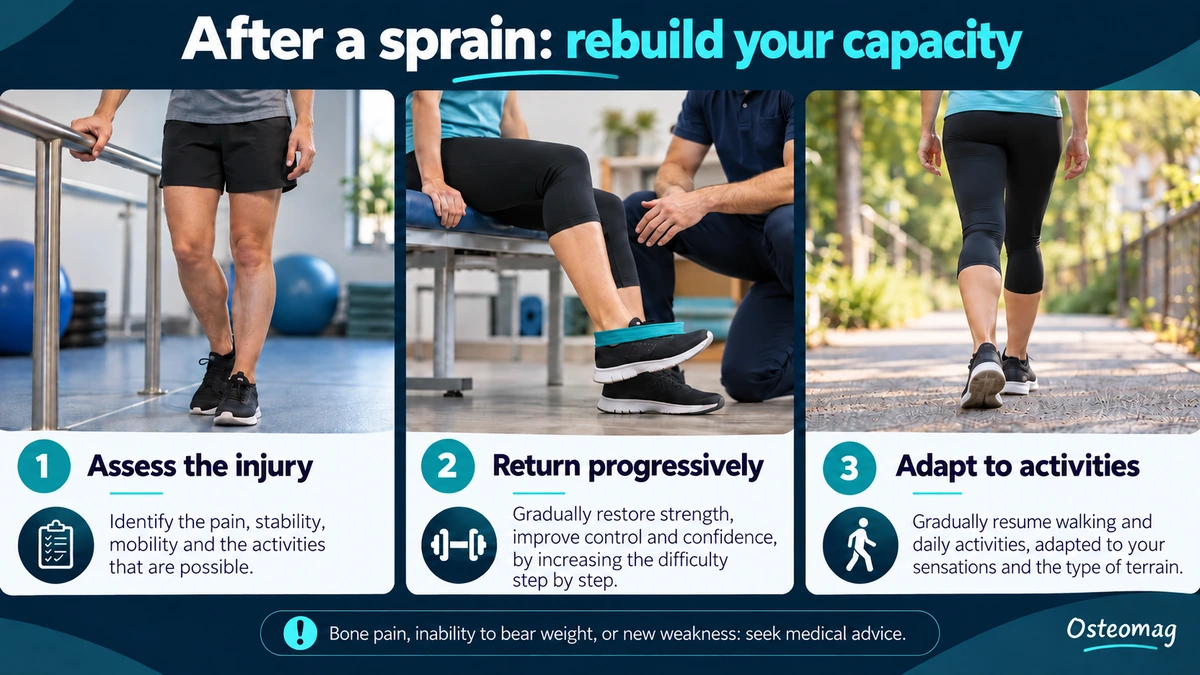
After ACL reconstruction, guidelines place exercise and functional criteria at the centre of progression; several dosing decisions still rely on limited evidence or consensus. For the ankle, guidelines support an individualized programme of strength, balance and return to activities. Progression is not decided by palpation alone [8] [9] [10].
A typical progression can begin with simple tasks and move toward more complex situations:
- stable single-leg balance;
- head or arm movements while balancing;
- a less stable surface when appropriate;
- external perturbations;
- jumps and landings;
- changes of direction;
- sport-specific movements.
The aim is not to make an exercise difficult for its own sake. Difficulty should match current ability and progress according to the quality of control.
The role of strength
Proprioception does not replace strength. A stable joint needs muscles capable of producing and absorbing enough force.
After an ankle sprain, working only on an unstable cushion without strengthening the calf or fibular muscles may leave a substantial deficit. After a knee injury, training the quadriceps, hamstrings and hips remains essential.
The role of speed
A joint may be well controlled during slow movement but lose that ability when a task becomes fast. The sensorimotor system must therefore be gradually exposed to the activity’s actual speed.
For an athlete, this may eventually mean jumping, changes of direction and reactions to unexpected signals. For an older person, it may mean learning to recover from a small loss of balance while walking.
Can ligaments be ‘re-informed’ by the hands?
Any skin contact clearly provides sensory information to the nervous system. But this does not justify claiming that manual treatment specifically restores the mechanoreceptors of an injured ligament.
Active rehabilitation provides rich information because it combines load, position, muscle effort, vision, balance and context.
Touch can be a starting point, but movement remains the main setting for learning.
Micromovements: a concept to use cautiously
Joints have small accessory movements, and tissues deform slightly under load. However, there is no need to assume that specific ‘ligament micromovements’ exist that a practitioner could accurately perceive and correct manually.
A more robust description refers to tissue deformation, loading, joint gliding and sensory information.
What osteopathy cannot claim
Osteopathy cannot reconstruct a torn ligament, restore a mechanically unstable ACL, measure proprioception through palpation or guarantee that manual care restores mechanoreceptors.
It can, however, contribute to comfort, mobility and a return to movement when integrated into active rehabilitation and when situations requiring medical consultation have been recognized.
Conclusion
Ligaments are not simply passive straps. They contribute to mechanical stability and contain sensory structures that contribute to proprioception and motor control.
After an injury, recovery must therefore go beyond tissue healing alone. Strength, balance, speed, coordination and confidence must gradually be restored.
For an osteopath, the best use of this knowledge is to connect touch with movement: observe, treat cautiously when it helps, retest and then get the patient moving again. Proprioception is rebuilt through experience, not only on the treatment table.
Scientific references
- [1] Banios et al. Anterior and Posterior Cruciate Ligaments Mechanoreceptors: A Review of Basic Science. Diagnostics (Basel). 2022;12(2):331. doi:10.3390/diagnostics12020331.
- [2] Solomonow et al. Sensory-motor control of ligaments and associated neuromuscular disorders. J Electromyogr Kinesiol. 2006;16(6):549-567. doi:10.1016/j.jelekin.2006.08.004.
- [3] Sjölander et al. Spinal and supraspinal effects of activity in ligament afferents. J Electromyogr Kinesiol. 2002;12(3):167-176. doi:10.1016/s1050-6411(02)00017-2.
- [4] Lee et al. Disrupted sensorimotor control after ACL injury: from mechanoreceptor degeneration to neuroplasticity-oriented rehabilitation. Ann Med. 2026;58(1):2604403. doi:10.1080/07853890.2025.2604403.
- [5] Xue et al. Insufficient recovery of proprioception in chronic ankle instability after surgical restabilization: A systematic review. Asia Pac J Sports Med Arthrosc Rehabil Technol. 2024;35:48-58. doi:10.1016/j.asmart.2023.11.005.
- [6] Çabuk et al. Mechanoreceptors of the ligaments and tendons around the knee. Clin Anat. 2016;29(6):789-795. doi:10.1002/ca.22743.
- [7] Proske et al. The proprioceptive senses: their roles in signaling body shape, body position and movement, and muscle force. Physiol Rev. 2012;92(4):1651-1697. doi:10.1152/physrev.00048.2011.
- [8] Kotsifaki et al. Aspetar clinical practice guideline on rehabilitation after anterior cruciate ligament reconstruction. Br J Sports Med. 2023;57(9):500-514. doi:10.1136/bjsports-2022-106158.
- [9] Martin et al. Ankle Stability and Movement Coordination Impairments: Lateral Ankle Ligament Sprains Revision 2021. J Orthop Sports Phys Ther. 2021;51(4):CPG1-CPG80. doi:10.2519/jospt.2021.0302.
- [10] Bsoul et al. Evidence-based clinical practice guidelines for the management of acute ankle injuries according to: a PRISMA systematic review and quality appraisal with AGREE II. BMC Musculoskelet Disord. 2024;25(1):523. doi:10.1186/s12891-024-07655-z.