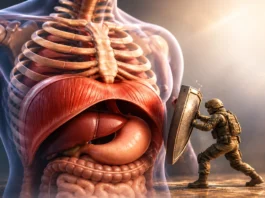
Noticing internal signals without turning every sensation into an alarm
A faster heartbeat, a tightening abdomen, breathing that becomes more noticeable: the body continually provides information about its state. These sensations can guide our choices, but they can also become worrying when we try to explain them with an impossible degree of certainty. Should we listen more closely to our bodies, or learn to monitor them less? The answer depends on what we mean by “listening”.
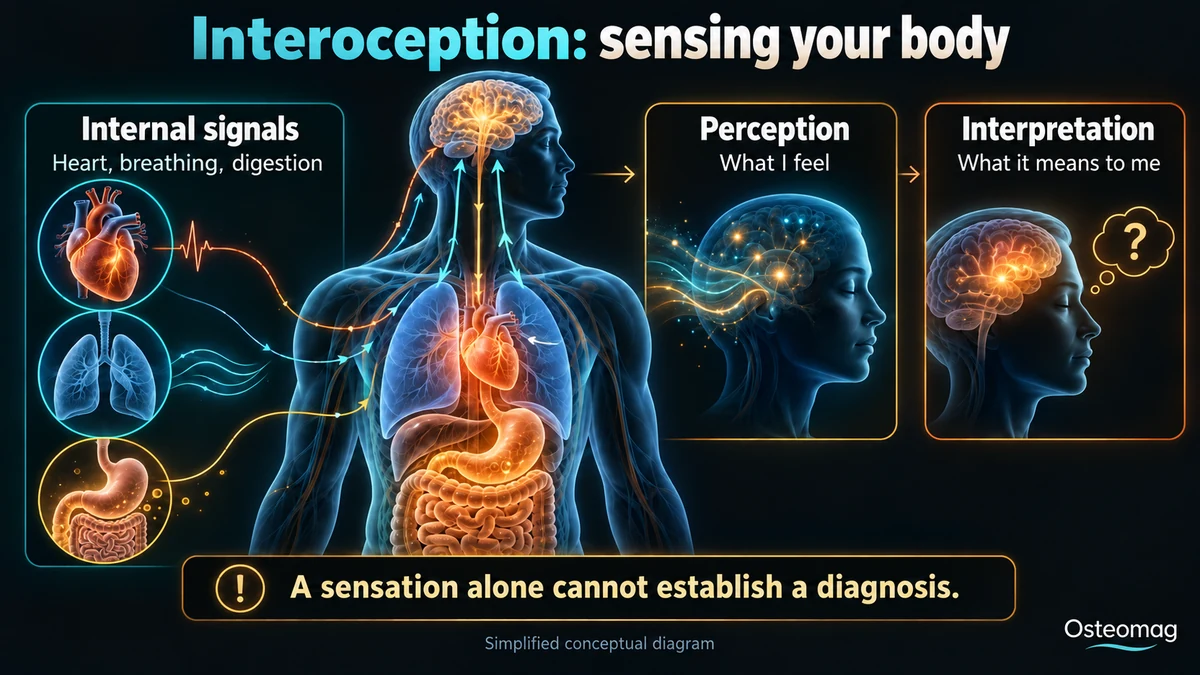
Interoception refers to the processes through which we detect, integrate and interpret information from inside the body. Much of this happens outside conscious awareness [1, 2]. This field helps explain relationships between physiology, attention and emotions. However, it neither allows a disease to be diagnosed from a sensation nor establishes that an unexplained symptom is necessarily psychological. Here is what research establishes, what it suggests and what remains hypothetical.
What is interoception?
Hunger, fullness, the need to urinate, awareness of heartbeats and breathing discomfort are examples. Interoception differs from perception of the outside world and from proprioception, which provides information about the position and movement of body parts. In everyday life, these sources of information combine: climbing stairs involves movement, vision and sensations of effort.
The nervous system receives information through several pathways, including spinal and vagal pathways. The brainstem, insula and other regions participate in processing it. Hormonal and immune signalling also contributes to communication between the body and brain [2]. It would therefore be reductive to describe interoception as simply a function of the vagus nerve or the activity of a single “emotion centre”.
This organisation contributes to physiological regulation. However, noticing a sensation and correctly understanding its cause are different things. A feeling of breathlessness does not, by itself, reveal how the lungs are functioning. Medical assessment may be needed even when someone is very familiar with their sensations.

Feeling strongly does not mean perceiving accurately
Researchers distinguish several dimensions: performance on a perception task, beliefs about our abilities, and how well our confidence corresponds to our performance [3]. These dimensions are not interchangeable. Someone may feel highly attentive to their heart without detecting its beats with unusual accuracy.
Questionnaires explore other aspects. The MAIA-2, for example, examines different ways of noticing sensations, regulating attention to them and trusting them. It describes an experience reported by the person; it does not directly measure how well an organ functions [5]. A score is therefore neither a medical assessment nor proof of “disconnection from the body”.
This distinction has a practical consequence: being less sensitive to certain sensations does not mean being less self-aware. Nor is an intense sensation automatically more reliable. The clinical aim should not be to classify people as “good” or “bad” perceivers, but to understand what helps or hinders them.
Why scientific measurement remains difficult
A commonly used task asks people to count their heartbeats without taking their pulse. This seems intuitive, but results may depend on what someone believes a normal heart rate should be, rather than solely on detected sensations. A study comparing heartbeat counting with a heartbeat detection task found that performance on the two tasks was unrelated [4].
A cardiac test does not summarise perception of breathing or digestion either. Research must specify which system is being studied and how it is measured. These limitations prevent a laboratory experience from becoming a general verdict on someone’s relationship with their body.
Interoception and anxiety: a less straightforward relationship than it seems
It is sometimes claimed that anxious people perceive their bodies “too well”. The evidence does not support this general rule. A meta-analysis of 55 studies found no overall association between anxiety and cardiac interoceptive accuracy as measured by the tasks studied [6]. This does not prove that no relationship exists; it mainly limits the idea of a single mechanism.
Another meta-analysis, covering 71 studies using questionnaires, found associations between anxiety and some dimensions, including negative evaluations of sensations, worried attention and difficulties describing bodily signals [7]. The authors also highlighted overlap between questionnaires and interpretative difficulties. These associations cannot establish cause and consequence in an individual person.
A reasonable interpretation separates the sensation from its meaning. “My heart is beating faster” describes an experience; “I am in danger” is an interpretation. The latter may be correct in some situations and excessive in others. Distinguishing them requires consideration of the context, how things evolve and, when necessary, medical assessment.
Body awareness and monitoring: two uses of attention
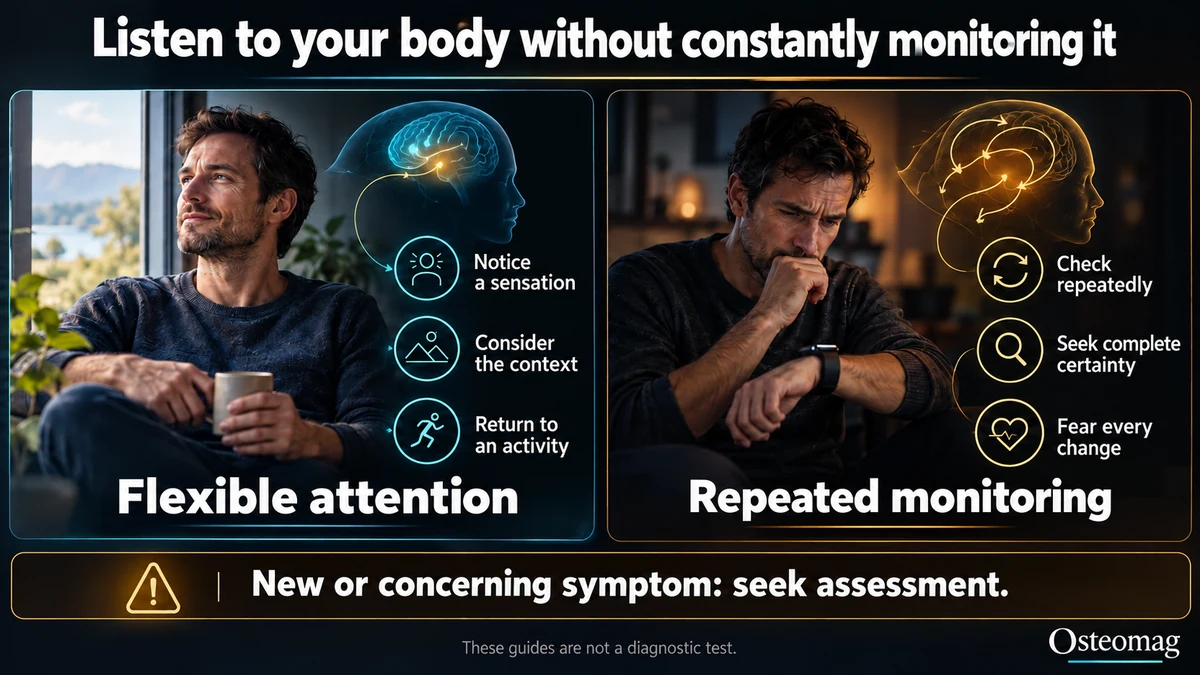
Consider an illustrative situation with no diagnostic meaning. After familiar exertion, one person notices faster breathing, recovers and continues their day. Another immediately compares their sensations with yesterday’s, checks their watch repeatedly and searches online for every possible cause. The initial signal may be similar, but the mental activity accompanying it differs.
The expression “flexible attention” can be a useful educational guide: noticing what is happening, considering the context and then being able to shift attention. “Repeated monitoring” describes checks that provide only brief reassurance or gradually take over the day. These are neither medical categories nor a validated test.
Caution avoids two opposite mistakes: asking someone to ignore everything, or encouraging constant examination of every fluctuation. Monitoring prescribed for a known disease serves a different purpose from checking in pursuit of permanent certainty. Follow-up must respect the recommendations of the professional responsible for that condition.
What is established, suggested or still hypothetical?
| Level | What can be said | Limitation |
|---|---|---|
| Established | Internal signals are processed by several systems; perception has several dimensions [1, 2, 3, 4, 5]. | An isolated sensation does not identify its cause. |
| Suggested | Some ways of evaluating sensations are associated with anxiety [7]. | An association does not establish individual causation. |
| Hypothetical in osteopathy | A consultation might help someone explore sensations more flexibly. | The cited studies do not establish an “interoceptive correction” through touch. |
Predictive models propose that expectations contribute to the interpretation of internal signals [1, 2]. They provide a research framework, not a universal explanation. They do not justify attributing a sensation to a hidden emotion, a memory stored in tissues or trauma inferred through palpation.
Symptoms remain real even when their explanation is complex
A systematic review with meta-analysis of somatic symptoms and some functional syndromes reported differing results across the groups studied [8]. It does not establish that everyone with persistent symptoms perceives their body inaccurately. Functional disorders cannot be diagnosed simply because an initial examination is normal.
Physical disease, an anxious response and increased attention can coexist. The useful question is therefore not “body or mind?”, but “which explanations need to be considered, and which actions are appropriate?” Recognising the influence of attention diminishes neither the reality of a symptom nor the right to appropriate investigation.
Can interoception be trained?
A randomised trial assessed a specific training programme, called ADIE, in autistic adults. The results showed an improvement in anxiety compared with an active control group [9]. This is an interesting possibility, but it concerns a specific population, protocol and set of outcomes. It does not automatically validate an online exercise or an osteopathic technique.
A change in a questionnaire must also be distinguished from improvement on a task and a meaningful benefit in everyday life. These outcomes may evolve differently. Before promising that a method “restores the mind–body connection”, relevant, lasting and reproducible effects would need to be demonstrated, with monitoring for adverse effects.
Practical guidance without deliberately provoking symptoms
When a situation has been assessed and no warning sign requires another approach, a discussion with a professional can address three questions: what exactly do you feel, what explanation do you give it, and what do you do next? Separating these elements can make the experience more understandable without claiming to establish its cause.
A brief period of observation can remain descriptive: “I notice warmth”, rather than “an emotion is leaving my body”. Keeping the eyes open, looking around the room or returning to an ordinary activity are also options. These are suggestions for comfort, not a validated treatment protocol or an obligation to focus inward.
If attention to the body increases anxiety, dizziness or a sense of disconnection, it is reasonable to stop and seek support. A review of adverse events associated with meditation reminds us that attention-based practices can involve difficulties [10]. Those findings do not provide a risk rate for a brief observation of bodily sensations.
Exercises designed to provoke feared sensations belong to specific treatment approaches. This article does not recommend hyperventilation, breath-holding or deliberately uncomfortable exertion. Any suggestion must consider health status, preferences and the person’s ability to stop.
A realistic role for osteopathy
An osteopathic consultation can provide an opportunity to describe discomfort, examine movement capacities and clarify goals. The practitioner can ask what someone feels before offering an interpretation, obtain consent and adapt touch to their tolerance. The person must be able to decline, modify or stop a proposed activity.
These principles do not establish that touch improves measurable interoceptive accuracy. The research discussed here does not justify promises of brain reprogramming, release of emotions from tissues or treatment of an anxiety disorder through osteopathy. Any proposed benefit from reassuring bodily exploration must remain explicitly a hypothesis.
A practical goal might be returning to a valued activity with fewer intrusive checks, if clinical assessment allows it. When anxiety substantially limits everyday life, referral to a mental health professional is appropriate. Osteopathy may support an associated musculoskeletal problem while respecting medical and psychological follow-up.
When should medical assessment be sought?
Chest pain or pressure, unusual breathlessness, sweating or feeling unwell may indicate a cardiovascular emergency. Call 911 for signs suggesting a heart attack; do not attribute them to stress without assessment [11]. Sudden weakness on one side, difficulty speaking or loss of consciousness also requires an urgent response.
New or repeated palpitations, persistent discomfort, worsening symptoms or symptoms that interfere with activities warrant a consultation. Based on the history and examination, the physician will decide whether investigations are needed. Perceived intensity, the ability to relax or a favourable response to touch is insufficient to exclude disease.
Key points
Interoception helps us understand how we perceive our internal state. It is not a personal disease detector. Research encourages distinguishing sensations, attention, beliefs and perceptual accuracy, rather than measuring a supposed quality of “connection” to the body.
For Osteomag, listening to the body means taking the experience seriously, considering several possible explanations and acting according to the context. Curiosity can help; it is most useful when compatible with daily activities, personal preferences and medical assessment when indicated.
- [1] Khalsa SS, Adolphs R, Cameron OG, et al. Interoception and Mental Health: A Roadmap. Biol Psychiatry Cogn Neurosci Neuroimaging. 2018;3(6):501–513. doi:10.1016/j.bpsc.2017.12.004.
- [2] Chen WG, Schloesser D, Arensdorf AM, et al. The Emerging Science of Interoception: Sensing, Integrating, Interpreting, and Regulating Signals within the Self. Trends Neurosci. 2021;44(1):3–16. doi:10.1016/j.tins.2020.10.007.
- [3] Garfinkel SN, Seth AK, Barrett AB, Suzuki K, Critchley HD. Knowing your own heart: distinguishing interoceptive accuracy from interoceptive awareness. Biol Psychol. 2015;104:65–74. doi:10.1016/j.biopsycho.2014.11.004.
- [4] Ring C, Brener J. Heartbeat counting is unrelated to heartbeat detection: A comparison of methods to quantify interoception. Psychophysiology. 2018;55:e13084. doi:10.1111/psyp.13084.
- [5] Mehling WE, Acree M, Stewart A, Silas J, Jones A. The Multidimensional Assessment of Interoceptive Awareness, Version 2 (MAIA-2). PLoS One. 2018;13(12):e0208034. doi:10.1371/journal.pone.0208034.
- [6] Adams KL, Edwards A, Peart C, et al. The association between anxiety and cardiac interoceptive accuracy: A systematic review and meta-analysis. Neurosci Biobehav Rev. 2022;140:104754. doi:10.1016/j.neubiorev.2022.104754.
- [7] Clemente R, Murphy A, Murphy J. The relationship between self-reported interoception and anxiety: A systematic review and meta-analysis. Neurosci Biobehav Rev. 2024;167:105923. doi:10.1016/j.neubiorev.2024.105923.
- [8] Wolters C, Gerlach AL, Pohl A. Interoceptive accuracy and bias in somatic symptom disorder, illness anxiety disorder, and functional syndromes: A systematic review and meta-analysis. PLoS One. 2022;17:e0271717. doi:10.1371/journal.pone.0271717.
- [9] Quadt L, Garfinkel SN, Mulcahy JS, et al. Interoceptive training to target anxiety in autistic adults (ADIE): A single-center, superiority randomized controlled trial. EClinicalMedicine. 2021;39:101042. doi:10.1016/j.eclinm.2021.101042.
- [10] Farias M, Maraldi E, Wallenkampf KC, Lucchetti G. Adverse events in meditation practices and meditation-based therapies: a systematic review. Acta Psychiatr Scand. 2020;142(5):374–393. doi:10.1111/acps.13225.
- [11] Fondation des maladies du cœur et de l’AVC du Canada. Emergency signs: when to call 911. Ressource clinique consultée le 6 octobre 2026.
An exploratory educational article. The examples do not constitute a diagnosis or personalised treatment method.