A small sensory branch that may explain some pain near the base of the thumb
A burning sensation in the palm, a highly sensitive scar, or numbness near the wrist does not always indicate carpal tunnel syndrome. The palmar cutaneous branch of the median nerve is a small sensory nerve that branches off from the median nerve before the wrist and reaches the skin of the palm along a separate path. It can become irritated or injured, particularly after trauma or a local procedure. This neuropathy is uncommon and requires a precise examination; the location of the pain alone is not sufficient to confirm it.[1] [4]
The practical challenge is to determine whether the discomfort originates from this branch, the median nerve within the carpal tunnel, a scar, or another structure. These conditions do not all require the same management. A clear understanding of the anatomy helps guide the examination without assuming that every sensitive palm involves a nerve injury.
A superficial course outside the carpal tunnel
The palmar cutaneous branch usually arises in the distal forearm from the radial side of the median nerve. It travels near the palmaris longus and flexor carpi radialis tendons, then reaches the palm through superficial tissue planes. It generally passes above the flexor retinaculum, while the main trunk of the median nerve travels through the deeper carpal tunnel. Anatomical variations occur and are particularly important during wrist surgery.[1]
Its role is sensory: it transmits information particularly from the skin of the thenar eminence, the raised area at the base of the thumb, and part of the proximal palm. Cutaneous territories overlap and vary from person to person. This branch does not independently control the thumb muscles. Clear weakness of opposition or progressive loss of strength therefore requires investigation for a more extensive nerve injury or another cause.[1] [5]
What can irritate this branch
A cut or trauma can directly injure a superficial nerve. A scar can also alter its relationship with surrounding tissues. Neuropathies of this branch have been reported after procedures on the palmar side of the wrist, such as carpal tunnel release or local surgery. A series of four post-traumatic cases shows that seemingly minor injuries can sometimes be followed by persistent sensory symptoms.[2] [4]
A neuroma is an abnormal organization of nerve fibres after an injury; it can be highly sensitive to pressure. A mass or local compression is another possibility to investigate depending on the context. However, pain within a scar does not prove that a neuroma is present. The diagnosis must correlate the history, symptoms, examination, and, when necessary, additional tests.[8] [9]
Prolonged pressure on a sensitive area can aggravate discomfort, for example when using a tool, holding handlebars, or resting on a desk support. This does not prove that these objects caused a nerve injury. It is therefore important to distinguish the factor currently triggering the pain from the initial mechanism. This distinction makes it possible to adapt activities while continuing the assessment.
Sometimes highly localized skin sensations
The person may describe burning, electric shock-like sensations, tingling, or reduced sensation in the proximal palm. Contact with clothing, an object, or a surface may become unpleasant. The discomfort may be centred near a scar but can also spread. The history should clarify when the symptoms began, how they have changed, and which movements or activities are limited, rather than focusing solely on the word “pain.”
Hypersensitivity may lead to reduced use of the hand. Conversely, loss of sensation may make heat or excessive pressure less noticeable. These two situations require different adaptations. If the hand is numb, testing it with a very hot source should be avoided, and the skin should be monitored during activities. The degree of sensation and recovery should be assessed during follow-up.[10]
Why it is not necessarily carpal tunnel syndrome
In typical carpal tunnel syndrome, symptoms mainly affect the fingers supplied by the median nerve and may wake the person at night. Because the palmar cutaneous branch leaves the nerve before the tunnel, sensation in the proximal palm is usually spared. This anatomical rule aids clinical reasoning but is not an absolute boundary. Injury to the branch can coexist with carpal tunnel syndrome, as illustrated by clinical and electrophysiological publications.[5] [6]
A 2021 ultrasound study involving healthy volunteers and patients with carpal tunnel syndrome also investigated the size of this branch. These observations do not mean that all palmar pain indicates compression within the tunnel. They underscore the need to compare findings from several territories and avoid drawing a conclusion based on a single symptom or measurement.[7]
Comparing possible causes without self-diagnosing
The possibilities below can guide which questions to ask. They do not make it possible to diagnose an injury yourself. After surgery in particular, pain when pressure is applied can have several causes and does not automatically mean that the nerve has been severed.[11]
| Possible cause | Possible presentation | What to check |
|---|---|---|
| Palmar cutaneous branch of the median nerve | Proximal palm, especially toward the base of the thumb; burning or sensitivity to touch | Look for a matching nerve pathway, a scar, or trauma. |
| Carpal tunnel syndrome | Tingling in the fingers supplied by the median nerve, often at night | Sensation in the proximal palm is usually preserved, but an associated injury remains possible. |
| Pillar pain after surgery | Pain when pressure is applied to the raised areas of the palm near the scar | By itself, it does not prove injury to the cutaneous branch. |
| Tendon, joint, or sensitive scar | Pain related to a task or local pressure | Compare sensation, movement, and context; several causes may coexist. |
| More proximal nerve injury | Wider territory, sometimes with weakness or other signs | A more complete neurological examination becomes relevant. |
| Complex regional pain syndrome | Severe pain with changes in colour, temperature, swelling, or sweating | A set of criteria is required; pain alone is not sufficient. |

Mapping sensation and examining the hand
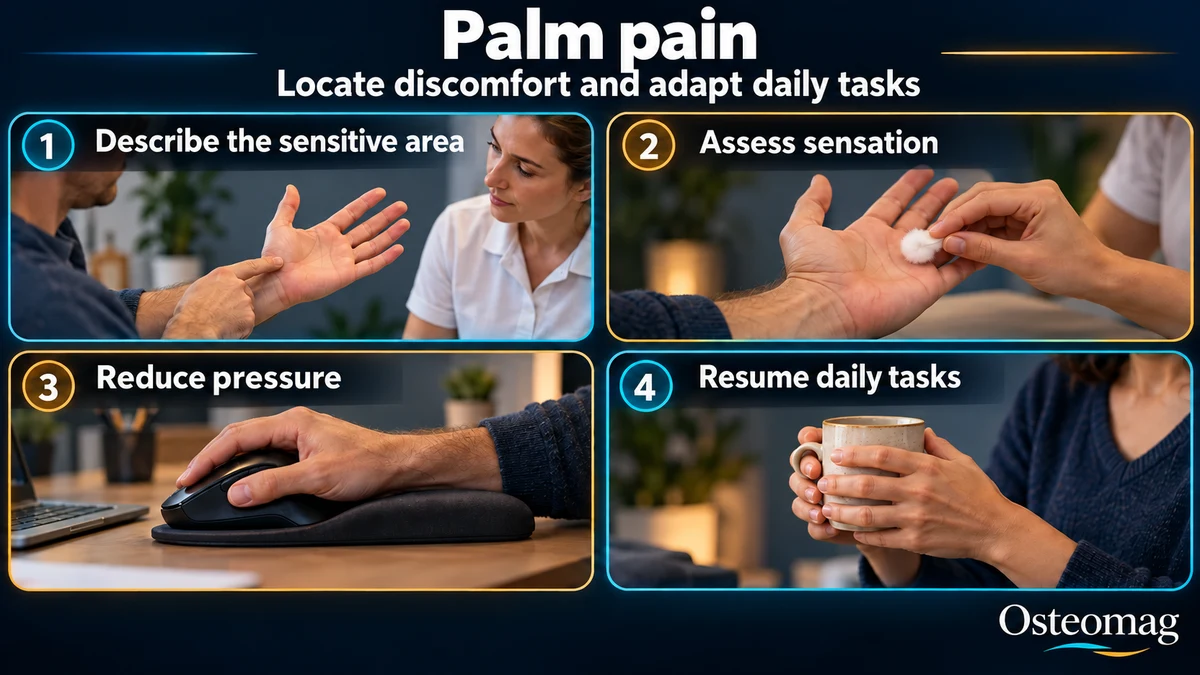
The examination compares sensations in several areas of the hand using controlled, non-aggressive contact. Monofilaments can help assess skin sensation. The practitioner also observes the scar, swelling, mobility, and motor function. Comparing sides provides context, but differences must be interpreted in light of anatomical variations and the person’s history.[5]
Gently tapping over a nerve can sometimes reproduce tingling, known as a Tinel sign. This sign remains one clue among others; by itself, it does not confirm which nerve is responsible. There is no benefit in repeatedly and forcefully performing this test at home on an irritable area. Similarly, pain reproduced by pressure does not automatically distinguish between a nerve, tendon, and scar.
Ultrasound and nerve conduction studies
High-resolution ultrasound can trace this small branch and look for abnormalities in its course, thickness, or continuity. A 2008 study involving volunteers and patients with sensory symptoms demonstrated its usefulness, although it did not detect an abnormality in every case. A normal examination therefore does not systematically rule out neuropathy. The quality of visualization depends in particular on the size of the nerve and the operator’s experience.[2]
A 2019 study identified the course of the branch in thirty healthy volunteers. It illustrates the possibility of locating it with ultrasound, but its measurements do not constitute universal diagnostic thresholds for patients with pain. The main clinical value is to answer a specific question and correlate any abnormality with the symptomatic territory.[3]
Nerve conduction studies assess nerve function. The protocol must be adapted to this branch; an examination focused solely on the carpal tunnel may not answer the question. Studies have described their use for injuries associated with carpal tunnel syndrome or following trauma. These tests are interpreted by a specialist in conjunction with the clinical examination because the small size of the branch and variations in its territory complicate the analysis.[4] [5] [6]
After surgery: not all pain has the same cause
After carpal tunnel release, “pillar” pain in the palm can make applying pressure uncomfortable. It affects the raised areas on either side of the operated region and does not, by itself, prove injury to the cutaneous branch. The team providing postoperative follow-up can distinguish this pain from scar hypersensitivity, neuropathy, or another problem. Any new loss of sensation should be reported.[11]
Severe pain accompanied by persistent changes in colour or temperature, swelling, or sweating also requires assessment. Among other causes, these signs may prompt investigation for complex regional pain syndrome. This diagnosis is based on a set of criteria and the exclusion of other explanations. It cannot be inferred from severe pain alone, but early recognition is helpful in arranging appropriate support.[12]
Adapting pressure and resuming useful tasks
An initial measure is to identify pressure points that irritate the area and temporarily modify them. A different handle, better distribution of pressure, or breaks can make a task easier. Protective equipment should not constrict the wrist or shift all the pressure to another sensitive area. Advice depends on the diagnosis and, after surgery, on the instructions provided by the surgical team.
Recovery is built around practical activities: holding a light cup, writing for a few minutes, or using an adapted tool. One element of difficulty is increased at a time, while monitoring the response during and after the activity. The goal is to restore use of the hand without straining a highly irritable area. A persistent sensory deficit or worsening symptoms require reassessment rather than simply continuing the exercises.
Desensitization must be carefully graded
In the presence of hypersensitivity, a hand therapist may suggest gradual exposure to tolerable contact and textures. The American Society for Surgery of the Hand describes this approach for certain hypersensitive hands. It should begin at an appropriate level, on sufficiently healed skin, and progress according to the response. It does not involve enduring severe pain or aggressively rubbing an irritated nerve.[10]
General information on desensitization does not prove the effectiveness of a single protocol for this specific neuropathy. Follow-up primarily assesses tolerated contact, hand use, and changes in symptoms. If a nerve injury or persistent compression is suspected, rehabilitation is not a substitute for specialist advice.
When a surgical opinion may be helpful
A hand specialist may discuss surgery when a corresponding injury or neuroma has been identified and the symptoms remain significant. The possible procedures depend on the mechanism and the continuity of the nerve. A small, older case series reports the treatment of seven neuromas of this branch; a 2024 study concerns various sensory neuromas of the upper limb. These data do not guarantee an individual outcome or support recommending the same operation for all palmar pain.[8] [9]
The discussion should take into account the expected benefits, possible sensory limitations, function, and uncertainties. Success reported in a selected case series is not a cure rate applicable to every patient. Diagnostic accuracy is therefore important before any invasive choice.
The role of osteopathy
The osteopath can help identify irritating tasks, support adaptations, and promote comfortable mobility, in collaboration with the team managing the hand. Touch can provide information about sensitivity, but it cannot by itself confirm the integrity of a small nerve branch. There is no robust clinical evidence that osteopathy repairs this branch or provides lasting treatment for a neuroma.
Considering the relationship between structure and function has a practical meaning here: knowing the anatomical course, understanding which activities are limited, and checking whether support actually improves hand use. It also requires recognizing a situation that goes beyond supportive care. The goal is more accessible function and greater independence, with appropriate referral when necessary.
Seek prompt assessment
New loss of sensation after an injury, severe pain, deformity, inability to hold an object, or a hand that changes color requires prompt assessment. A very hot and swollen area accompanied by fever should also be examined. Progressive weakness or persistent symptoms warrant appropriate medical advice.[13]
Scientific references
- [1] Smith and Ebraheim. Anatomy of the palmar cutaneous branch of the median nerve: A review. 2019.
- [2] High-resolution sonography of the palmar cutaneous branch of the median nerve. 2008.
- [3] Jeong et al. Risk Assessment of Injury to Palmar Cutaneous Branch of the Median Nerve Using High-Resolution Ultrasound. 2019.
- [4] Pardal-Fernández et al. Posttraumatic neuropathy of the palmar cutaneous branch of the median nerve: four cases. 2011.
- [5] Wada et al. Entrapment neuropathy of the palmar cutaneous branch of the median nerve concomitant with carpal tunnel syndrome. 2002.
- [6] Imai et al. Entrapment neuropathy of the palmar cutaneous branch of the median nerve in carpal tunnel syndrome. 2004.
- [7] Is Palmar Cutaneous Branch of the Median Nerve More Swollen in Carpal Tunnel Syndrome? 2021.
- [8] Nerve stripping: new treatment for neuromas of the palmar cutaneous branch of the median nerve. 2000.
- [9] Outcomes of upper extremity sensory neuromas treated with excision and burial. 2024.
- [10] American Society for Surgery of the Hand. Hand Therapy for Hypersensitivity.
- [11] American Society for Surgery of the Hand. Pillar Pain After Carpal Tunnel Release.
- [12] NHS. Complex regional pain syndrome: symptoms.
- [13] NHS. Wrist pain: signs that warrant medical attention.