Understanding early influences without treating them as destiny
Pregnancy takes place in a real environment: housing, income, food, relationships, work, and access to care. These conditions can influence parental health and be associated with the child’s development. Recognizing these influences is useful for arranging support. It does not make it possible to predict a baby’s trajectory or read family history in their tissues.[2]
Research on prenatal stress and epigenetics describes possible mechanisms and associations, with significant uncertainties. A difficult period does not automatically establish an irreversible program. Findings must be interpreted according to the measurements, populations, and limitations of the studies. Clinical communication should help families take action without turning a concern during pregnancy into lifelong biological responsibility for the child.
The key point
Influence does not mean inevitability. Material support, relationships, and care have a concrete role. No manual examination can detect inherited fear or erase epigenetic programming.
Social determinants before birth
Socioeconomic hardship can involve several constraints: an inadequate food budget, unstable housing, transportation difficulties, demanding schedules, or exposure to violence. Their accumulation can limit rest and access to resources. These situations do not necessarily result from the pregnant person’s choices. Suggesting only that they relax more is reductive when the main causes are material or social.
The review by Herzberg and Smyser brings together research on maternal environments and neonatal brain development. Associations with socioeconomic disadvantage, stress, sleep, and mental health have been studied. The methods and dimensions measured differ. The imaging used in this research compares groups; it does not provide an individual reading of a child’s future abilities.[2]
Nielsen and colleagues observed an association between prenatal social disadvantage and functional connectivity at birth. This finding contributes to understanding when certain differences may emerge. It does not mean that every exposed baby has a brain injury or will inevitably develop a psychiatric disorder. A statistical difference in brain networks must not be translated into an individual diagnosis.[5]
Stress: several possible pathways
Stress triggers biological responses and can alter behaviours and living conditions: sleep, diet, activity, or availability for care. The placenta plays an active role in exchanges and their regulation. Fetal exposure is therefore not simply the unfiltered transmission of every parental emotion. Effects depend on the type and duration of the stressor and many other factors.[1]
Developmental origins of health models examine how early conditions contribute to later trajectories. These involve probabilistic influences and interactions. The same exposure does not produce the same outcome in every person. Experiences after birth continue to matter; the child is not locked into a response determined during pregnancy.
It is also important to distinguish an everyday stressful experience from intense or prolonged adversity. Studies do not all measure the same thing. Some use a one-time questionnaire, while others measure an accumulation of events or social indicators. Grouping these measures under a single concept of stress can create an impression of certainty that the data do not support.
What epigenetics does and does not show
Epigenetics concerns, among other things, the regulation of gene activity without changing the gene sequence. DNA methylation is a frequently studied marker. Its measurement depends on the tissue sampled and the cell populations present. A finding in cord blood or saliva does not directly describe every organ, and particularly not overall brain function.[1]
Drzymalla’s systematic review examines epigenomic studies of prenatal maternal mental health. It highlights the lack of consistent replication of findings across studies. This does not make biological mechanisms impossible; it limits the claims that can currently be made about specific signatures in infants. A newly identified association must be confirmed in other data.[3]
The 2026 publication by Murgatroyd and colleagues analyzes 3,928 dyads across three cohorts. It finds no significant association between their measure of prenatal stress and the gestational epigenetic age estimates studied. This finding concerns these measures and populations; it does not prove the absence of any effect of stress. However, it argues against the idea of an easily measurable universal imprint.[4]
Intergenerational and transgenerational
During pregnancy, the pregnant person and the fetus are directly exposed to the same context. The cells that will contribute to the next generation may also be present in the fetus. Observing an effect in a descendant is therefore not enough to demonstrate transmission independent of direct exposure. Transgenerational claims require more rigorous evidence.[6]
Families transmit resources, living conditions, habits, and relationships, in addition to genetic factors. These pathways must be disentangled to establish an inherited epigenetic mechanism. In humans, this is particularly difficult to demonstrate. It cannot be concluded that fear or poverty is written into the genes and detectable through touch.[6]
A table for interpreting research
| Observation | What it can contribute | What it does not demonstrate |
|---|---|---|
| Association with socioeconomic hardship | Identify a need for support | A fixed individual destiny |
| Difference in brain connectivity | Study development in groups | A diagnosis for every baby |
| Difference in methylation | Explore a biological marker | An emotion stored in tissues |
| Effect across generations | Examine multiple transmission pathways | Automatic proof of epigenetic inheritance |
| Calming during skin-to-skin contact | A benefit of appropriate parental contact | The effectiveness of osteopathic treatment |
| Unusual muscle tone or posture | A clinical sign to investigate | A reading of the family’s emotional history |

A baby’s behaviours are not an emotional code
An infant communicates through crying, movements, gaze, and feeding. These behaviours should be observed, but they do not have a single psychological explanation. Significant crying can occur in a healthy baby or accompany a problem that needs investigation. A parent’s difficulty soothing their child is not proof of an insufficient bond.[11]
A preference for turning the head in one direction, cranial asymmetry, or feeding difficulty requires an appropriate assessment. It is not justified to interpret these as maternal fear, a birth memory, or a transmitted conflict. This interpretation can divert attention from a genuine clinical indication and add guilt. Observation should describe the facts before hypotheses are developed.
Co-regulation and parental contact
Infants depend on adults for much of their care and soothing. Responding to their cues, offering appropriate closeness, and seeking help when caregiving becomes difficult are concrete actions. This co-regulation does not require a parent to be calm or perfectly available at all times. Respite and the presence of other adults can support the family.
The Canadian Paediatric Society recommends skin-to-skin contact under appropriate conditions. Evidence concerns human milk feeding, physiological stability, and thermoregulation, among other outcomes. The practice must be safe, with an awake adult and positioning that keeps the airway clear. Prematurity or special care situations require adaptations by the care team.[7]
Parental skin-to-skin contact is not equivalent to an osteopathic intervention. Its outcomes cannot be used as evidence that all therapeutic touch reprograms the nervous system. A pleasant experience deserves to be recognized for what it provides without attributing a comprehensive biological correction to it. Safety and the child’s responses remain the priorities.
Touch: observe and respect boundaries
Parental consent is necessary, and the child must be observed throughout the contact. Increased crying, agitation, or a change in breathing calls for stopping and reassessing. A session should not seek to overcome resistance at all costs. The parent must be able to remain present, decline a proposal, or stop at any time.
The description of a technique and its purpose must remain understandable. An intervention intended for comfort should not become a purported treatment for family inheritance. Concrete indicators, such as tolerance of a position or ease of movement, are preferable to a supposed reading of the vagus nerve or epigenome.
Pediatric osteopathy: uncertain outcomes
Franke’s 2022 review includes 47 trials covering numerous pediatric conditions. It reports favourable findings for some comparisons, but no high-quality evidence for any condition. Several indications were examined in only a very small number of studies. This diversity limits the generalization of an average benefit to every infant.[8]
Posadzki’s review from the same year concludes that the evidence in the analyzed trials was low or very low and finds no clear effect on the length of hospitalization of preterm infants compared with usual care. Differences between reviews require critical appraisal. They do not support promises of neurological maturation, prevention of future disorders, or erasure of prenatal stress.[9]
Any potential contribution to musculoskeletal comfort remains complementary and should have a proportionate objective. In cases of torticollis, feeding difficulties, or developmental concerns, the appropriate professionals should be consulted. Osteopathy does not replace pediatric follow-up or indicated rehabilitation. It does not provide a diagnosis of generational stress.
Addressing social needs
Vousden’s umbrella review examines interventions during pregnancy in high-income countries. Some home-based, psychosocial, or interdisciplinary approaches show potential benefits, with persistent gaps. Upstream factors, including finances and housing, remain essential. The response cannot be reduced to a body-based technique.[10]
Useful support often begins with a practical question: what makes daily life difficult? It may involve transportation to appointments, food, safe housing, or a lack of support. Referring people to available resources and facilitating access to them is more direct than asking the body to better tolerate the constraints. The needs expressed by the family guide the priorities.
Support should respect confidentiality and avoid judgment. A person may not wish to recount every hardship they have experienced. They do not have to provide a trauma history for their pain or fatigue to be acknowledged. Care and resources can be offered with their consent, taking practical and cultural barriers into account.
When to seek prompt medical attention
A fever in an infant under three months of age requires urgent assessment, even if the infant appears relatively well. Breathing difficulties, bluish discoloration, or reduced responsiveness also require immediate help. These signs should not be attributed to family stress or left to wait until a manual therapy session.[12]
Refusal to drink, unusual vomiting, poor weight gain, or a marked change in behavior warrants appropriate medical attention. If the crying becomes unbearable for the adult, placing the baby somewhere safe and asking someone to take over can prevent a dangerous situation. Never shake the baby. Asking for help is a protective measure, not a parenting failure.[11]
Key takeaways
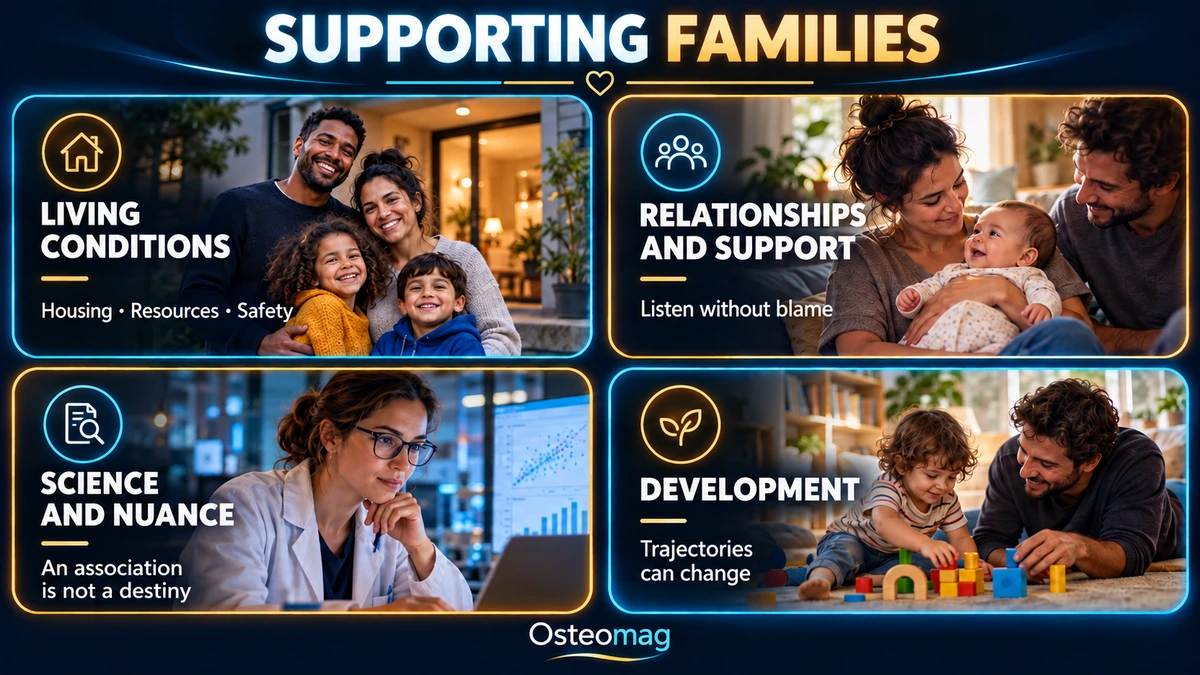
Prenatal and social influences deserve attention, but they do not determine a child’s fate. Supporting living conditions, relationships, and care provides tangible opportunities. Current evidence does not support any promise of epigenetic reprogramming through osteopathy.
Scientific references and resources
- [1] Dieckmann and Czamara (2024). Epigenetics of prenatal stress in humans.
- [2] Herzberg and Smyser (2024). Prenatal social determinants of health and neonatal brain development.
- [3] Drzymalla et al. (2023). Prenatal maternal mental health and infant epigenetic profiles: systematic review.
- [4] Murgatroyd et al. (2026). Prenatal stress and gestational epigenetic age: multicohort study.
- [5] Nielsen et al. (2024). Prenatal social disadvantage and functional networks at birth.
- [6] Heard and Martienssen (2014). Transgenerational epigenetic inheritance: myths and mechanisms.
- [7] Altit et al. (2024). Skin-to-skin care for term and preterm infants.
- [8] Franke et al. (2022). Osteopathic treatment for pediatric conditions: systematic review.
- [9] Posadzki et al. (2022). Pediatric osteopathic treatment: systematic review and meta-analysis.
- [10] Vousden et al. (2025). Interventions to reduce inequalities during pregnancy: umbrella review.
- [11] Canadian Paediatric Society. Colic and crying.
- [12] Canadian Paediatric Society (updated 2026). Febrile infants 90 days of age or younger.