


Distinguishing between tendon, joint, and nerve problems to tailor movements and rehabilitation
Pain on the little-finger side of the wrist can make using a mouse or keyboard, opening a jar, or carrying a bag difficult. The proximity of several tendons, bones, joints, and nerves makes this region difficult to interpret without an examination. Immediately calling it “keyboard-induced tendinitis” may obscure another cause and lead to an unsuitable exercise. A good starting point is to determine where, when, and how the pain occurs. [2] [3]
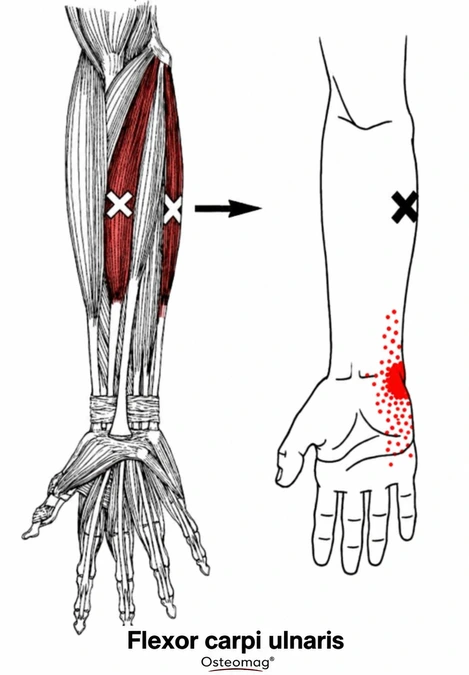
The flexor carpi ulnaris, sometimes called the anterior ulnar muscle, is one of the structures to consider. It helps flex the wrist and bend it toward the little finger; its tendon attaches to the pisiform. This muscle does not directly flex the fingers. Pain when gripping may therefore involve several structures and is not, on its own, enough to attribute the symptoms to this muscle. [1]
Understanding the region without self-diagnosing
The pisiform is a small bone that can be felt at the base of the palm on the ulnar side. The flexor carpi ulnaris tendon is located in this area, near other sensitive tissues. Localized pain may be related to a tendon injury, a problem with the pisotriquetral joint, or, following trauma, a bone injury. Ultrasound can help clarify certain conditions when clinically warranted; it does not replace the medical history and examination. [10]
Other causes are possible on the back and side of the wrist, including a problem with the extensor carpi ulnaris tendon or the triangular fibrocartilage complex, often abbreviated as TFCC. Neurological symptoms may involve the ulnar nerve. Clinical reviews recommend organizing the diagnosis according to location, triggering movements, examination findings, and circumstances. A list of possible conditions is not an invitation to choose the most alarming one. [2] [3]

Pain, tingling, and loss of strength are not equivalent
Pain when pressing on a specific point provides different information from numbness in certain fingers. Carpal tunnel syndrome primarily involves the median nerve and is not a general explanation for all ulnar-sided pain. Difficulty holding an object may result from pain, but also from a neurological deficit or another limitation. The clinician seeks to distinguish between these situations before discussing strengthening.
Provocative tests have limitations. A prospective study of ulnar-sided wrist pain illustrates the difficulty of associating an isolated sign with a specific diagnosis. Several structures may produce a similar painful response. It is therefore preferable to let the professional choose and interpret the tests rather than repeatedly performing compression and twisting tests at home in an attempt to name the injury. [4]

Is the keyboard responsible?
Computer work may coincide with symptoms, but this coincidence does not establish the exact cause. The duration, task variation, grip force on the mouse, support surfaces, equipment, and activities performed outside work must be examined. Pain that began after a workstation change warrants analysis, without automatically attributing every painful tendon to keyboard use.
The review of associations between computer work and neck and upper-limb symptoms brings together studies with differing exposures and methods. Much of the data reflects older technologies. These findings cannot be used to determine an individual threshold for minutes of keyboard use or to claim that a modern computer necessarily causes flexor carpi ulnaris tendinopathy. Symptoms, function, and the actual task remain essential. [5]
The review of occupational risk factors for carpal tunnel syndrome particularly emphasizes the importance of certain exposures combining force and repetition. Its findings should not be extrapolated indiscriminately to all wrist pain or used to consider computer use protective in every case. A neurological condition and tendon pain are different issues, with their own examinations and strategies. [6]
Preparing for a useful assessment
It is helpful to point to the painful spot with one finger, describe the troublesome movement, and explain how the pain changes throughout the day. Did it begin after a fall, a twist, an unusual load, or a return to sports? Does the pain occur at rest, when bearing weight, or while rotating the forearm? Swelling, snapping, or a change in sensation also provides useful information. A photograph of intermittent swelling may help if one is available without excessive monitoring.
The examination may include wrist and forearm mobility, appropriate tendon-loading tests, palpation, and a neurological examination. The professional also checks whether the symptoms could originate in the neck or another region. The aim is to relate the findings to the difficulty experienced, such as turning a key or using the mouse, rather than diagnosing solely on the basis of a tender area. [2] [3]
When to seek prompt medical attention
After a fall, deformity, severe pain, or an inability to use the hand warrants prompt assessment. An initial X-ray does not always answer every question: persistent symptoms after trauma may require reassessment. A cold or pale hand, significant new weakness, progressive loss of sensation, or a very red and swollen area accompanied by fever also requires appropriate care without waiting to try a series of comfort measures.
| Symptom | What needs to be distinguished | Useful next step |
|---|---|---|
| Pain near the pisiform | Tendon, joint, or another injury | Local examination guided by the history. |
| Pain during rotation or weight-bearing | Several possible ulnar-sided structures | Avoid repeated self-testing and clarify the diagnosis. |
| Tingling or weakness | Possible nerve involvement | Neurological examination and appropriate reassessment. |
| Severe pain after a fall | Fracture or another acute injury | Prompt assessment. |
Clinical guidance — Osteomag. This table is not a substitute for an individual assessment.
The situations in the table are intended to support triage and discussion. They cannot reliably distinguish a tendon from a joint remotely. If function deteriorates despite a reasonable reduction in strain, or if symptoms return without a clear explanation, the initial hypothesis should be reconsidered. Continuing a painful routine because it matches the presumed name of the injury may delay more appropriate support.
Adapting the workstation through practical trials
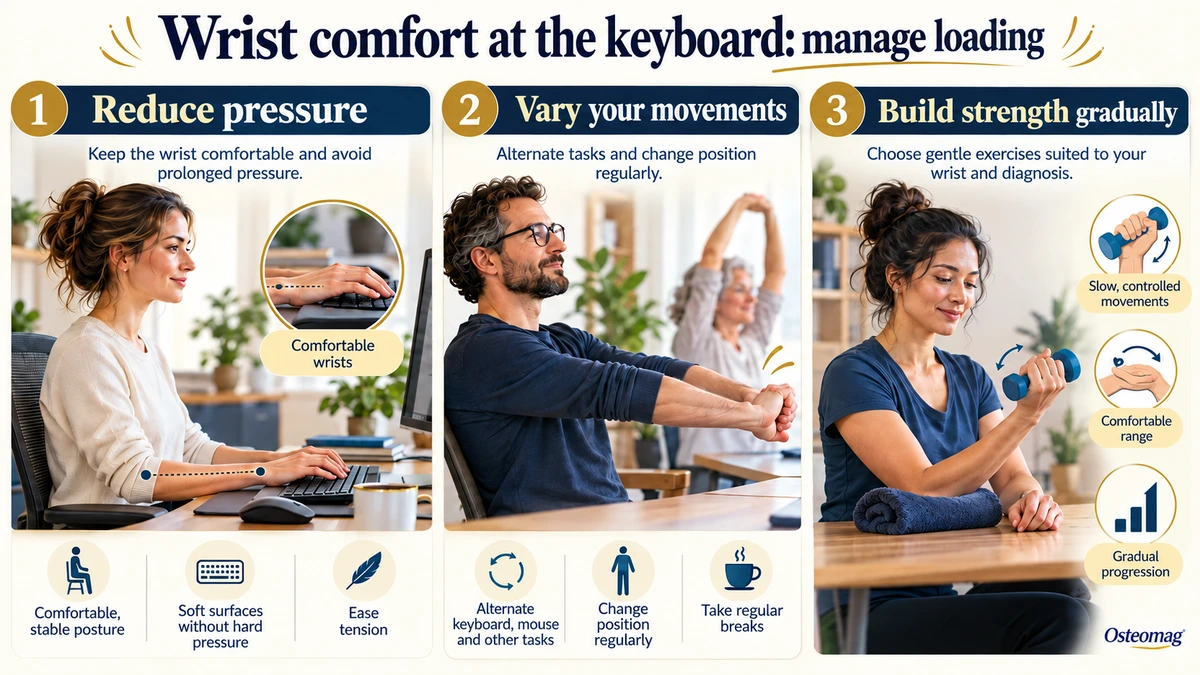
Start by identifying movements that require avoidable effort: a mouse positioned too far away, an object that is difficult to grasp, a hard edge beneath the palm, or a keyboard that forces an uncomfortable position. Bringing equipment closer, providing comfortable forearm support, or varying input methods are possible options to try. The goal is to reduce perceived strain without holding the hand in one supposedly perfect position for hours.
An accessory may help one person and hinder another. Hand size, type of work, and the need for precision all matter. Before making a purchase, a simple, reversible change can often be used to test a hypothesis: mouse placement, pointer sensitivity, keyboard shortcuts, or task rotation. Its effect on the painful area and the possible onset of discomfort elsewhere, particularly in the shoulder, should be assessed.
What ergonomic trials show
A trial involving computer operators studied, among other things, a forearm support combined with ergonomic training, with favourable results for certain upper-limb symptoms and disorders. This specific context does not establish that an identical support is suitable for every occupation or treats a flexor carpi ulnaris injury. Above all, it demonstrates the value of evaluating a defined intervention using clinical criteria. [8]
Another trial of postural advice did not demonstrate the expected reduction in symptoms. The Cochrane review describes the evidence as variable or uncertain depending on the intervention, including certain breaks and adaptations. These findings support testing changes and monitoring their usefulness rather than promoting a posture or piece of equipment as a universal solution. Methodologically limited trials also do not prove that no adaptation can help an individual. [7] [9]
Reducing aggravation without immobilizing everyday life
While awaiting further guidance, temporarily reducing the most aggravating movement may be helpful. This may mean breaking a task into shorter intervals, using both hands to handle an object, or changing the grip. The strategy depends on the suspected cause: after trauma or in the presence of a deficit, the professional’s instructions take priority. Any protective measure should have a purpose and a timeframe for reassessment rather than automatically becoming a permanent solution.
Continuing tolerable activities helps preserve confidence and function. This does not mean pushing through severe pain or systematically avoiding every wrist movement. For a specific activity, an easier version can be compared with the usual version, followed by observation of recovery. If an adaptation reduces pain but makes the task impractical, a compromise should be sought with the people concerned.
Building an individualized progression
Once the clinical hypothesis has been sufficiently clarified, rehabilitation may include gentle mobility exercises followed by gradually increased loading selected according to the tendon or function involved. Resistance, range of motion, and frequency are adjusted based on the person’s response. Squeezing a ball is not a neutral exercise: gripping may increase the load on several structures and aggravate certain types of pain. It should therefore not be prescribed for every painful wrist.
Progression benefits from using a target activity: holding a cup, turning a handle, or working for an appropriate length of time. Ease of performance and changes after the activity can be recorded, rather than constantly trying to provoke pain to confirm that it is present. Lasting worsening, new swelling, or neurological signs require the plan to be adjusted and reassessed. Recovery does not always follow a steady course.
Role and limitations of osteopathic care
Support can contribute to movement analysis, education, and comfort strategies compatible with the diagnosis. Gentle soft-tissue care, if indicated and well tolerated, should aim for an observable functional improvement. It does not prove tendon healing and does not replace assessment for a fracture, instability, nerve injury, or another condition requiring specific management.
The choice of care should be discussed with the person and remain within the practitioner’s scope of practice. General evidence on ergonomics or ulnar-sided pain does not constitute proof of the specific effectiveness of osteopathy for flexor carpi ulnaris tendinopathy. The consultation should therefore avoid promises of a definitive correction and, when necessary, be integrated into coordinated care with the professionals responsible for assessment and rehabilitation.
Checking the progress that matters
Follow-up can focus on two or three simple indicators: performing a given task, using the hand more easily, and recovering after an appropriate period of work. It is also important to check whether workstation changes continue to be applied daily. A temporary improvement during the consultation is not enough to conclude that all contributing demands have been addressed. A meaningful outcome is better-tolerated capacity in real-life activities.
If symptoms persist, returning to the initial questions can help: is the location the same, does the diagnosis remain plausible, and has the exposure changed? A new stage of examination or investigation may be more relevant than adding identical exercises. Acknowledging this uncertainty helps protect the hand, limit unnecessary advice, and develop an appropriate return to work and personal activities.
References
- [1] Musculo-tendinous junction of the flexor carpi ulnaris muscle. An anatomical study. 2001.
- [2] Ulnar-Sided Wrist Pain: Systematic Clinical Approach and Principles of Treatment. 2025.
- [3] Clinical and Radiographic Evaluation of Ulnar-Sided Wrist Pain. 2022.
- [4] Ulnar-sided wrist pain: a prospective analysis of diagnostic clinical tests. 2021.
- [5] Associations of screen work with neck and upper extremity symptoms: a systematic review with meta-analysis. 2019.
- [6] Work-relatedness of carpal tunnel syndrome: systematic review including meta-analysis and GRADE. 2022.
- [7] Ergonomic interventions for preventing work-related musculoskeletal disorders of the upper limb and neck among office workers. Cochrane, 2018.
- [8] A randomised controlled trial evaluating the effects of two workstation interventions on upper body pain and incident musculoskeletal disorders among computer operators. 2006.
- [9] A randomised controlled trial of postural interventions for prevention of musculoskeletal symptoms among computer users. 2005.
- [10] Enthesiopathy of the flexor carpi ulnaris at the pisiform: findings of high-frequency sonography. 2010.


