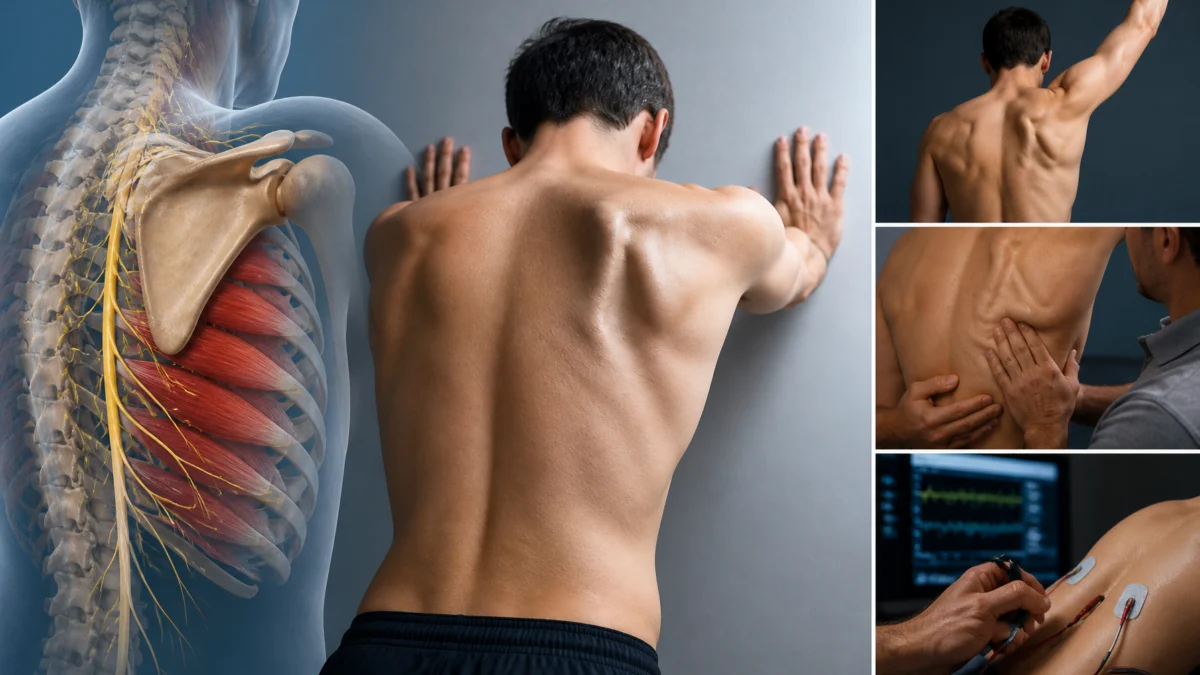
A shoulder blade that clearly lifts away from the rib cage when a person pushes against a wall is not always a simple posture problem. One important, although uncommon, cause is palsy or neuropathy of the long thoracic nerve. This nerve supplies the serratus anterior, a muscle essential for holding the scapula against the thorax and rotating it upward during arm elevation.
When the serratus anterior becomes weak, the medial border of the scapula can protrude: this is scapular winging. The patient may have difficulty raising the arm, pushing, carrying, or sustaining overhead activity. Some also report fatigue, pain around the scapula, and reduced power.
For the osteopath, this matters because the presentation can resemble ordinary scapular dyskinesis. True long thoracic nerve injury, however, is a neuropathy and requires accurate diagnosis, often with electromyography and sometimes ultrasound or MRI. Manipulation does not instantly restore a denervated nerve.
Anatomy of the Long Thoracic Nerve
The long thoracic nerve arises mainly from C5, C6, and C7. It descends along the lateral chest wall and supplies the serratus anterior at several levels.
Its long and relatively superficial course exposes it to traction, trauma, surgery, and some inflammatory neuropathies.
The serratus anterior contributes to:
- holding the scapula against the chest wall;
- scapular protraction;
- upward rotation during arm elevation;
- stabilizing the shoulder girdle during pushing and sport.
What Does Scapular Winging Look Like?
With serratus anterior dysfunction, the medial border and inferior angle of the scapula become more prominent, especially during a wall push or arm elevation.
The deformity may be subtle at rest and obvious during effort.
The patient may compensate by shrugging or leaning the trunk to help elevate the arm.
What Can Cause It?
Long thoracic neuropathy can occur after:
- trauma;
- repetitive movement or intense effort;
- thoracic, breast, or axillary surgery;
- prolonged load carrying;
- sport;
- neuralgic amyotrophy or Parsonage-Turner syndrome;
- an idiopathic episode.
A 2023 review emphasizes that natural history is not as uniformly favourable as was once believed: some patients recover spontaneously, while others retain weakness, fatigue, and residual winging [1].
Can Sport Cause Long Thoracic Neuropathy?
Cases have been described after weight training, throwing, swimming, racket sports, or carrying heavy bags. Mechanisms may involve repetitive traction, compression, or inflammation.
But altered scapular motion in an athlete does not automatically mean nerve injury. Scapular dyskinesis without neuropathy is much more common.
Differential Diagnosis: Scapular Dyskinesis
Scapular dyskinesis describes altered scapular movement without identifying the cause. It can occur with shoulder pain, muscle weakness, fatigue, or motor strategy.
The key difference is that long thoracic neuropathy causes serratus anterior weakness that can be documented electrophysiologically.
Differential Diagnosis: Spinal Accessory Nerve
Spinal accessory nerve injury weakens the trapezius and can also cause winging, but the pattern differs. The shoulder may droop, winging can become more obvious during abduction, and trapezius weakness is apparent.
The examination should therefore compare serratus anterior and trapezius function.
Differential Diagnosis: Dorsal Scapular Nerve
The dorsal scapular nerve mainly supplies the rhomboids. Its injury can produce subtler winging and weak retraction.
Marked medial winging during a wall push is more suggestive of serratus anterior dysfunction.
Differential Diagnosis: Shoulder Disease
A rotator-cuff tear, severe pain, or glenohumeral stiffness can alter scapular motion without neuropathy.
A complete shoulder examination is therefore necessary.
How Is the Diagnosis Confirmed?
Clinical examination observes scapular movement, pushing strength, and arm-elevation ability.
Electromyography of the serratus anterior is often used to confirm denervation and follow recovery.
High-resolution ultrasound is also becoming more useful. A recent technical publication describes ultrasound evaluation of the long thoracic nerve and image-guided approaches in neuropathy [2].
Muscle Imaging
MRI can show denervation edema and, in chronic cases, fatty atrophy of the serratus anterior.
It may also help investigate another pain source or a brachial-plexus disorder.
How Long Should Recovery Be Observed?
Historically, it was often taught that most patients would recover spontaneously within two years. Modern data qualify that assumption [1].
Recovery can be slow because a peripheral nerve must reinnervate the muscle and the muscle must then regain strength and endurance.
Clinical follow-up should therefore be regular, especially when the deficit is substantial.
Conservative Treatment
Initial management often includes:
- activity modification;
- maintaining shoulder mobility;
- progressive serratus anterior work when activation is possible;
- strengthening other scapular stabilizers;
- limiting painful compensations;
- functional rehabilitation.
A severely denervated muscle should not be abruptly overloaded.
Serratus Anterior Exercises
Depending on capacity, progression can include:
- light supine protraction;
- wall slides;
- wall push-up plus;
- quadruped work;
- light resisted elevation;
- more demanding pushing as strength returns.
Movement quality matters more than the raw number of repetitions.
The Role of Osteopathy
An osteopath can help preserve thoracic, cervical, and glenohumeral mobility, reduce some secondary pain, and guide movement that limits compensation.
Neurological winging is not corrected by “putting the shoulder blade back.”
Treatment should be centred on function and nerve recovery.
Should the Scapula Be Manipulated?
Gentle scapular mobilization may improve comfort or facilitate movement. It does not restore serratus anterior innervation.
If strength is declining or winging is progressing, neurological assessment takes priority.
Bracing or Taping
A scapular support or selected taping may temporarily improve comfort or mechanics during activity.
These strategies do not heal the nerve but may be useful during recovery.
When Is Surgery Considered?
In some patients with persistent winging and substantial functional limitation, nerve decompression, nerve transfer, or tendon transfer may be discussed.
The review by Wu and Ng reports that some centres have achieved good results with decompression even after more than twelve months in selected cases [1].
These are specialist decisions based on cause, EMG findings, and evolution.
Parsonage-Turner Syndrome and the Long Thoracic Nerve
Neuralgic amyotrophy is an important cause. It can produce very severe shoulder pain followed days or weeks later by serratus anterior weakness.
In that context, management differs from a simple traumatic compression and may require specific neurological follow-up.
Red Flags
Medical referral is especially important when:
- weakness progresses rapidly;
- several muscles or nerves are involved;
- breathing becomes difficult;
- winging appears after surgery;
- a mass or major trauma is suspected;
- there is no evidence of recovery.
Phrenic-nerve involvement with neuralgic amyotrophy is rare but can cause shortness of breath.
Useful Retesting
Follow-up measures can include:
- active arm elevation;
- prominence of the medial scapular border during a push;
- push-up-plus endurance;
- functional pushing strength;
- fatigue during overhead activity.
These provide a better picture of recovery than static observation alone.
What Osteopathy Cannot Claim
It cannot reinnervate the serratus anterior through manipulation, determine the exact level of nerve injury by palpation, or replace EMG when a true deficit is present.
It can contribute to mobility, comfort, scapular control, and appropriate referral.
Conclusion
Long thoracic nerve palsy is an important cause of scapular winging. The sign often becomes obvious when the patient pushes against a wall or attempts to elevate the arm.
Diagnosis requires distinguishing neuropathy from ordinary scapular dyskinesis, spinal accessory nerve injury, and shoulder disease.
For the osteopath, the best strategy is not to reduce the problem to a scapula that is “out of place.” Function should be preserved, recovery supported, and a neurological deficit investigated appropriately.
Why Shoulder Function May Remain Limited Even as the Nerve Recovers
Nerve recovery is only one part of the process. After months of winging, the patient may have lost endurance, avoided certain movements, and developed compensations through the trapezius, neck, or trunk. Even when EMG shows reinnervation, the serratus anterior must regain the ability to work for long periods and coordinate the scapula with the arm.
Rehabilitation should therefore continue beyond the first return of strength. For an athlete or overhead worker, the final goal is repeated activity without excessive fatigue, not simply one successful arm elevation.
References
- Wu F, Ng CY. Long Thoracic Nerve Palsy: When Is Decompression Indicated. J Hand Surg Glob Online. 2023. PMID:37521538. PMCID:PMC10382883.
- Ultrasound evaluation and ultrasound-guided injection in long thoracic nerve neuropathy: a technical approach. 2026. PMID:42570153.
- Ng CY, Wu F. Scapular winging secondary to serratus anterior dysfunction: analysis of clinical presentations and etiology in a consecutive series of 96 patients. J Shoulder Elbow Surg. 2021;30(10):2336-2343.