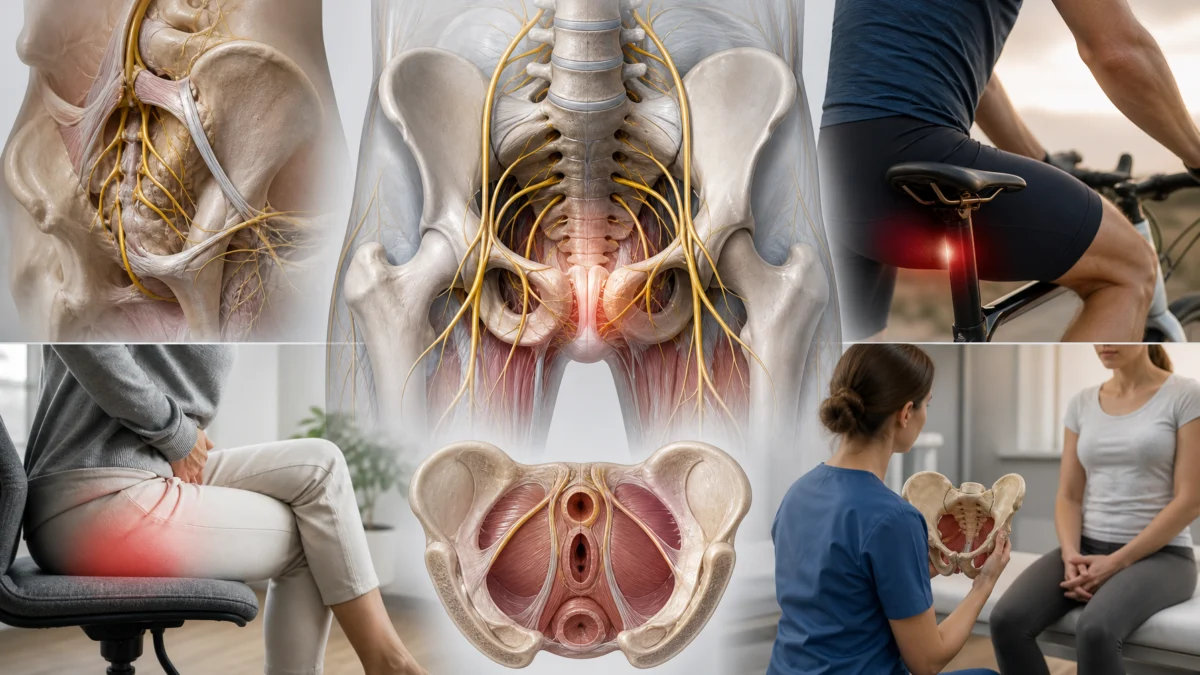
Pain when sitting: recognizing the signs without jumping to conclusions about nerve compression
Aburning sensation in the perineum, genital pain, or a feeling of a foreign body can make sitting difficult. When these symptoms persist, they can sometimes disrupt work, travel, sleep, and intimacy. The pudendal nerve is one of the structures to consider, but not all perineal pain is pudendal neuralgia.
The helpful approach is to describe the symptoms precisely, investigate other possible causes, and recognize situations requiring medical evaluation. Pain cannot be attributed to a nerve simply because it occurs in its distribution area.
Osteopathy can support certain muscular and associated functional difficulties. It cannot, however, confirm nerve entrapment manually or guarantee its correction. Treatment is based on a medical evaluation and, depending on the needs, collaboration with pelvic physiotherapy and pain management specialists. [1–3] PubMed
Anatomy: Where does the pudendal nerve pass?
The pudendal nerve originates primarily from the sacral nerve roots S2, S3, and S4. It exits the pelvis through the greater sciatic foramen, passes near the ischial spine and the sacrospinous ligament, and then returns to the perineum through the lesser sciatic foramen. Part of its course continues within the pudendal canal, also known as Alcock’s canal.
Its main branches include the inferior rectal nerve, the perineal nerve, and the dorsal nerve of the clitoris or penis. They contribute to perineal and genital sensation, as well as the control of perineal muscles and external sphincters.
The pudendal nerve is primarily a sensory and motor somatic nerve . These functions must be distinguished from the pelvic autonomic pathways, which are involved in the functioning of the viscera. Therefore, urinary or sexual difficulties alone are insufficient to localize pudendal nerve involvement.
The proximity of the nerve, ligaments, and muscles explains several hypotheses of irritation. However, it does not demonstrate that a nerve is compressed in a given individual. [3,4] PubMed
What symptoms might suggest pudendal neuralgia?
The pain may be located in the area between the anus and the external genitalia. It is sometimes described as burning, shooting, hypersensitivity, or deep discomfort. Some people report a sensation of rectal pressure or a foreign body.
Worsening pain when sitting is an important factor. The pain may lessen when the person stands or lies down. However, this behavior alone is insufficient to confirm nerve damage: pain in the coccyx or pelvic floor can also make sitting painful.
Symptoms can appear after a period of cycling, pelvic surgery, or childbirth. Their chronology aids in assessment, but does not automatically establish a causal link. Pain can also develop without a clearly identifiable triggering event.
It is helpful to note the location, triggering activities, duration of sitting, and changes in sensitivity. This information is more valuable than a series of self-tests or repeated pressure on a painful area. [3,5] PubMed
The Nantes criteria: a clinical framework to be interpreted
The Nantes criteria were proposed to help identify pudendal neuralgia related to suspected spinal obstruction. The five essential criteria are:
- pain located in the territory of the pudendal nerve;
- pain mainly aggravated by sitting;
- pain that does not wake the patient at night;
- the absence of objective sensory deficit on examination;
- relief after an anesthetic block of the pudendal nerve.
These criteria must be interpreted together. They do not constitute a questionnaire for self-diagnosis. The absence of nighttime awakenings does not necessarily mean the absence of all discomfort during the night.
Similarly, subjective numbness must be distinguished from a loss of sensation objectively observed during examination. A sensory deficit requires broadening the range of possible diagnoses rather than ruling out this finding.
The original publication specifies that no single clinical sign or additional examination is, on its own, specific. Pain exclusively located in the coccyx, pubic area, or buttocks, in particular, should prompt a search for another explanation. [1] PubMed
When to seek medical help: distinguishing between an emergency and a medical appointment
An immediate assessment
New-onset urinary retention, recent loss of urinary or bowel control, saddle anesthesia, or progressive neurological weakness require urgent evaluation. These signs should not be automatically attributed to previously diagnosed pudendal neuralgia.
Unusual acute pain accompanied by fever, significant deterioration of general condition or occurring after trauma also requires rapid assessment adapted to the situation.
A consultation is necessary without waiting for the situation to worsen.
Persistent pain, unexplained bleeding, a lump, unintentional weight loss, or unusual nighttime symptoms warrant a medical consultation.
Even without these signs, pain that persistently limits sitting, work, or intimate life warrants a structured approach. It is not necessary to wait for extreme pain to seek medical help. Urinary, rectal, and genital symptoms should be described separately to guide further investigations. [4,5] pubmed.ncbi.nlm.nih.gov
What other causes should be investigated?
Perineal pain can originate from several tissues or diseases. Evaluation may investigate vulvodynia, dermatological conditions, infection, endometriosis, bladder pain syndrome, or chronic pelvic pain of a different origin.
Hyperactivity of the pelvic floor muscles can cause pain or accompany a nerve problem. Coccydynia is more often felt around the coccyx, while sacral nerve root involvement can present with other neurological signs. Some buttock pain also involves other nerves, particularly the cluneal nerves.
These possibilities can coexist. Finding a tender muscle does not rule out a medical condition; recognizing neuropathic characteristics does not prove isolation either.
The interview and examination guide the investigations toward the actual question being asked. The approach must avoid misinterpreting all pelvic pain as a pudendal problem. [6,7] PubMed
Clinical examination, imaging and diagnostic block
The doctor examines the distribution of symptoms, medical history, triggering factors, and any neurological signs. Depending on the presentation, a gynecological, urological, proctological, or neurological evaluation may be indicated.
MRI is used, in particular, to investigate certain alternative causes. Neurography and electrophysiological examinations can provide additional information, but their results do not systematically confirm or rule out pudendal neuralgia.
A targeted anesthetic block can aid in diagnostic reasoning. Its interpretation depends on the technique, the area actually anesthetized, and the observed response. Temporary relief does not demonstrate that definitive mechanical correction is necessary.
The diagnostic utility of a block must be distinguished from its effectiveness as a long-term treatment. Studies on infiltrations do not allow us to promise a prolonged benefit to every patient. [4,8] pubmed.ncbi.nlm.nih.gov
Pelvic floor and consent: a respectful assessment
A person experiencing pain may involuntarily contract their pelvic floor muscles as a protective mechanism. This reaction can perpetuate the discomfort, without necessarily being the initial cause.
A physiotherapist or a physiotherapist specializing in pelvic floor rehabilitation can assess coordination, sensation, and relaxation capacity. Systematic strengthening is not indicated when the primary problem is painful hyperactivity.
An internal examination is not automatically required. When offered, it must address a specific question, fall within the professional’s scope of practice, and be subject to explicit consent. The individual may refuse or discontinue the examination.
The possibilities for external evaluation and alternatives should be explained. Refusal of an intimate examination should never be interpreted as psychological resistance or a deliberate obstruction of recovery. [2,7] pubmed.ncbi.nlm.nih.gov
Rehabilitation: reducing constraints and regaining tolerance
The conservative strategy is built around genuinely limited activities. It may include adapting the seating position, temporarily reducing perineal pressure, and providing individualized pelvic support.
A cushion with a cutout can be tried if its use actually improves comfort. Observe the response rather than assuming that one model suits everyone. Alternating positions and breaking up sitting periods can be more helpful than trying to achieve a perfect posture.
For cycling, adjustments to the saddle, settings, and duration of rides can be discussed. Any activity that causes persistent numbness or lasting worsening should not be continued without reassessment.
The exercises may aim for comfortable breathing, improved coordination, and well-tolerated movements. They do not seek to overstretch a nerve or cause pain to “release” it. The recommendations are based in part on expert consensus; their effectiveness should be assessed individually. [2] pubmed.ncbi.nlm.nih.gov
| Situation | Objective | Cautious response |
|---|---|---|
| Sitting quickly becomes painful | Reduce prolonged pressure | Divide the seat and try a suitable support |
| Worsening after cycling | Identify the poorly tolerated load | Suspend or modify the activity, then reassess |
| Difficulty relaxing the perineum | Improve coordination | Pelvic physiotherapy assessment |
| Sustained growth after treatment | Avoid excessive stimulation | Reduce the intensity and review the strategy |
| New sphincter disorder or saddle anesthesia | Investigate for a neurological emergency | Immediate evaluation |
What is a realistic place for osteopathy?
Osteopathic care can address comfortable hip and spinal mobility, associated muscle tension, and difficulties encountered in daily activities. Any intervention must be consensual, proportionate, and compatible with other treatments.
A decrease in pain after a session does not prove that a nerve has been decompressed. It may correspond to a temporary change in comfort or tolerance to movement. Research on treatments for pudendal neuralgia does not allow us to conclude that a specific osteopathic approach cures the condition.
The practitioner does not make a medical diagnosis of obstruction. They identify concerning changes and recommend an evaluation when one is lacking or when the condition worsens.
Repeated deep pressure on a hypersensitive area should not be continued simply because it is supposed to treat the cause. The benefit is judged by useful function between sessions, not solely by immediate relief. [6,9] PubMed
Monitor progress and re-evaluate treatment options
Monitoring may focus on tolerated sitting time, walking, sleep, and the frequency of flare-ups. Goals should be chosen in consultation with the individual and remain compatible with their daily life.
A brief log allows you to note one change at a time. For example, gradually increasing a tolerated activity level provides more information than constantly monitoring every sensation. Improvement should remain compatible with acceptable recovery after exertion.
If the pain remains severely debilitating despite appropriate management, a specialist team can discuss other options. Surgery is reserved for selected patients; a randomized trial evaluated decompression in a specific context, which cannot be generalized to all perineal pain. [10] pubmed.ncbi.nlm.nih.gov
Recent meta-analyses highlight the heterogeneity and low quality of many intervention studies. Therefore, no treatment should be presented as universally superior. The priority remains careful explanation, functional goals, and reassessment when the trajectory is not favorable. [9] PubMed
References
- [1] Labat JJ et coll. Diagnostic criteria for pudendal neuralgia by pudendal nerve entrapment (Nantes criteria). Neurourology and Urodynamics. 2008. PubMed
- [2] Levesque A et coll. Recommendations on the management of pudendal nerve entrapment syndrome: A formalised expert consensus. European Journal of Pain. 2022;26:7–17. PubMed
- [3] Conic RRZ, Kaur P, Kohan LR. Pudendal Neuralgia: A Review of the Current Literature. 2025. PubMed
- [4] Ahmed M et coll. The Diagnosis and Management of Pudendal Neuralgia. Pain and Therapy. 2026;15:97–129. PubMed
- [5] National Health Service. Pudendal neuralgia. Information for the public. NHS
- [6] Diagnosis and treatment of pudendal and inferior cluneal nerve entrapment syndrome: a narrative review. PubMed
- [7] European Association of Urology. Guidelines on Chronic Pelvic Pain — Management. Recommandations
- [8] Labat JJ et coll. Adding corticosteroids to the pudendal nerve block for pudendal neuralgia: a randomised, double-blind, controlled trial. BJOG. 2017. PubMed
- [9] Andiman SE et coll. Impact of Treatment of Pudendal Neuralgia on Pain: A Systematic Review and Meta-Analysis. International Urogynecology Journal. 2025;36:35–58. PubMed
- [10] Robert R et coll. Decompression and transposition of the pudendal nerve in pudendal neuralgia: a randomized controlled trial and long-term evaluation. European Urology. 2005. PubMed