Orientation, startle and motor preparation: several rapid responses, not a hidden language
A noise sounds and the head turns. A movement seems uncertain and slows down. Breathing changes before a person can explain what worried them. We experience rapid bodily responses that sometimes precede a detailed conscious understanding of the situation.
In this text, the “body’s first movement” is an observation framework proposed by the author. It refers to attention to that initial response: orientation, interruption, a change in support, preparation or withdrawal. It is neither a single scientifically defined reflex nor a method for reading an emotion, personality or trauma in a posture. Experimental studies illuminate certain responses to threat without automatically validating an interpretation during a consultation. [1][2]
The body must be able to act before lengthy analysis
To avoid an obstacle, maintain balance or respond to a sudden event, the nervous system rapidly processes sensory information and prepares actions. Some of these adjustments do not wait for a conscious verbal decision. This does not mean that the body acts independently of the nervous system or possesses infallible knowledge of the situation.
Several phenomena must be distinguished. Orientation directs attention toward information. Startle is a rapid response to certain abrupt events. Withdrawal may move a region away from a potentially harmful stimulus. Anticipatory postural adjustments prepare for an action or an expected disturbance. These responses may combine, but do not necessarily form a fixed sequence in everyone. [1][4][5]
Tensing up is not always a problem
Muscle contraction makes action possible. It can support weight bearing, accompany a task or help limit a disturbance. Momentary stillness may also be part of an attentive response before action. The clinical goal therefore cannot be to eliminate all tension or obtain a constantly relaxed body.
Laboratory studies of avoidable threat have described combinations of heart-rate slowing, changes in gaze and electrocortical activity consistent with attentive preparation. [1] A 2026 study shows that several of these components vary according to threat intensity and the possibility of acting. The finding argues against an oversimplified interpretation in which one bodily sign reveals a single internal response. [9]
These experiments use controlled tasks and stimuli. They do not show that observing a shoulder or a breath alone can identify what is happening in a particular patient. Shallower breathing or interrupted movement can have many explanations.


Threat, balance and anticipation
A context perceived as riskier may change how a movement is prepared. Research on a postural disturbance compares different height conditions and observes altered muscle strategies. Changes concern anticipation and compensation, rather than simply “all the muscles tense up.” [4]
A study using a walking apparatus in healthy young adults shows that postural threat during learning can interfere with later abandonment of anticipation that has become inappropriate. [3] This is an interesting experimental example of a persisting strategy. It is not proof that a clinical posture is the memory of an old danger, or that manual care could erase that learning.
A review of spatial perception and possibilities for action found effects that varied with the nature of the threat. Findings were notably conflicting for some situations involving pain. [2] It is therefore preferable to speak of possible context-dependent responses rather than a universal protection program.
| Observed response | Useful question | What cannot be concluded from it alone |
|---|---|---|
| Rapid orientation | What information drew attention? | The presence of psychological trauma |
| Interruption or slowing | Pain, uncertainty, an instruction or difficulty? | A specific fear hidden in a tissue |
| A change in support | What goal or discomfort accompanies the movement? | Necessarily pathological asymmetry |
| A breathing change | What effort or sensation does the person report? | An autonomic disorder diagnosed by sight |
Pain can change movement without imposing a single pattern
A person in pain may move more slowly, reduce a range of motion, change recruitment order or use another region more. The model of motor adaptation to pain describes variable redistribution of activity and loading, not one pattern valid for everyone. [10] A strategy may help in the short term and become less suited to another task; this possibility should be examined, not presumed.
A meta-analysis of defensive reflexes found threshold differences between people in pain and controls, with a possible interpretation in terms of broader protection. [5] However, an average group result cannot diagnose the cause of an individual’s pain. During a consultation, observation is complemented by the history, examination and monitoring of function.
Breathing and fear: avoiding shortcuts
Breathing participates in action and responds to context. A change may reflect effort, an instruction, pain, anticipation or a medical condition. Saying “you briefly hold your breath during that movement” remains descriptive. Saying “your diaphragm contains an old fear” adds an interpretation that the observation does not demonstrate.
A conditioning experiment in healthy adults shows specific effects of learned fear on the perception of respiratory stimuli, different from findings for cutaneous stimuli. [6] This difference reminds us that one result cannot be indiscriminately extended to all sensations. It demonstrates neither emotional storage in breathing muscles nor efficacy of osteopathic treatment for fear.
New or significant breathlessness must be assessed in context. Noticing chest tension is insufficient to infer a psychological origin. Chest pain, faintness or acute breathing difficulty calls for an appropriate medical response.
Does uncertainty always increase pain?
One might expect an unpredictable situation automatically to intensify every pain. The data are less straightforward. A meta-analysis of 73 experimental studies in adult volunteers found no overall effect of unpredictability on pain perception, although some factors moderated results. Patient studies were insufficient to answer the question in the same way. [8]
Expectations and attention may play a role in some pain-modulation paradigms, with limited or conflicting results depending on conditions. [7] This does not mean that distracting a person is enough to correct their inhibitory system. The practical value of a clear explanation and an announced movement also rests on respect and consent, without promising a specific neurophysiological effect.
Observing before interpreting during a consultation
The author’s framework invites attention to what precedes or accompanies a movement: does the gaze turn away, does movement stop, does support change, does the person report discomfort? The next step is to ask what they notice. From the sign alone, the practitioner does not know whether it involves pain, habit, preference or concern.
An open question may be enough: “What makes this movement difficult?” An answer should not be forced. Patients may not know, may not want to tell their story or may prefer to focus on the task. The absence of an emotional explanation is not resistance to treatment.
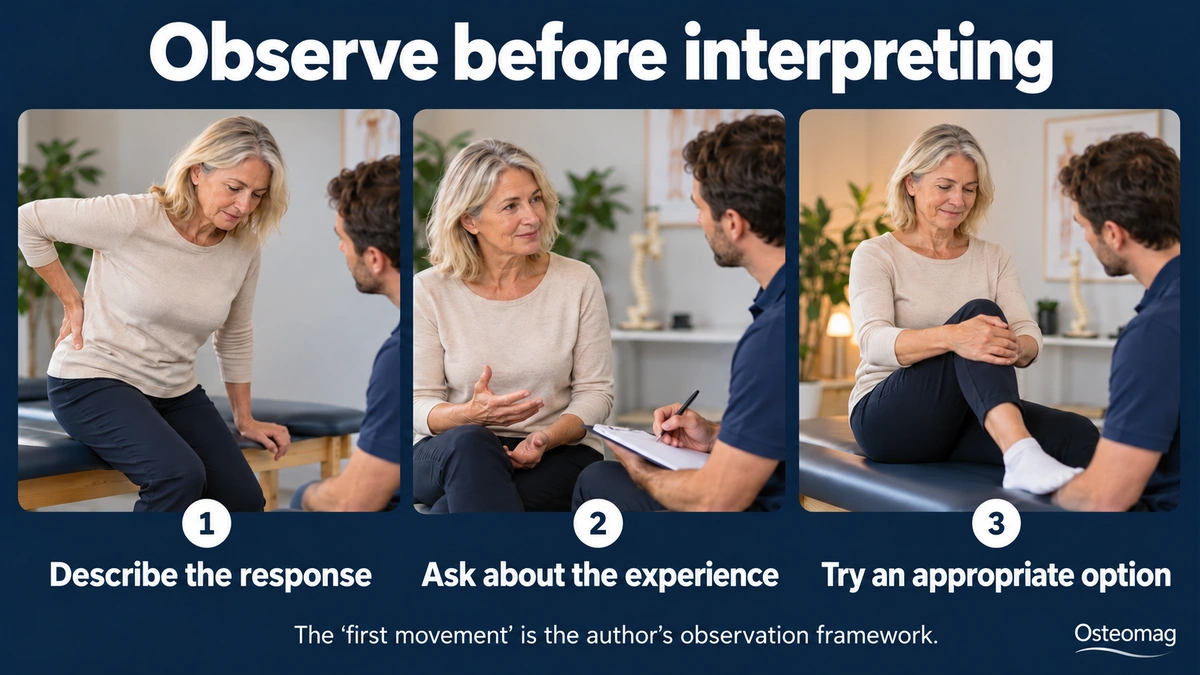
Exploring another option, if appropriate
After the necessary assessment, a smaller range, better support or another way of performing the task can be proposed. This exploration is not a test of courage. It must remain compatible with the diagnosis, protection instructions and tolerance. A fracture, neurological condition or postoperative restriction does not disappear because movement becomes temporarily easier.
If an option seems useful, we check whether it genuinely helps with a chosen activity. The aim is not a perfect response in the clinic or an assertion that the nervous system has been reprogrammed. An observed improvement may support a practical decision, but its mechanism often remains uncertain.
When should the reaction not be attributed to protection?
New weakness, unusual involuntary movements, progressive loss of balance or a persistent sensory disturbance warrant appropriate assessment. Markedly worsening pain, fever, significant trauma or general deterioration also changes the priority. A rapid bodily reaction is not always learning or a stress response.
Sudden neurological signs—difficulty speaking, one-sided weakness, facial changes—are an emergency. Significant psychological distress likewise deserves appropriate support. An osteopath must neither replace medical diagnosis with a protection metaphor nor act as a psychotherapist without the necessary competence and authorization.
Key points
The “first movement” can be an interesting way to observe how a person begins an action. It does not reveal a hidden story. Experimental knowledge shows diverse responses modulated by the task and context; clinical hypotheses must remain identified as such. An available body is not a body without contraction: in the author’s reflection, it is a body allowed several possibilities for action, with safety reference points and no imposed interpretation.
References
- [1] Stegmann Y, Teigeler J, Mirifar A et al. Electrocortical Responses in Anticipation of Avoidable and Inevitable Threats: A Multisite Study. J Neurosci. 2024;44(42):e0575242024. doi:10.1523/JNEUROSCI.0575-24.2024.
- [2] MacIntyre E, Pinto E, Mouatt B et al. The influence of threat on visuospatial perception, affordances, and protective behaviour: A systematic review and meta-analysis. Clin Psychol Rev. 2024;112:102449. doi:10.1016/j.cpr.2024.102449.
- [3] Ellmers TJ, Durkin M, Sriranganathan K et al. The influence of postural threat-induced anxiety on locomotor learning and updating. J Neurophysiol. 2024;131(3):562-575. doi:10.1152/jn.00364.2023.
- [4] Cesari P, Piscitelli F, Pascucci F et al. Postural Threat Influences the Coupling Between Anticipatory and Compensatory Postural Adjustments in Response to an External Perturbation. Neuroscience. 2022;490:25-35. doi:10.1016/j.neuroscience.2022.03.005.
- [5] Wallwork SB, Grabherr L, O’Connell NE et al. Defensive reflexes in people with pain – a biomarker of the need to protect? A meta-analytical systematic review. Rev Neurosci. 2017;28(4):381-396. doi:10.1515/revneuro-2016-0057.
- [6] Jelinčić V, Sone M, Cerrahoğlu B et al. Conditioned fear selectively increases the perception and neural processing of respiratory stimuli relative to somatosensory stimuli. Int J Psychophysiol. 2024;206:112463. doi:10.1016/j.ijpsycho.2024.112463.
- [7] Billens A, Van Oosterwijck S, Dhondt E et al. The influence of expectations and attention on conditioned pain modulation: A systematic review and meta-analysis. Clin Psychol Rev. 2024;114:102517. doi:10.1016/j.cpr.2024.102517.
- [8] Pavy F, Zaman J, Van den Noortgate W et al. The effect of unpredictability on the perception of pain: a systematic review and meta-analysis. Pain. 2024;165(8):1702-1718. doi:10.1097/j.pain.0000000000003199.
- [9] Teigeler J, Stegmann Y, Gamer M. Acting upon threat: Electrocortical, autonomic, and oculomotor responses in anticipation of avoidable and inevitable threats. Imaging Neurosci (Camb). 2026;4:IMAG.a.1318. doi:10.1162/IMAG.a.1318.
- [10] Hodges PW, Tucker K. Moving differently in pain: a new theory to explain the adaptation to pain. Pain. 2011;152(3 Suppl):S90-S98. doi:10.1016/j.pain.2010.10.020.