A pre-contact reaction that deserves to be understood
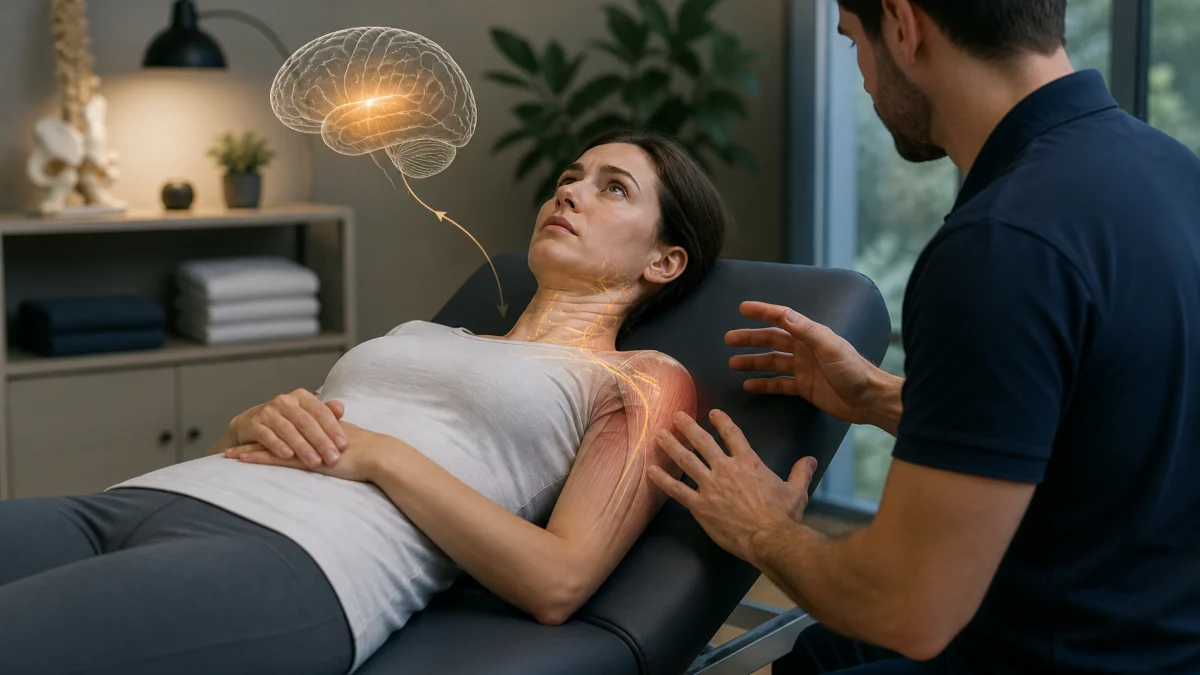
The practitioner brings a hand closer and, even before contact, the patient raises their shoulders, holds their breath, or tenses their abdomen. This reaction may surprise both people. It does not automatically mean that the patient is refusing care, that a muscle is injured, or that an emotion is trapped in tissue. The motor system can prepare for an anticipated action, and this preparation depends in particular on position, pain, previous experiences, and how the contact is announced.[1] [2] [7]
The useful question is therefore a practical one: what does the person feel, when do they react, and what helps them remain comfortable? An isolated observation does not provide access to their personal history. It calls for adjusting the interaction. During an osteopathic session, listening, ongoing consent, and predictable movements should accompany the physical examination, without attributing to touch the ability to diagnose psychological trauma.[8] [10] [11]
The key point
Tensing before contact is an observation, not an emotional diagnosis. The patient may ask for an explanation, change position, request less pressure, or stop the procedure at any time.
The body also prepares for ordinary movements
Muscles do not work only after a disturbance. When someone raises an arm, bends over, or anticipates being moved, certain activations may precede the movement to help maintain balance. These are called anticipatory postural adjustments. A person lying on a table may also stabilize themselves to change position or because they do not know whether the practitioner is going to move their limb. Therefore, not all activity before touch is an abnormal defensive response.[1]
The review by Knox and colleagues describes changes in the timing of muscle activation in people with chronic low back pain. The data on acute low back pain are less conclusive. These studies concern experimental tasks and defined disturbances; they do not make it possible to determine, by sight or touch, the exact cause of a contraction observed during a consultation. Above all, they remind us that movement depends on coordination rather than on a single muscle.[1]
An uncomfortable position may be enough to keep the abdominal or neck muscles engaged. Cold, unstable support, being uncovered, or the effort required to follow an instruction may also play a role. Before interpreting the reaction, it is reasonable to check these simple conditions: the height of the support, the pillow, the blanket, arm position, and the ability to breathe without restriction. These adjustments address the comfort expressed by the patient, without claiming to reveal a hidden mechanism.
Pain and anticipation can alter motor control
Pain can redistribute activity among the muscles performing a task. Some become less active, others contribute more, and the person may slow down or reduce their range of motion. The model proposed by Hodges and Tucker helps explain this diversity: an adaptation may be protective in the short term but become costly if it limits activities over the long term. This model is a theoretical explanation, not a rule that applies identically to every patient.[2]
Experiments involving induced pain in volunteers also show changes in motor control, sometimes with little visible change in movement. These results cannot be directly extrapolated to persistent pain or to a complex personal experience. Nevertheless, they prevent every reaction from being reduced to a simple matter of willpower. Saying “relax” may not be enough when the person genuinely anticipates an unpleasant sensation.[3] [7]
If previous pressure was painful, the approaching hand may become a cue for what will follow. The person may then prepare before contact. This hypothesis should be checked with an open-ended question: “Do you expect pain when my hand approaches?” It should not be imposed as a certainty. The patient may say that they are cold, that they are trying to stabilize themselves, or simply that they do not know what will happen next.
Fear of movement does not explain every reaction
Research has found associations between certain pain-related beliefs and motor behaviours, but these vary depending on the situation. In the review by De Baets and colleagues, the associations observed during demanding knee tasks were not necessarily found during walking. Ippersiel’s meta-analysis also describes weak to moderate relationships during trunk flexion, with no consistent finding for other movements.[4] [5]
The review by Homs published in 2026 distinguishes a general fear of movement from apprehension about a specific task. Task-specific measures are more closely associated with motor changes than general questionnaires. This supports asking “Does this contact concern you?” rather than assuming a general fear. These are associations between measures; they do not imply that a contraction can be used to measure a person’s anxiety.[6]
A person may say they are worried while moving freely, or move cautiously without feeling particularly anxious. Observation and verbal communication provide complementary information. Apparent contradictions warrant discussion, not authoritarian correction. The clinical objective remains to understand what is impairing function and choose an acceptable adjustment, taking pain and physical condition into account.
Observe without turning a hypothesis into a label
Palpation can locate tenderness or describe perceived resistance, but it is not a validated test of emotional state. The reliability of certain manual observations is limited, particularly when examiners seek to identify a specific abnormality. Therefore, a muscle perceived as firm proves neither an injury, nor fear, nor a traumatic memory. This sensation must be considered in relation to the symptoms, position, and movements.[8]
Pain itself is a personal experience influenced by multiple dimensions. Recognizing these dimensions does not mean that it is imaginary. Conversely, invoking psychological factors never removes the need to examine a physical limitation or unusual signs. A coherent approach welcomes the patient’s account and keeps several hypotheses open until sufficient evidence is available.[7] [13]
A table for adapting the session
| Observation | Hypotheses to discuss | Possible adjustment |
|---|---|---|
| Shoulders raised as the hand approaches | Uncertainty, apprehension about contact, or an uncomfortable position | Explain the procedure and support the arms |
| Abdomen tensed during a change of position | Stabilizing effort or anticipated pain | Let the person choose their movement and points of support |
| Breath held during pressure | Effort, discomfort, or excessive pressure | Pause and ask what the person is feeling |
| Different reaction depending on the area touched | Local sensitivity, context, or personal preference | Obtain specific consent and adapt the contact |
| Stiffness accompanied by new weakness | A physical or neurological cause must be investigated | Refer for an appropriate assessment |
| Significant distress or intrusive memory | Need for additional support, without diagnosis through touch | Stop the procedure and discuss seeing a qualified professional |

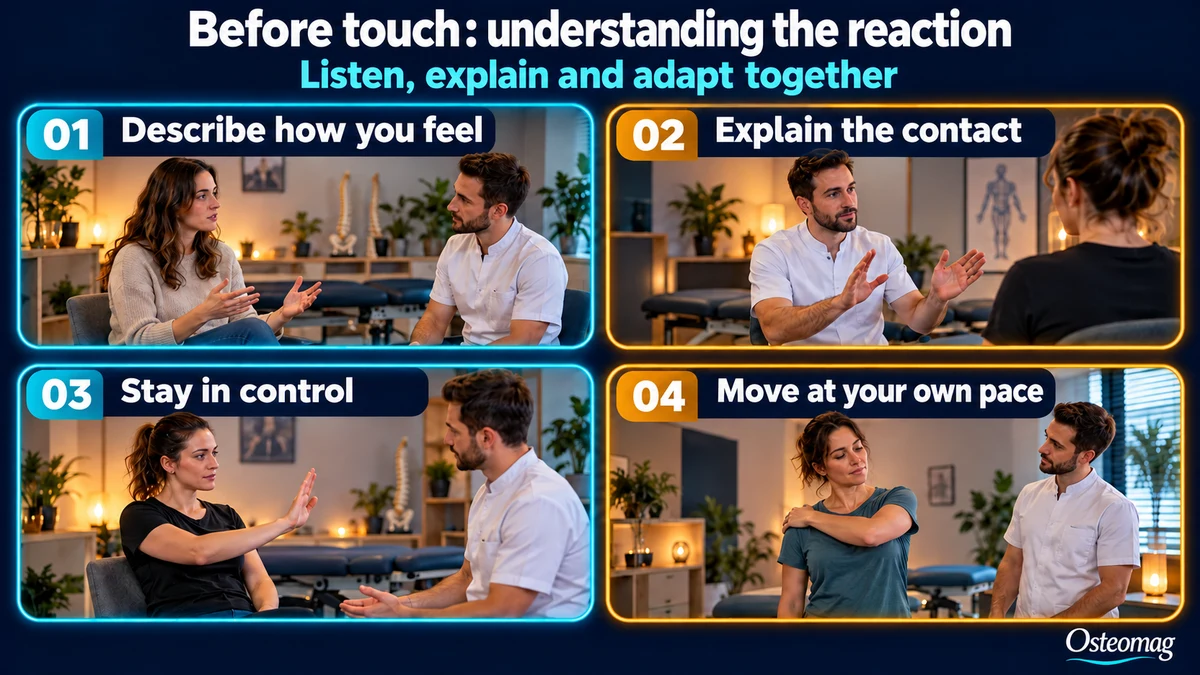
Making touch predictable and truly consensual
Consent is not limited to the agreement given at the beginning of the session. Before contact, the practitioner can specify the area, purpose, and expected sensation, then ask whether the person wishes to proceed. The practitioner can demonstrate the procedure on themselves, offer lighter contact, or begin with an active movement. A hesitant response warrants time for discussion. Silence or tensing does not replace explicit consent.[10]
The patient must be able to stop the examination easily. An agreed-upon word or hand signal may help, but it creates no obligation to continue. After a pause, the practitioner checks what has changed and whether the person wishes to resume. If an area is too sensitive or too intimate to be examined at that time, other information can be sought or that part of the session can be postponed.
It is preferable to avoid instructions to relax immediately and alarming comments about a supposedly blocked body. Descriptive wording remains more useful: “I notice that your shoulders are rising; would you like to change your support?” The practitioner explains the uncertainty and the options, while the patient contributes their experience and priorities. This cooperation facilitates an appropriate decision, without promising that a good explanation will make the pain disappear.[10]
What role is there for osteopathy and movement?
A gentle manual intervention may be considered for comfort if it is desired and tolerated. Its effects may depend on several sensory and contextual mechanisms; a feeling of release does not demonstrate that tissue has been put back into place or that an emotion has been released. If contact increases discomfort, there is no need to continue in order to achieve a supposed necessary step towards improvement.[9]
The session may also prioritize simple active movements: gently moving the arm, finding a tolerable sitting position, or taking a few steps. An objective related to daily life is chosen rather than the abstract outcome of perfect relaxation. Progression takes into account the response during the activity and recovery afterwards. Greater confidence in a movement can be helpful even if some tension persists.
Osteopathy’s focus on the person as a whole has a practical application here: respecting their choices, understanding physical constraints, and supporting their autonomy. It does not justify exceeding the practitioner’s scope of practice. The effectiveness of care is assessed through shared objectives, such as better-tolerated activity or a more comfortable examination, rather than through an unverifiable interpretation of tissues.
Distress, trauma and professional boundaries
A reaction to touch may occur in someone who has had a difficult experience, but it does not justify assuming what they have been through or asking for a detailed account. The patient chooses what they wish to share. If contact triggers distress, the examination stops and immediate comfort becomes the priority. Persistent symptoms of post-traumatic stress require appropriate assessment and support; touch is not the standard treatment.[11]
In Quebec, the right to practise psychotherapy is governed by a specific framework. Physicians, psychologists, marriage and family therapists, and holders of a psychotherapist’s permit may practise it in accordance with their authorizations. Being an osteopath does not, in itself, confer this authorization. Listening respectfully, explaining a procedure and referring the patient to a qualified resource can complement physical care; treating a psychological disorder requires the corresponding qualifications.[12]
When to look for another cause
A new contraction accompanied by loss of strength, difficulty walking, an unusual involuntary movement or a progressive change in function warrants assessment. New severe pain, recent trauma or a significant change in symptoms should also be taken seriously. The sudden onset of weakness on one side, speech problems or another acute neurological sign requires urgent care.[13]
Persistent stiffness should therefore not automatically be attributed to stress. Task-related contractions, painful spasms and certain neurological manifestations are not interchangeable. Distinguishing between them depends on the history, an appropriate examination and, where necessary, targeted investigations. Temporary improvement after a session is not enough to rule out another cause.
Key takeaway
A reaction before touch can be understood by discussing the person’s sensations and the context. Explaining the procedure beforehand, respecting consent and allowing the patient to remain in control make the session more appropriate. A contraction cannot be used to diagnose an emotion or trauma.
Scientific references and resources
- [1] Knox et al. (2018). Anticipatory and compensatory postural adjustments in people with low back pain.
- [2] Hodges and Tucker (2011). Moving differently in pain: a new theory to explain the adaptation to pain.
- [3] Bank et al. (2013). Motor consequences of experimentally induced limb pain.
- [4] De Baets et al. (2020). Pain-related beliefs and protective motor behavior in peripheral joint conditions.
- [5] Ippersiel et al. (2022). Pain-related threat and motor behavior in nonspecific low back pain.
- [6] Homs et al. (2026). Task-specific versus general measures of pain-related fear and spinal motor behaviour.
- [7] Raja et al. (2020). The revised IASP definition of pain.
- [8] Nolet et al. (2021). Reliability and validity of manual palpation for low back pain.
- [9] Bialosky et al. (2009). The mechanisms of manual therapy in the treatment of musculoskeletal pain.
- [10] NICE. Shared decision making, NG197.
- [11] NICE. Post-traumatic stress disorder, NG116.
- [12] Ordre des psychologues du Québec. Who practises psychotherapy?
- [13] NICE. Suspected neurological conditions: recognition and referral, NG127.