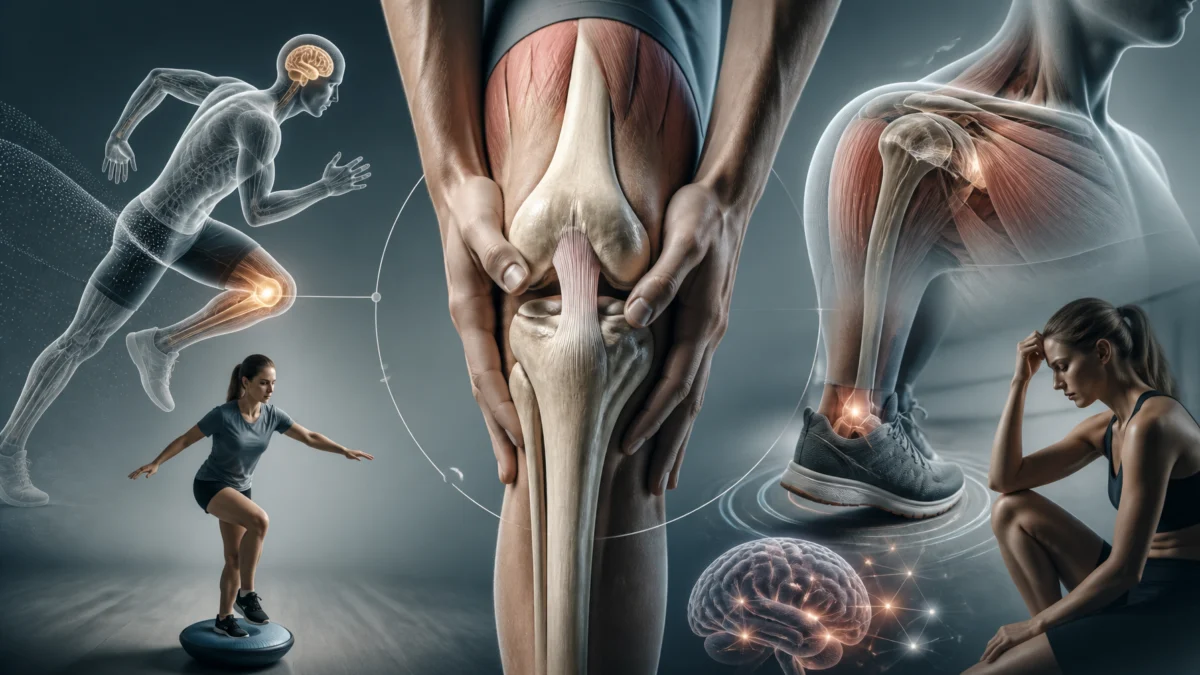
A knee may feel as if it is giving way, an ankle may seem to “roll,” or a shoulder may feel unreliable during certain movements even when no major ligament tear has been demonstrated. This is a common clinical situation and it highlights an important distinction between mechanical instability and the sensation of instability.
A stable joint depends on the ligaments, but also on the muscles, proprioception, coordination, pain, and the nervous system’s ability to adjust motor responses quickly. A joint can therefore be structurally relatively stable while still giving the person a feeling of poor control.
What Is Mechanical Instability?
Mechanical instability refers to excessive laxity or displacement related to structural damage, such as a ligament tear, dislocation, subluxation, or another injury that genuinely compromises the passive stability of the joint.
What Is Functional Instability?
Functional instability is more about a sensation of giving way, insecurity, or lack of control during activity. It may occur with or without significant mechanical laxity. A patient may say, “my ankle does not hold” or “my knee wants to give out,” even though ligament tests are reassuring.
Why Are Ligaments Not the Only Structures Responsible for Stability?
Ligaments help limit excessive movement, but muscles continuously adjust joint position. Vision, balance, and proprioception also contribute by detecting position and movement speed so that the body can produce an appropriate response.
What Is Proprioception?
Proprioception is the ability to sense the position and movement of a joint, along with certain aspects of force. It depends on signals coming from muscles, tendons, joints, and other sensory tissues.
Can an Injury Alter Proprioception?
Yes. In chronic ankle instability, several studies have identified proprioceptive deficits in some patients. A 2021 meta-analysis found differences in kinesthesia and joint position sense across several comparisons, although results varied according to the methods used.
What About After Ligament Surgery?
A systematic review found that surgical stabilization of the ankle does not always fully normalize proprioception. This illustrates an important point: restoring structure does not automatically guarantee restoration of sensorimotor control.
Why Can a Joint “Give Way” Without a Tear?
A delayed muscular response, weakness, significant fatigue, poor coordination, or pain may temporarily reduce the ability to control a joint. The sensation of giving way can therefore occur without a new structural injury.
Can Pain Alter Proprioception?
Yes, depending on the region. A review of the shoulder found moderate evidence that some aspects of kinesthesia may be altered in people with shoulder pain. However, the findings were not uniform across all components of proprioception.
Why Can Fatigue Increase the Feeling of Instability?
When a muscle is fatigued, its ability to generate force quickly may decrease. A patient may feel stable at the beginning of an activity and then progressively lose confidence after repeated efforts or toward the end of the day.
Can Muscle Weakness Be Responsible?
Yes. Weakness in the muscles that control a joint can reduce the margin of safety during a task. However, function should be tested rather than assuming that a specific muscle is weak solely from posture or palpation.
Why Is Balance Important for the Ankle?
The ankle must constantly adapt the position of the foot to the ground. After repeated sprains, some patients show deficits in postural control and balance. Rehabilitation therefore often includes single-leg exercises, changes of direction, and progressively more demanding tasks.
Does a Sensation of Instability Mean the Joint Is Fragile?
Not necessarily. A person can feel very insecure even when passive structures are strong. Conversely, someone may have considerable laxity yet remain functionally stable because of good muscular control.
Why Are Ligament Tests Important?
They help distinguish mechanical laxity from a functional sensation of instability. Depending on the joint and the clinical situation, examination may be complemented by imaging or medical assessment when a significant injury is suspected.
When Is Imaging Appropriate?
Imaging may be indicated after significant trauma, a dislocation, suspected fracture, persistent major instability, or a clinical course that is not progressing as expected. It is not required for every episode of giving way.
What About the Shoulder?
The shoulder depends heavily on muscular and proprioceptive control because it is highly mobile. A 2025 systematic review on traumatic anterior shoulder instability confirmed that proprioceptive deficits may be present, while also showing substantial variability between studies.
What About the Knee?
A giving-way sensation may be associated with a ligament injury, but it can also occur with patellofemoral pain, quadriceps weakness, muscular inhibition, or other problems. Repeated actual falls or mechanical locking deserve careful assessment.
Can a Joint Feel Unstable Simply Because It Hurts?
Yes. Pain can reduce activation of certain muscles or alter movement timing. A person may interpret this hesitation as loss of stability even when significant laxity is absent.
Can Fear of Reinjury Amplify the Sensation?
Yes. After a sprain or dislocation, a person may anticipate that the joint will give way. This anticipation can alter movement speed, range, and strategy. It should not be dismissed as “imaginary,” but rather considered as one component of rehabilitation.
Why Is Progressive Movement Important?
The sensorimotor system improves through practice. Exercises can begin with simple, controlled tasks and then progress toward changes of direction, greater loading, or situations that more closely resemble the patient’s real activities.
Is Strengthening Enough?
Not always. Strength is important, but rapid control, balance, endurance, and confidence in the task may also be necessary. An effective program should match the patient’s actual functional demands.
Are Proprioception Exercises Useful?
In chronic ankle instability, several balance and neuromuscular-control programs can improve function. A recent meta-analysis of certain proprioceptive techniques found improvements in balance, strength, and symptoms, although not every outcome improves to the same extent.
Can Taping or an Ankle Brace Help?
They may sometimes improve confidence and certain functional measures, especially during the return to activity. They do not necessarily need to be viewed as creating dependence. External support can be a useful step while active capacity is being rebuilt.
What Is the Role of Osteopathy?
An osteopath can assess mobility, pain, and movement, and may use manual treatment when it helps facilitate function. However, an osteopath should not claim that an unstable joint is simply being “put back into place” through manipulation.
Can Manual Treatment Stabilize a Joint?
Manual treatment may temporarily change comfort or range of motion, but functional stability depends mainly on the system’s ability to control load. Manual care therefore makes more sense as a complement to active exercise rather than as a replacement for it.
Why Should We Avoid Saying “Your Joint Is Out of Place”?
Because that wording can reinforce a sense of fragility when no dislocation is present. A sensation of instability is not proof that a bone is moving abnormally or that it needs to be put back into place.
How Can the Situation Be Explained to the Patient?
A cautious explanation might be: “Your joint appears structurally reassuring, but you still have a sensation of reduced control. We will work on strength, balance, and confidence in the movements that are giving you difficulty.”
When Should the Patient Be Referred?
Instability after significant trauma, recurrent dislocation, neurological weakness, major swelling, joint locking, or a persistent inability to bear weight warrants medical or specialist assessment.
How Can Progress Be Measured?
Progress can be measured by the number of giving-way episodes and by the person’s ability to walk on uneven ground, climb stairs, run, change direction, or return to sport. Functional improvement is more meaningful than an isolated impression that the joint is in a “better position.”
Conclusion
A joint can feel unstable even when the ligaments show no major injury. Proprioception, pain, fatigue, strength, balance, and neuromuscular control all contribute to functional stability.
The osteopath’s role is to distinguish mechanical instability that requires further investigation from functional instability that may benefit from active progression. The sensation of giving way is real, but it does not automatically mean that the joint is “out of place” or fragile.
References
- Xue X, et al. Chronic ankle instability is associated with proprioception deficits: a systematic review and meta-analysis. J Sport Health Sci. 2021.
- Insufficient recovery of proprioception in chronic ankle instability after surgical restabilization: a systematic review. 2023.
- Amen X, et al. Proprioceptive deficits following a traumatic anterior shoulder instability: a systematic review. 2025.
- Ager AL, et al. Proprioception: How is it affected by shoulder pain? A systematic review. J Hand Ther. 2020;33(4):507-516.
- Yin et al. Effect of proprioceptive neuromuscular facilitation on patients with chronic ankle instability: a systematic review and meta-analysis. 2025.