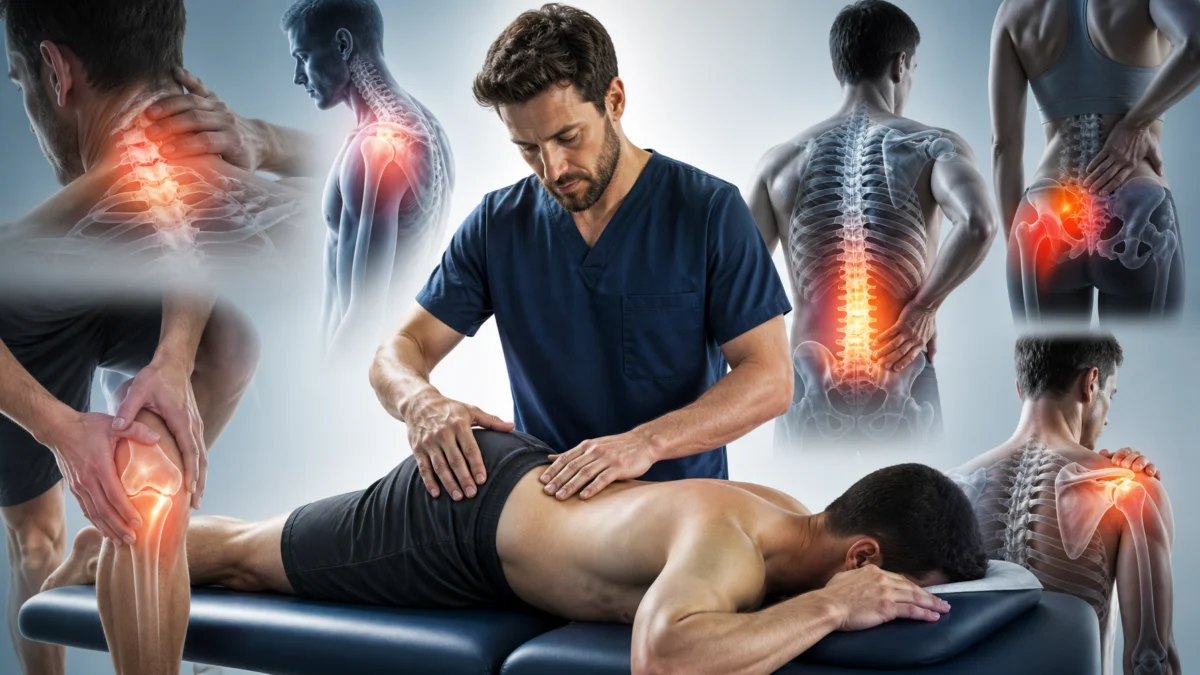
Start with the painful region, then broaden the examination if necessary
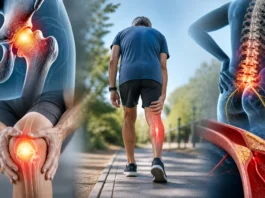
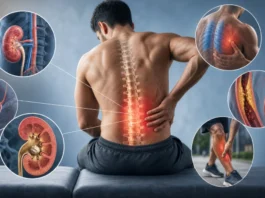
A person points to their knee, shoulder, or buttock: that is where they feel pain, and that region deserves to be examined. However, the location of the symptom does not always correspond exactly to the structure contributing to it. The hip can produce pain felt in the knee; the neck can contribute to shoulder pain. These possibilities should be considered when they fit the clinical picture, without becoming an automatic explanation.[1] [3] [6]
The goal is not to choose in advance between local treatment and treatment at a distance. It is to gather consistent information: symptom onset, circumstances, difficult movements, physical signs, and progression. An osteopathic approach that considers the whole person may include several regions, but it must explain why each hypothesis deserves to be examined. An appealing anatomical connection is not enough to establish the cause of pain.
The key principle
The painful area must be taken seriously. The examination should be broadened when symptoms or findings warrant it; it should not systematically search for a distant cause.
A local source of pain remains an important hypothesis
Trauma, a recent increase in activity, swelling, or pain reproduced by a muscle contraction may point to a local condition. The painful region may contain a joint, tendon, muscle, or nerve that directly contributes to the symptom. The history also clarifies whether the pain occurs at rest, during exertion, after several repetitions, or the next day. These differences help determine which tasks to examine.[10]
The examination may compare range of motion, strength capacity, and tolerance of a representative activity. Knee pain when walking down stairs cannot be understood solely by pressing on the tender area: the task itself provides information. Palpation can complement the overall assessment, but a tender spot alone does not identify a lesion. The aim is to look for consistent findings while taking the limitations of each observation into account.
It is also important to distinguish localized tenderness from a limitation that genuinely matters to the person. An area that is painful to the touch may interfere little with daily life; another may limit walking without being very tender under the examiner’s fingers. The care plan should address this functional difficulty rather than pursuing every tender spot found during the examination. Several causes may coexist and need to be prioritized.
Understanding referred pain
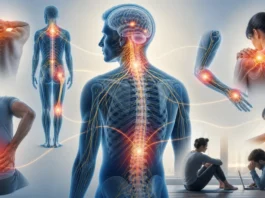
Referred pain is felt at a distance from the tissue contributing to the pain signal. Sensory pathways from different regions may converge on common neurons, contributing to difficulties in localization. Several mechanisms have been proposed, and their importance varies depending on the situation. It is therefore preferable to present this phenomenon as a documented neurophysiological possibility, without drawing a universal map linking every pain to a specific structure.[1] [2]
Pain distributions overlap. Two people with a comparable condition may describe different areas, while several conditions may produce pain in the same location. The patient’s drawing helps clarify the distribution but is not sufficient for diagnosis. How symptoms change with activity and any associated signs also matter. A diffuse sensation is not necessarily referred, and well-localized pain does not rule out a contribution from a nearby region.
Radicular pain and radiculopathy: two concepts that should be distinguished
Radicular pain may occur when a nerve root or its ganglion is irritated, producing pain in a limb. It is not synonymous with all pain that radiates from the back or neck. Radiculopathy instead refers to impaired function of a nerve root, which may manifest as loss of strength, altered sensation, or changes in reflexes. Pain and neurological deficit may coexist, but they are not synonymous.[2] [8]
Burning, electric-shock sensations, or numbness may guide the discussion without automatically identifying a specific nerve root. A peripheral nerve may also be involved. When warranted by the history, the neurological examination complements movement tests and helps identify functional impairment. New or progressive weakness should not simply be reframed as tension or compensation. It may require a targeted assessment.[8]
Knee and hip: a useful example
Studies of hip pain distributions describe symptoms in the groin, buttock, thigh, and sometimes farther down the limb. Hip osteoarthritis, in particular, may present as pain felt in the knee. Clinical case series report situations in which this presentation delayed identification of the problem. These observations demonstrate a possibility, not a frequency that applies to all patients with knee pain.[3] [4] [5]
When a painful knee presents few consistent local signs, examining gait and hip movements may provide information. Limited hip mobility or reproduction of the usual symptom increases the relevance of this possibility, without being sufficient on its own to draw a conclusion. Conversely, a slightly stiff hip may be an incidental finding unrelated to the reason for consultation. Causes specific to the knee still need to be considered.
Shoulder and neck: symptoms that may overlap
Pain around the shoulder blade, shoulder, or arm may include a cervical contribution. The review by Roldán-Ruiz and colleagues presents reasons to investigate this contribution when suggested by the clinical picture. Certain neck movements may alter the shoulder symptom, while a shoulder condition may itself extend into the arm. Distribution alone therefore cannot distinguish between the hypotheses.[6]
The practitioner may compare an arm movement with the neck or trunk in different comfortable positions, then determine whether the change is reproducible. Strength, sensation, and the activities involved are also considered. A response to a test provides information about how the symptom behaves; it does not demonstrate that a vertebra is displaced. The cervical and shoulder examinations complement each other when their findings are consistent with the history.
Comparing hypotheses without applying an automatic map
| Situation | Possibilities to examine | Limit of interpretation |
|---|---|---|
| Pain after a local impact, with swelling | The injured region and local structures | The trauma may require a specific assessment |
| Knee pain with few local signs | Knee, hip, gait, and functional tasks | Not all knee pain comes from the hip |
| Shoulder pain altered by neck movements | Shoulder, cervical spine, and neurological examination if indicated | A change in the symptom does not prove a single cause |
| Limb pain with weakness or numbness | Nerve roots and peripheral nerves according to the signs | Radiating pain alone does not define radiculopathy |
| Arm pain with chest tightness and shortness of breath | A cardiac emergency must be considered | Do not continue investigating a mechanical cause: call emergency services |
| Persistent pain with poorly consistent test findings | Progression, abilities, other causes, and need for referral | Avoid identifying a structure as the culprit without sufficient evidence |

A change in the symptom is not proof of causality
Changing a position, point of support, or range of motion can help find a better-tolerated option. If a movement becomes more comfortable when the hip or trunk participates differently, that adaptation may be useful. But several factors change simultaneously: effort, attention, expectations, sensory stimulation, and repetition. The immediate response does not make it possible to identify the responsible structure with certainty.[11] [12]
Manual care may also temporarily alter pain. This result deserves to be monitored, but it does not prove that the area treated was the original cause of the problem. An encouraging observation must be distinguished from anatomical proof. A hypothesis becomes more relevant if it is consistent with several pieces of information and produces lasting improvement in an activity; it remains open to revision if the findings cease to support it.
Reassessment may use a simple task selected before the intervention: walking for a few minutes, raising the arm, or getting up from a chair. Discomfort and ease of movement are compared, then changes between sessions are observed. If the response changes little or activities remain limited, it is useful to review the plan. Repeating treatment at a distance solely because a theory dictates it perpetuates an explanation without verifying its value.
Imaging answers a clinical question
An X-ray or MRI may be appropriate when a fracture, a specific joint condition, or a disorder requiring a particular decision is suspected. It is not always necessary for common pain. Degenerative changes in the spine also occur in people without pain: findings must therefore be related to the symptoms and examination rather than presented as an automatic explanation.[9] [10] [13]
The absence of an abnormality that explains everything does not mean that the pain does not exist. Conversely, finding an abnormality does not necessarily confirm that it is causing the symptom observed. The professional responsible for diagnosis selects investigations based on the question to be resolved and their potential effect on management. This approach avoids seeking an image to validate a predetermined hypothesis.
Recognizing situations that fall outside musculoskeletal care
Arm pain accompanied by chest tightness, shortness of breath, sweating, nausea, or feeling unwell may indicate a cardiac emergency. Emergency services should be called without waiting to see whether a movement or test produces a response. Symptoms are not always the same from one person to another; the absence of a perfectly typical presentation does not rule out the problem.[7]
Pain associated with fever, a deterioration in general health, unexplained weight loss, or unusual abdominal or urinary symptoms also warrants appropriate assessment. No single sign necessarily indicates a serious condition: the context and progression matter. New problems with bladder or bowel control, loss of sensation in the perineal area, or significant weakness in the context of spinal pain require urgent referral.[8] [13]
Movement, adaptations, and the role of osteopathy
The body has several ways of performing a task. A change in gait or weight-bearing may temporarily protect a painful region; it is not automatically harmful. It is mainly considered when it limits activity or becomes poorly tolerated. The pain adaptation model highlights this diversity without providing a list of compensations that should be eliminated in everyone.[14]
The plan may combine load modification, exercises, and, if it provides useful comfort, consensual manual intervention. The selection depends on the person’s abilities and the identified problem. Recommendations common to musculoskeletal care emphasize education, activity, follow-up, and the use of manual care as an adjunct. They do not justify treating every region at each session.[10]
Osteopathy’s holistic perspective becomes tangible when it connects the examination to the person’s needs and involves collaboration with other professionals. It loses its value if every pain is automatically attributed to a fascial chain or a distant region. Explaining the hypotheses and their limitations helps the patient understand the choices, participate in the adaptations, and recognize when another assessment is needed.
Key takeaway
Examining the area where the pain is felt remains essential. Adjacent regions or the nervous system are explored when findings warrant it. The plan should improve a relevant activity and be reassessed, without confusing immediate relief with proof of a single cause.
Scientific references and resources
- [1] Jin et al. (2023). Referred pain: characteristics, possible mechanisms, and clinical management.
- [2] Bogduk (2009). On the definitions and physiology of back pain, referred pain, and radicular pain.
- [3] Lesher et al. (2008). Hip joint pain referral patterns: a descriptive study.
- [4] Khan et al. (2004). Hip osteoarthritis: where is the pain?
- [5] Dibra et al. (2018). Don’t forget the hip! Hip arthritis masquerading as knee pain.
- [6] Roldán-Ruiz et al. (2025). Cervical contribution in musculoskeletal shoulder pain.
- [7] NHS. Heart attack.
- [8] NICE. Suspected neurological conditions, NG127.
- [9] Brinjikji et al. (2015). Imaging features of spinal degeneration in asymptomatic populations.
- [10] Lin et al. (2020). Eleven consistent recommendations for musculoskeletal pain care.
- [11] Bialosky et al. (2009). Mechanisms of manual therapy in musculoskeletal pain.
- [12] Raja et al. (2020). The revised IASP definition of pain.
- [13] NICE. Low back pain and sciatica, NG59.
- [14] Hodges and Tucker (2011). Moving differently in pain: adaptation to pain.