Distinguishing pain patterns without turning clues into a diagnosis
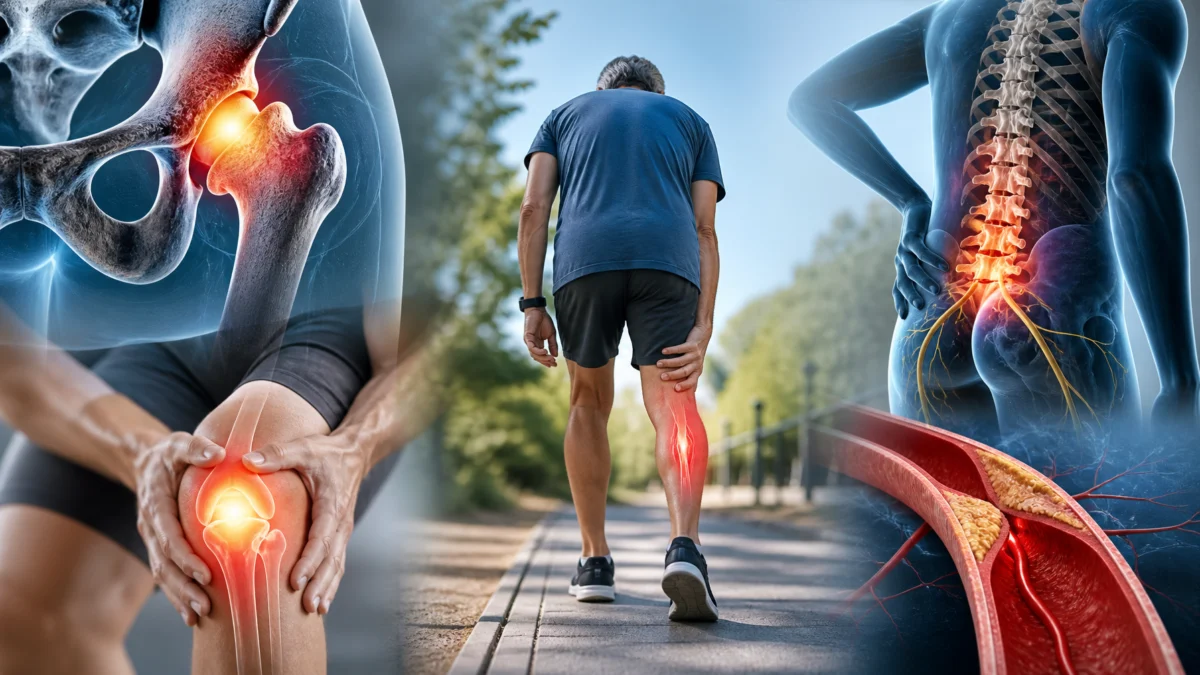
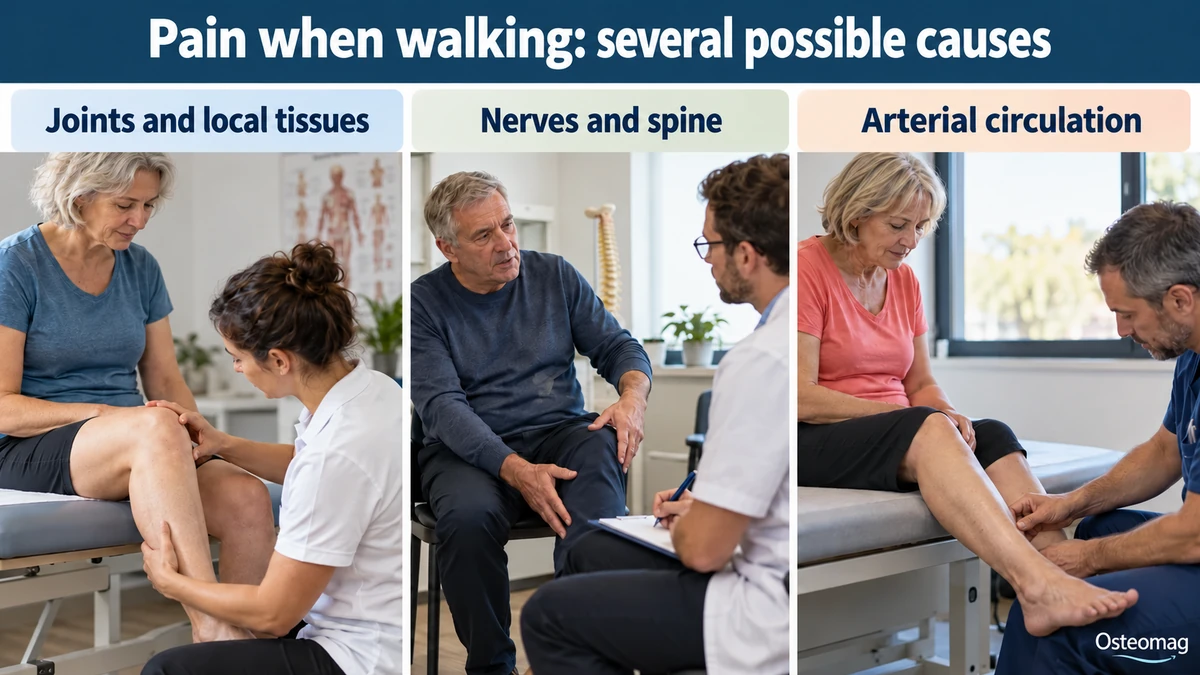
Pain that appears when walking and disappears at rest may seem purely musculoskeletal. Yet very different mechanisms can produce this pattern: hip or knee osteoarthritis, lumbar spinal stenosis with neurogenic claudication, peripheral artery disease, nerve involvement or muscle-tendon overload.
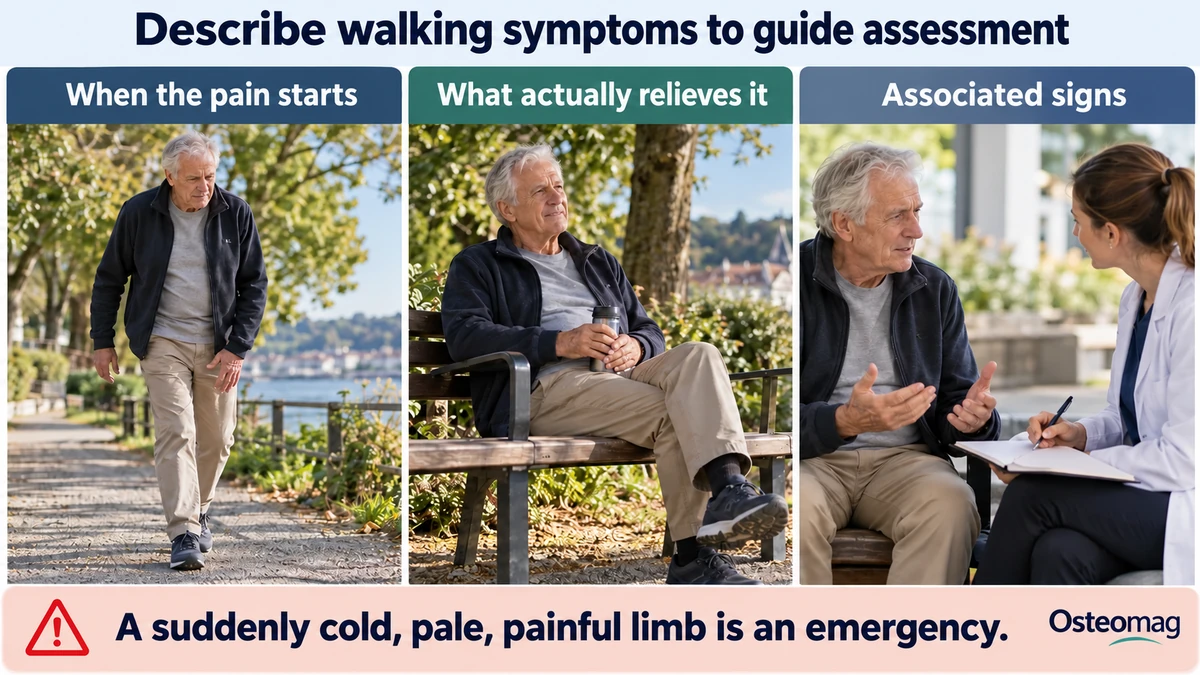
The distinction matters because treatment differs. Circulatory pain must not be treated as simple muscle tightness, and pain related to lumbar stenosis does not always behave like osteoarthritis. When pain starts, what stops it and the associated symptoms are often more informative than its location alone.
Why can walking trigger pain?
Walking increases demands on the joints, muscles, tendons, nerves and circulation of the legs.
If a joint tolerates loading poorly, pain may gradually increase. If a nerve or surrounding structures become sensitive, walking may provoke radiating pain. If arteries cannot supply enough blood to muscles during effort, claudication may occur.
Osteoarthritis: load-related pain
Hip or knee osteoarthritis often causes pain that increases with walking and weight-bearing activities.
Hip pain is frequently felt in the groin or front of the thigh, but may also refer to the knee. Knee osteoarthritis more often produces local pain around the joint.
In both cases, tolerable walking distance may decrease when symptoms become more pronounced. [1]
Does osteoarthritis pain disappear immediately at rest?
Not necessarily. It may decrease within a few minutes, but a very symptomatic joint may remain sensitive after activity stops.
This detail can help distinguish patterns, without establishing a diagnosis on its own.
Vascular claudication: when muscles lack blood during effort
Peripheral artery disease reduces blood supply to leg muscles. Some people have no symptoms at rest but develop pain, heaviness or cramping when walking.
The medical term is intermittent claudication. Pain generally appears after a certain amount of effort and decreases after a few minutes of rest.
The calf is a classic location, but the thigh or buttock may also be affected depending on the level of arterial disease.
Why does rest relieve vascular claudication?
During walking, muscles need more oxygen. If atherosclerosis limits arterial flow, demand may exceed the available supply.
When the person stops, energy demand falls and symptoms decrease.
This explains why pain may recur at a relatively reproducible distance.
Who is at greater risk of peripheral artery disease?
Risk increases with factors including:
- current or previous smoking;
- diabetes;
- hypertension;
- high cholesterol;
- older age;
- known cardiovascular disease;
- chronic kidney disease.
Several risk factors together should increase vigilance when assessing walking pain.
Which other signs may suggest a vascular problem?
A person may have a colder foot, reduced pulses, slow wound healing, changes in skin colour or loss of leg hair.
These signs are not always present. Many people with peripheral artery disease have atypical or few symptoms.
The ankle-brachial index: a simple, important examination
The 2024 ACC/AHA guideline recommends a resting ankle-brachial index to establish the diagnosis when peripheral artery disease is suspected. [2]
This test compares blood pressure measured at the ankle with that measured at the arm.
It is not part of manual treatment: it belongs to an appropriate vascular assessment when the clinical presentation warrants it.
Lumbar stenosis: walking pain that can resemble a circulatory problem
Lumbar stenosis reduces the space around neural structures in the spine. Some people develop neurogenic claudication: pain, heaviness, numbness or weakness in one or both legs during walking or standing.
The pattern may resemble vascular claudication, but trunk position often plays a greater role.
The ‘shopping cart sign’
Someone with neurogenic claudication may walk farther while leaning slightly forwards, for example when pushing a shopping cart.
Sitting down or bending the trunk may reduce symptoms more effectively than simply standing still.
This behaviour is often used as a clinical clue, but is not definitive.
Vascular or neurogenic: what is the practical difference?
With vascular claudication, stopping exertion is often enough to reduce pain, even while remaining upright.
With neurogenic claudication, position matters more: standing may continue to provoke symptoms, whereas sitting or leaning forwards reduces them.
However, both conditions can coexist, particularly with increasing age. [3]
Does walking distance provide a clue?
Classic vascular claudication may begin after a relatively reproducible distance as muscle demand progressively exceeds available blood supply.
Lumbar stenosis may vary more with posture, speed, slope and whether the person walks bent forwards or upright.
None of these features is reliable enough to replace an examination. [4]
| Possible cause | Common clue | Why assessment matters |
|---|---|---|
| Osteoarthritis or tendon | Discomfort related to loading and movement | Several tissues may contribute. |
| Neurogenic claudication | Relief when sitting or leaning forwards | Posture alone does not confirm stenosis. |
| Vascular claudication | Exertional discomfort relieved by stopping | A vascular assessment may be needed. |
| A suddenly cold, pale or weak limb | Possible acute ischaemia | Emergency: do not wait for a manual treatment appointment. |
Walking uphill can change the pattern
An uphill slope increases muscle work and oxygen demand. Vascular claudication may begin sooner.
However, an uphill slope may also increase forward trunk flexion and sometimes be better tolerated by someone with lumbar stenosis than walking downhill or on level ground.
This contrast may provide a useful clinical clue.
Cycling can help distinguish some patterns
Someone with lumbar stenosis may sometimes cycle relatively comfortably because the trunk remains flexed.
Someone with substantial arterial disease may develop symptoms as soon as muscle demand is sufficient, even with a different posture.
Again, this is not an absolute diagnostic test.
Hip pain or pain from the back?
Hip osteoarthritis can cause pain when walking, particularly in the groin, and restrict rotation or flexion.
Pain arising from the spine may be felt in the buttock, thigh or leg and accompanied by tingling or numbness.
Recent hip osteoarthritis guidance favours a functional examination combining history, mobility, strength and tasks such as walking. [5]
Can nerve involvement hurt only when walking?
Yes. Nerve root irritation may be sensitive to certain positions and loads. Walking may provoke or increase radiating pain, tingling or a feeling of weakness.
However, genuine progressive weakness must not simply be attributed to ‘irritation’ without appropriate assessment.
Simple muscle pain when walking
A deconditioned muscle may start to burn or hurt after walking for a certain time, particularly during a return to activity.
Muscle fatigue may accompany a return to activity, but diffuse or bilateral pain does not establish simple deconditioning. Assessment is needed according to the course of symptoms, associated features and risk factors.
It must nevertheless be distinguished from claudication in someone with vascular risk factors.
Tendinopathy and walking
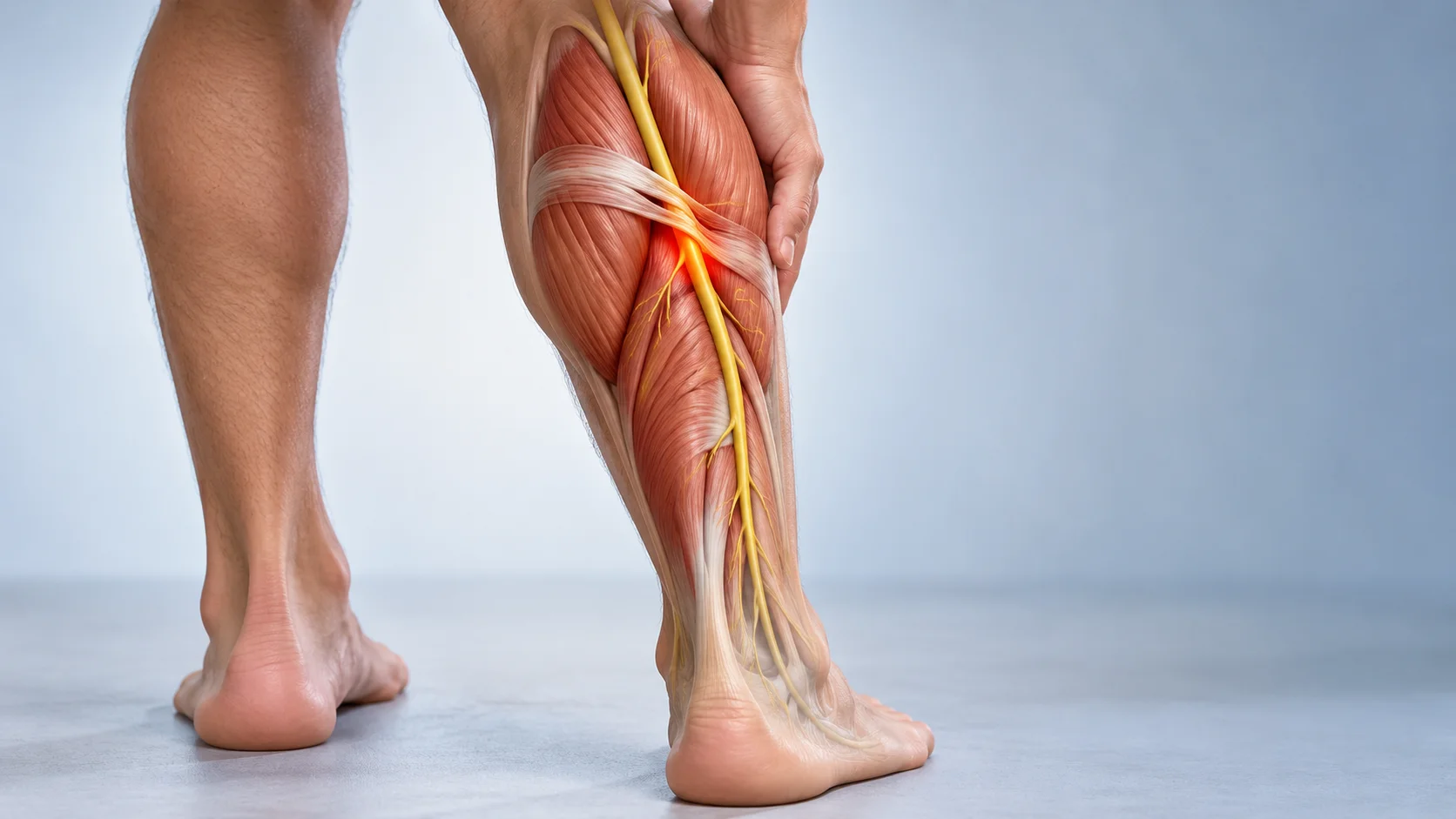
Achilles, fibularis or gluteal tendinopathy can cause pain that gradually increases with distance.
Pain is generally more localized and reproducible with particular tasks or contractions. [6]
It may also be more noticeable the next day if loading exceeds the tendon’s capacity.
When does walking pain become an emergency?
Sudden leg pain with a newly cold, pale, numb or weak foot may indicate acute limb ischaemia.
This is a medical emergency.
Leg pain with substantial swelling, especially on one side, may also suggest deep vein thrombosis and requires assessment. [7]
Pain at rest: why it raises vascular concern
In more advanced peripheral artery disease, pain may occur even at rest, particularly at night or when the leg is elevated.
Non-healing wounds, abnormal colour or persistent foot pain may suggest chronic limb-threatening ischaemia.
The 2024 guideline considers this much more serious than uncomplicated intermittent claudication.
When should you seek assessment?
Medical assessment is indicated when walking pain is new, progressive, clearly limits distance or occurs in someone with several cardiovascular risk factors.
Seek prompt assessment for: [8]
- a suddenly cold or pale foot;
- sudden, intense pain;
- known or suspected loss of a pulse;
- sudden weakness or numbness;
- a wound that does not heal;
- marked swelling in one leg;
- pain associated with shortness of breath or chest pain;
- bladder or bowel problems with neurological weakness.
Is exercise recommended for vascular claudication?
Yes. It may seem paradoxical, but structured exercise is central to treating peripheral artery disease.
The 2024 ACC/AHA guideline recommends supervised exercise therapy or a structured community-based programme to improve walking capacity, function and quality of life.
The programme is adapted to the medical context and does not replace management of cardiovascular risk factors.
This applies to an identified condition and a structured programme: unexplained walking pain should not be pushed through. Functional improvement does not mean that exercise has reopened a narrowed artery.
What about lumbar stenosis?
Guidance on neurogenic claudication generally favours multimodal care: education, activity modification, exercise, rehabilitation and, in some cases, manual therapy. [9]
Evidence syntheses on lumbar stenosis do not fully agree. In 2022, some programmes combining exercise, education and manual care had moderate-quality supporting evidence. In 2026, a network meta-analysis found no clear benefit from other interventions over placebo for pain or function, or for walking, with low to very low certainty. Neither finding proves that isolated manual care permanently widens the spinal canal. [10] [11]
The aim is to increase walking and functional capacity, not simply reduce pain temporarily.
What is the role of osteopathy?
A manual intervention may help when walking pain is clearly musculoskeletal or when lumbar stenosis is managed within a broader programme.
However, peripheral artery disease is not treated by ‘releasing’ muscles or treating the spine manually. Vascular claudication requires cardiovascular assessment and appropriate medical management.
Recognizing this distinction is part of clinical safety.
A simple question that helps considerably
Asking only ‘where does it hurt?’ is insufficient. It is often more useful to ask:
- how many minutes pass before pain begins?
- does it always occur at the same distance?
- is stopping while standing enough?
- do you need to sit or lean forwards?
- is there numbness or weakness?
- does the foot become cold or change colour?
- do uphill and downhill walking feel different?
Conclusion
Pain present during walking but absent at rest may arise from a joint, tendon, nerve or the circulation.
Osteoarthritis is generally load-related. Neurogenic claudication often depends strongly on posture and improves with sitting or leaning forwards. Vascular claudication appears with exertion and usually subsides after a few minutes of rest.
These patterns sometimes overlap. In someone with cardiovascular risk factors, reproducible walking pain must not automatically be considered muscular. Understanding what brings pain on and what makes it stop is often the key to differential diagnosis.
References
- [1] Lawford BJ, Hall M, Hinman RS et al. Exercise for osteoarthritis of the knee. Cochrane Database Syst Rev. 2024;12(12):CD004376. doi:10.1002/14651858.CD004376.pub4.
- [2] Writing Committee Members, Gornik HL, Aronow HD et al. 2024 ACC/AHA/AACVPR/APMA/ABC/SCAI/SVM/SVN/SVS/SIR/VESS Guideline for the Management of Lower Extremity Peripheral Artery Disease: A Report of the American College of Cardiology/American Heart Association Joint Committee on Clinical Practice Guidelines. J Am Coll Cardiol. 2024;83(24):2497-2604. doi:10.1016/j.jacc.2024.02.013.
- [3] Uesugi K, Sekiguchi M, Kikuchi S et al. Lumbar spinal stenosis associated with peripheral arterial disease: a prospective multicenter observational study. J Orthop Sci. 2012;17(6):673-81. doi:10.1007/s00776-012-0311-z.
- [4] Nadeau M, Rosas-Arellano MP, Gurr KR et al. The reliability of differentiating neurogenic claudication from vascular claudication based on symptomatic presentation. Can J Surg. 2013;56(6):372-7. doi:10.1503/cjs.016512.
- [5] Koc TA, Cibulka M, Enseki KR et al. Hip Pain and Mobility Deficits-Hip Osteoarthritis: Revision 2025. J Orthop Sports Phys Ther. 2025;55(11):CPG1-CPG31. doi:10.2519/jospt.2025.0301.
- [6] Challoumas D, Crosbie G, O’Neill S et al. Effectiveness of Exercise Treatments with or without Adjuncts for Common Lower Limb Tendinopathies: A Living Systematic Review and Network Meta-analysis. Sports Med Open. 2023;9(1):71. doi:10.1186/s40798-023-00616-1.
- [7] National Health Service. DVT (deep vein thrombosis). Official public information. Accessed October 15, 2026.
- [8] Finucane LM, Downie A, Mercer C et al. International Framework for Red Flags for Potential Serious Spinal Pathologies. J Orthop Sports Phys Ther. 2020;50(7):350-372. doi:10.2519/jospt.2020.9971.
- [9] Bussières A, Cancelliere C, Ammendolia C et al. Non-Surgical Interventions for Lumbar Spinal Stenosis Leading To Neurogenic Claudication: A Clinical Practice Guideline. J Pain. 2021;22(9):1015-1039. doi:10.1016/j.jpain.2021.03.147.
- [10] Ammendolia C, Hofkirchner C, Plener J et al. Non-operative treatment for lumbar spinal stenosis with neurogenic claudication: an updated systematic review. BMJ Open. 2022;12(1):e057724. doi:10.1136/bmjopen-2021-057724.
- [11] Chen H, Chen X, Fang J et al. Nonsurgical interventions for lumbar spinal stenosis with neurogenic claudication: A systematic review and network meta-analysis. Integr Med Res. 2026;15(3Part A):101321. doi:10.1016/j.imr.2026.101321.