Immediate relief, loading and recovery: understanding three different time frames
Pain sometimes decreases during exercise, occasionally within the first few minutes, then returns later in the day or the next morning. This pattern is particularly common in tendinopathies, some joint conditions and several persistent pain conditions.
It can be confusing: if exercise provides relief, why does the pain return afterwards? The answer is that pain experienced during activity and the response of the tissue or system over the following hours do not describe exactly the same thing.
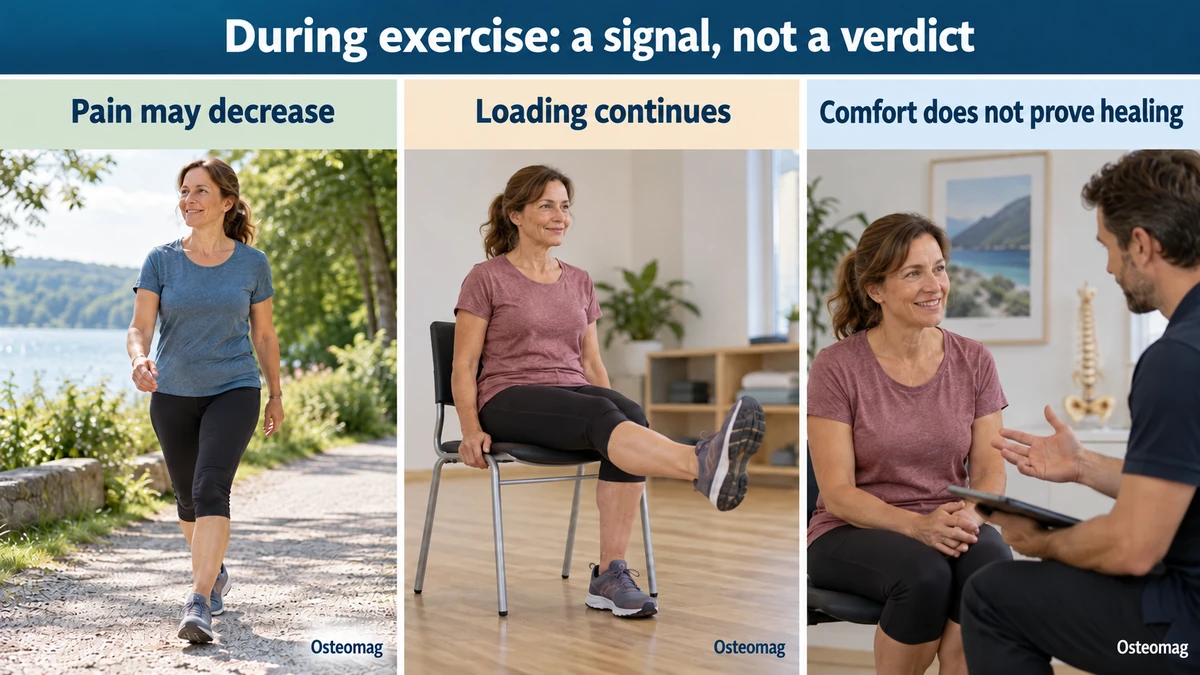
Why can pain decrease during exercise?
Several mechanisms may contribute. Movement raises muscle temperature, changes local circulation, improves coordination and may temporarily reduce pain sensitivity.
The nervous system can also modulate pain perception during and after activity. This phenomenon is often called exercise-induced hypoalgesia.
In people without chronic pain, some forms of exercise temporarily reduce experimentally measured pain sensitivity. In people with persistent musculoskeletal pain, the effect is much more variable. [1]
Exercise-induced hypoalgesia: real, but not universal
Studies show that a single bout of exercise can reduce pain sensitivity in some people.
However, recent reviews emphasize that the response is not consistent enough to be considered a universal mechanism in people with chronic pain. [2]
A study may therefore show an average reduction in pain even though some participants experience no change, or even an increase.
Why does pain return afterwards?
Relief during activity may be temporary. Once the pain-modulating effect wears off, baseline sensitivity returns.
Exercise also places a load on the body. Pain may increase after a demanding session, but its return does not directly measure a tissue’s capacity or an injury. It can reflect several local and contextual factors.
It is therefore possible to feel less pain during exercise and still have completed a session that was too demanding.
Tendinopathy: a classic example
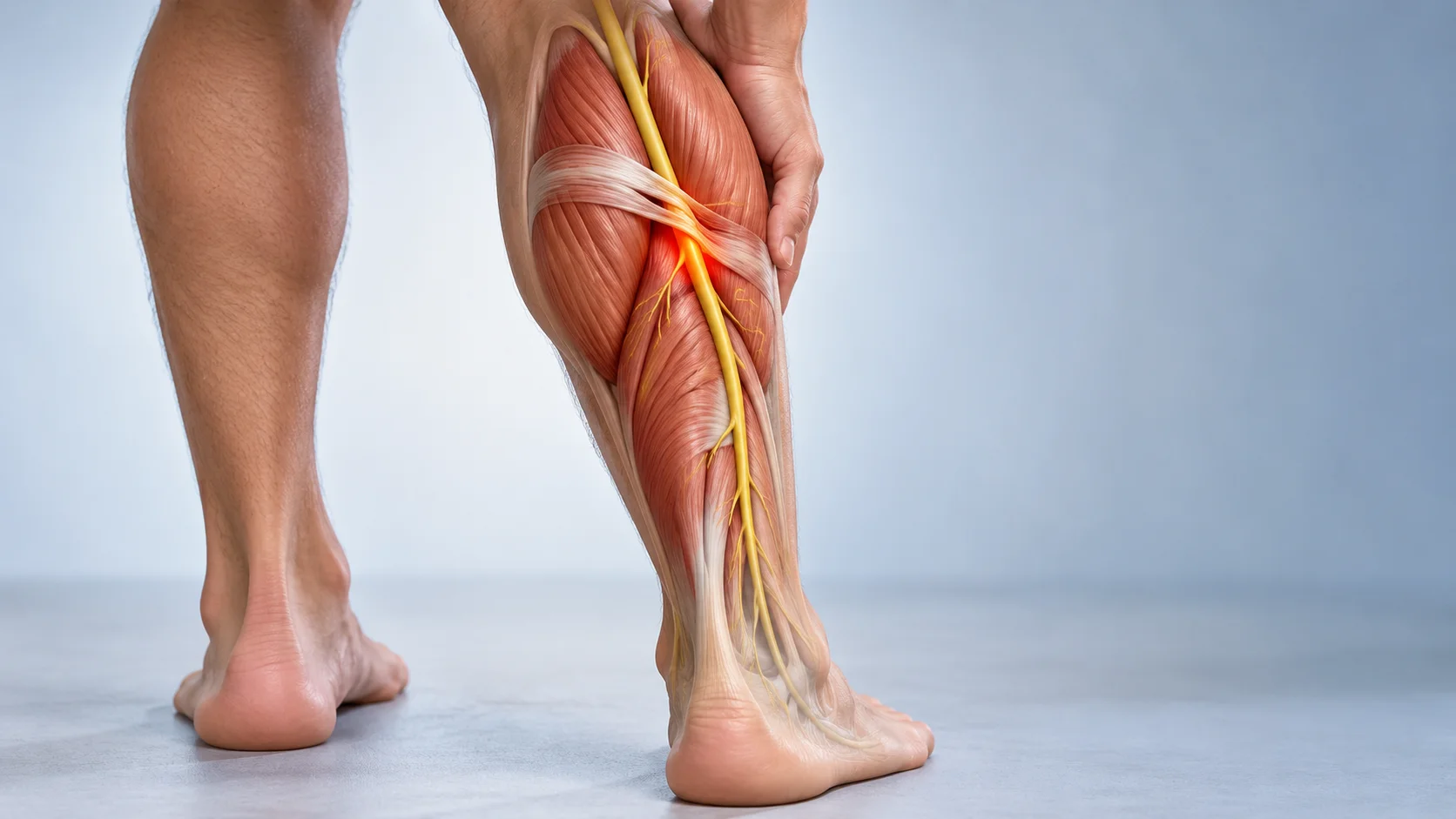
Someone with Achilles tendinopathy may start a run with moderate pain, feel the tendon ‘warm up’, run almost normally, then experience much greater stiffness that evening or the next morning.
The same pattern can occur in the patellar tendon, the gluteal tendons or the shoulder.
In these situations, the response over the following 24 hours often provides as much information as pain during exercise.
Has the tendon really ‘warmed up’?
This expression is useful but oversimplified. A tendon does not become healthy after ten minutes of activity.
What changes most is perception, local temperature, muscle activation and the way the load is distributed.
Pain can therefore decrease without an instantaneous change in the tendon’s structural capacity.
Isometrics: guaranteed pain relief?
Isometric exercises have often been presented as a way to reduce tendon pain quickly.
Recent research is more cautious. A 2026 systematic review covering several tendinopathies concluded that isometrics may be well tolerated and sometimes provide short-term pain relief, but robust evidence that they are superior to isotonic or eccentric exercises is lacking. [3]
They are therefore one possible tool, not a magic technique.
Should all pain during exercise be avoided?
Not necessarily.
A systematic review with meta-analysis published in 2025 compared programmes involving painful exercises with programmes performed without pain in people with chronic musculoskeletal pain.
The findings showed no clear difference in pain or disability. This suggests that some pain during exercise may be compatible with improvement. [4]
The certainty of this comparison is low to very low: the absence of a clear difference does not establish perfect equivalence between the programmes.
Nor does it mean that people should deliberately seek pain.
Pain during exercise is not a goal
The scientific message is nuanced: pain does not always have to be avoided, but it is not necessary for progress either.
A session can be effective with little or no pain. Another may cause tolerable pain without being harmful.
What matters is the overall response, improvements in function and changes over time.
Can a pain scale be useful?
Yes, but cautiously.
Some programmes use a scale from 0 to 10 and allow mild or moderate pain during exercise, provided it quickly returns to its usual level.
However, reviews of exercise prescription show considerable variation and little evidence supporting a single threshold for every patient. [5]
An ‘acceptable 3 out of 10’ is therefore not a biological law.
Next-day pain is often more informative
In several tendinopathies, clinicians monitor the response over the following hours and the next day.
If the patient quickly returns to their usual level, the load was probably tolerable.
This monitoring is a shared clinical guide, not a validated test of healing. Function, goals, the diagnosis and any medical restrictions must also be considered.
If pain rises sharply, morning stiffness becomes much greater or function declines for several days, reducing the exercise dose may be useful.
Why is the response delayed?
After loading, sensitivity can change over several hours. Inflammatory processes may contribute in some situations, but a delay in symptom onset alone neither demonstrates them nor measures tissue damage.
This delay does not necessarily mean that a new injury has occurred.
Timing helps track changes; on its own, it does not provide a biological explanation.
Osteoarthritis: movement may provide relief, then pain returns
In osteoarthritis, the first movements may be painful, then become more comfortable as the joint ‘loosens up’. [6]
However, prolonged activity may increase pain later if the total load is substantial.
This does not necessarily mean that exercise is causing further cartilage damage. It may simply indicate that the current dose needs adjusting.
Why is complete rest not always the answer?
Temporarily reducing loading may help during a flare-up, but prolonged complete rest reduces muscle and tissue capacity.
When activity resumes, a previously tolerable load may then become too demanding.
Rehabilitation therefore generally aims for progressive loading rather than alternating between overload and complete inactivity.
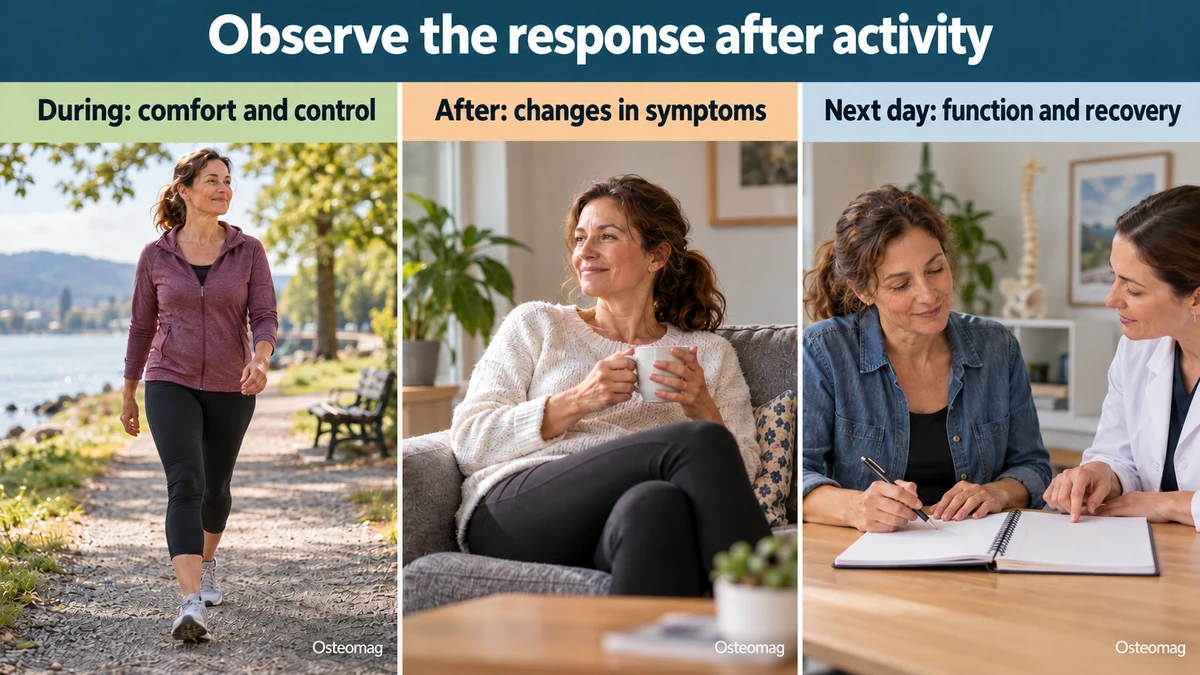
| When | What to observe | What cannot be concluded |
|---|---|---|
| During activity | Comfort, movement control and perceived effort | Less pain does not prove healing. |
| After activity | Changes in symptoms and activities that remain possible | Returning pain does not prove a new injury. |
| The next day and across sessions | Function, stiffness and recovery | A single number does not define a safe dose. |
Does the nervous system play a role?
Yes. Pain is not simply a measure of mechanical stress.
The nervous system integrates information from tissues, previous experience, expectations and context.
However, caution is needed: pain that returns after exercise should not automatically be attributed to ‘central sensitization’. [7]
Local loading and tissue capacity often remain important.
Why do some people feel less pain when focused on an activity?
Attention can change perception. Someone absorbed in a sport or another activity may notice their pain less.
Afterwards, when attention returns to the body, the symptom may become more noticeable again.
This does not mean that the pain is psychological or imaginary.
The warm-up effect
The first few minutes of exercise allow the cardiovascular system, muscles and coordination to adapt to the task.
This transition may reduce an initial feeling of stiffness.
Someone may therefore feel better after ten minutes while gradually accumulating a substantial load.
When should loading be reduced?
It may be reasonable to temporarily reduce intensity, volume or frequency when:
- pain increases sharply during the session;
- technique deteriorates;
- symptoms remain clearly worse for more than 24 to 48 hours;
- function declines from one session to the next;
- morning pain gradually increases;
- substantial weakness develops.
When might mild pain be acceptable?
Mild or moderate pain may be acceptable if it remains manageable, does not substantially alter movement and quickly returns to its usual level.
The threshold must be individualized.
Someone experienced in managing chronic tendinopathy will not necessarily use the same criteria as someone with a recent acute injury.
Progressive loading matters more than the pain score
Reviews of tendinopathies show that load management and progressive exercise are central components of rehabilitation. [8]
Progression can be based on several factors:
- pain during activity;
- the next-day response;
- strength;
- fatigue;
- movement quality;
- total weekly volume;
- the patient’s confidence.
No indicator should be used in isolation.
Why does exercise remain essential in tendinopathy?
A systematic review with network meta-analysis found no convincing evidence that treatments added to exercise outperform exercise alone for several common lower-limb tendinopathies. [9]
Exercise therefore remains a first-line treatment because it progressively increases the capacity of the tendon and surrounding muscles.
Does improvement during exercise mean the diagnosis is tendinopathy?
No. Several types of pain may decrease during activity: osteoarthritis, muscle pain, some low back pain and persistent pain conditions.
This behaviour is informative, but it is not specific to one structure.
What if pain appears only after exercise?
Pain that is absent during activity but appears several hours later may simply reflect the response to loading.
If it is moderate and quickly returns to its usual level, it may be compatible with normal adaptation.
If it becomes progressively more intense from one session to the next, the progression should be reassessed.
Pain during or after exercise: which matters more?
Both.
Pain during exercise provides information about immediate tolerance. The response afterwards provides information about recovery capacity.
Function over several weeks indicates whether the programme is actually producing useful adaptation.
When should something other than a simple response to loading be suspected?
Pain after exercise warrants more prompt assessment if accompanied by: [10]
- sudden pain with a tearing sensation;
- a sudden inability to use the limb;
- substantial swelling;
- extensive bruising;
- neurological weakness;
- chest pain or shortness of breath;
- fever;
- rapidly increasing pain without a clear relationship to loading.
What is the role of manual treatment?
Manual treatment may temporarily reduce pain or stiffness. This can help if it makes exercise and a return to activity easier.
However, it does not replace progressive loading when a tendon or muscle needs to rebuild capacity.
An immediate reduction in pain after a manual treatment session should not be interpreted as proof that the tissue has been ‘repaired’. [11]
What is the role of osteopathy?
Osteopathy may contribute to comfort, mobility and support for returning to movement.
When pain decreases during exercise then returns, its most useful role is often to help examine the activity dose, recovery, provoking movements and progression.
Explanations that pain returns because ‘the joint moves back into place’, ‘the body releases toxins’ or ‘the fascia sticks together again’ should be avoided. These mechanisms are not supported by evidence.
A more useful practical guide
Rather than asking only ‘did it hurt during exercise?’, it is more useful to monitor three time points:
- during activity: how much pain is there, and how good is the movement?
- a few hours later: does the symptom return strongly?
- the next day: have function and pain returned close to their usual level?
This approach provides a much fuller picture of tolerance to loading.
Conclusion
Pain that decreases during exercise then returns afterwards is not contradictory. Exercise may temporarily reduce pain perception while still imposing a load from which tissues must subsequently recover.
This pattern is particularly common in tendinopathy. The goal is neither to insist on completely pain-free activity nor to deliberately provoke pain, but to identify a dose that the person can tolerate and gradually increase.
The best indicator is therefore not just what happens during the session: the response over the following hours, the next day and functional progress over several weeks matter more.
References
- [1] Wewege MA, Jones MD. Exercise-Induced Hypoalgesia in Healthy Individuals and People With Chronic Musculoskeletal Pain: A Systematic Review and Meta-Analysis. J Pain. 2021;22(1):21-31. doi:10.1016/j.jpain.2020.04.003.
- [2] Aron V, Strul D, Vaegter HB et al. Reliability and measurement error of exercise-induced hypoalgesia in pain-free adults and adults with musculoskeletal pain: A systematic review. Scand J Pain. 2024;24(1). doi:10.1515/sjpain-2023-0104.
- [3] Soliman EFF, Nagra D, Goh SL et al. Isometric Exercises for Tendinopathies: A Systematic Literature Review. Clin Ther. 2026;48(10):952-957. doi:10.1016/j.clinthera.2026.04.027.
- [4] Tran I, Gibbs MT, Yu N et al. Effectiveness of Painful Versus Nonpainful Exercise on Pain Intensity, Disability, and Other Patient-Reported Outcomes in Adults With Chronic Musculoskeletal Pain: An Updated Systematic Review With Meta-Analysis. J Orthop Sports Phys Ther. 2025;55(8):1-11. doi:10.2519/jospt.2025.13253.
- [5] Escriche-Escuder A, Casaña J, Cuesta-Vargas AI. Load progression criteria in exercise programmes in lower limb tendinopathy: a systematic review. BMJ Open. 2020;10(11):e041433. doi:10.1136/bmjopen-2020-041433.
- [6] Lawford BJ, Hall M, Hinman RS et al. Exercise for osteoarthritis of the knee. Cochrane Database Syst Rev. 2024;12(12):CD004376. doi:10.1002/14651858.CD004376.pub4.
- [7] Chen KK, Rolan P, Hutchinson MR et al. Exercise-induced changes in central sensitization outcomes in individuals with chronic musculoskeletal pain: A systematic review with meta-analysis. Eur J Pain. 2024;28(9):1431-1449. doi:10.1002/ejp.2277.
- [8] Pavlova AV, Shim JSC, Moss R et al. Effect of resistance exercise dose components for tendinopathy management: a systematic review with meta-analysis. Br J Sports Med. 2023;57(20):1327-1334. doi:10.1136/bjsports-2022-105754.
- [9] Challoumas D, Crosbie G, O’Neill S et al. Effectiveness of Exercise Treatments with or without Adjuncts for Common Lower Limb Tendinopathies: A Living Systematic Review and Network Meta-analysis. Sports Med Open. 2023;9(1):71. doi:10.1186/s40798-023-00616-1.
- [10] Finucane LM, Downie A, Mercer C et al. International Framework for Red Flags for Potential Serious Spinal Pathologies. J Orthop Sports Phys Ther. 2020;50(7):350-372. doi:10.2519/jospt.2020.9971.
- [11] Keter DL, Bialosky JE, Brochetti K et al. The mechanisms of manual therapy: A living review of systematic, narrative, and scoping reviews. PLoS One. 2025;20(3):e0319586. doi:10.1371/journal.pone.0319586.