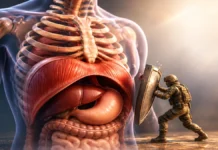

Anticipation, expectations and perception: why pain is never a simple reading of the tissues
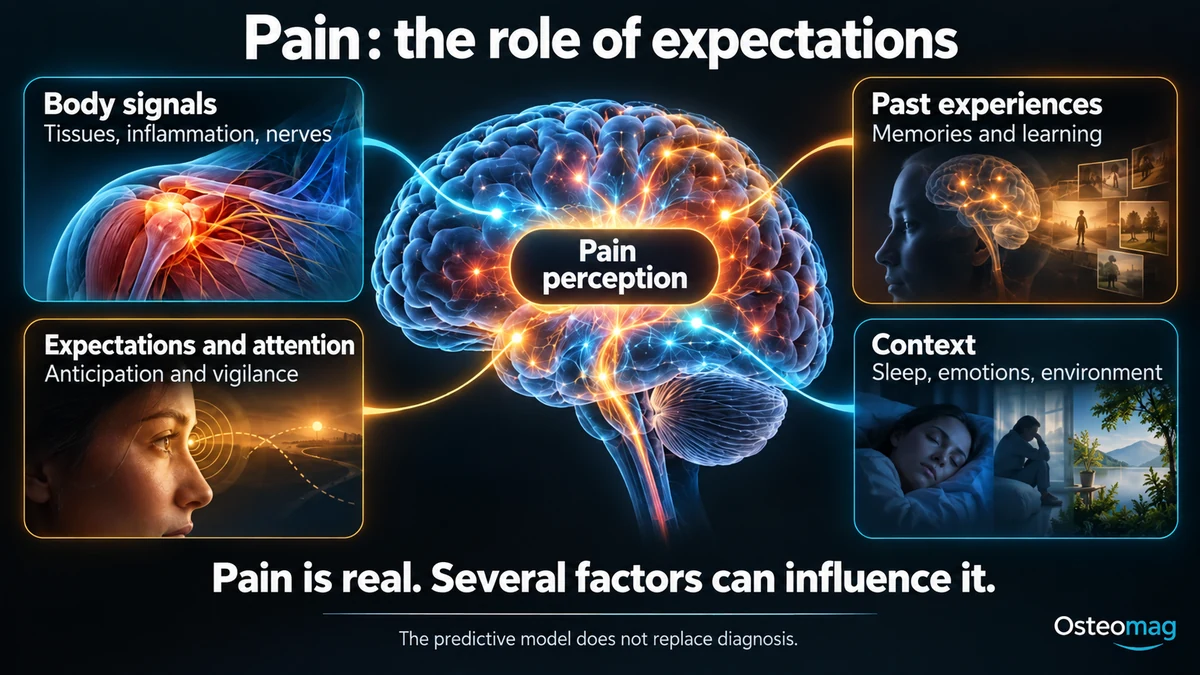
When we bump an elbow or burn ourselves, it seems intuitive to think of pain as a direct measure of what is happening in the tissues. Modern research shows a more complex picture: pain is an experience shaped by several sources of information. Signals from the body certainly matter, but they are interpreted alongside context, attention, past experience, emotional state and expectations [1, 2].
This is the setting for an idea increasingly discussed in neuroscience: the brain does not simply receive information; it also anticipates what is likely to happen. Predictive processing models propose that perception involves an ongoing dialogue between sensory signals and expectations developed through experience [3]. Applied to pain, this model may help explain why the same stimulus is not always experienced in the same way.
However, a tempting simplification must be resisted: saying that the brain “predicts” pain does not mean that it invents it. Nor does it mean that all chronic pain is a brain error. The predictive model is a useful but debated explanatory framework that must remain compatible with tissue biology, nociceptive mechanisms, diseases and actual injuries.
Pain is an experience, not a simple tissue thermometer
Nociception and pain are not synonymous. Nociception is the processing of signals that may threaten tissues. Pain is the conscious experience that may result. Their relationship matters, but it is not perfectly proportional. A major injury may sometimes cause little pain initially, while an apparently healed area can remain sensitive long after tissue repair.
This distinction does not make pain less real. It shows that the organism continuously interprets the meaning of the signals it receives. Attention to a sensation, memory of a painful episode, uncertainty or a sense of danger can influence how that sensation is interpreted [1].
Research on expectations allows this phenomenon to be observed experimentally. A meta-analysis published in 2024, covering 31 studies and 1,566 participants, found that interventions intended to change expectations had a moderate effect on pain intensity. Participants’ reported expectations also predicted part of their pain experience [2]. This does not mean that expectation explains all pain, but that it is one measurable factor among others.
Why use the word “prediction”?
In predictive processing models, the brain is described as a system continually attempting to anticipate the most likely causes of sensory information. It then compares predictions with what actually happens and gradually adjusts its internal models. This can be understood as a form of ongoing statistical learning.
For pain, the idea suggests that the brain may use previous experiences to estimate the threat associated with a sensation or movement [3]. If someone developed acute pain while bending after a back injury, for example, that movement may later become associated with an expectation of pain. On the next occasion, the organism does not start from scratch: it already has a history.
This mechanism is probably adaptive. Anticipating danger helps avoid some potentially harmful situations. A problem may arise when an old model remains highly influential after the context has changed. Someone may then adopt a protective response before a new situation has actually become threatening.
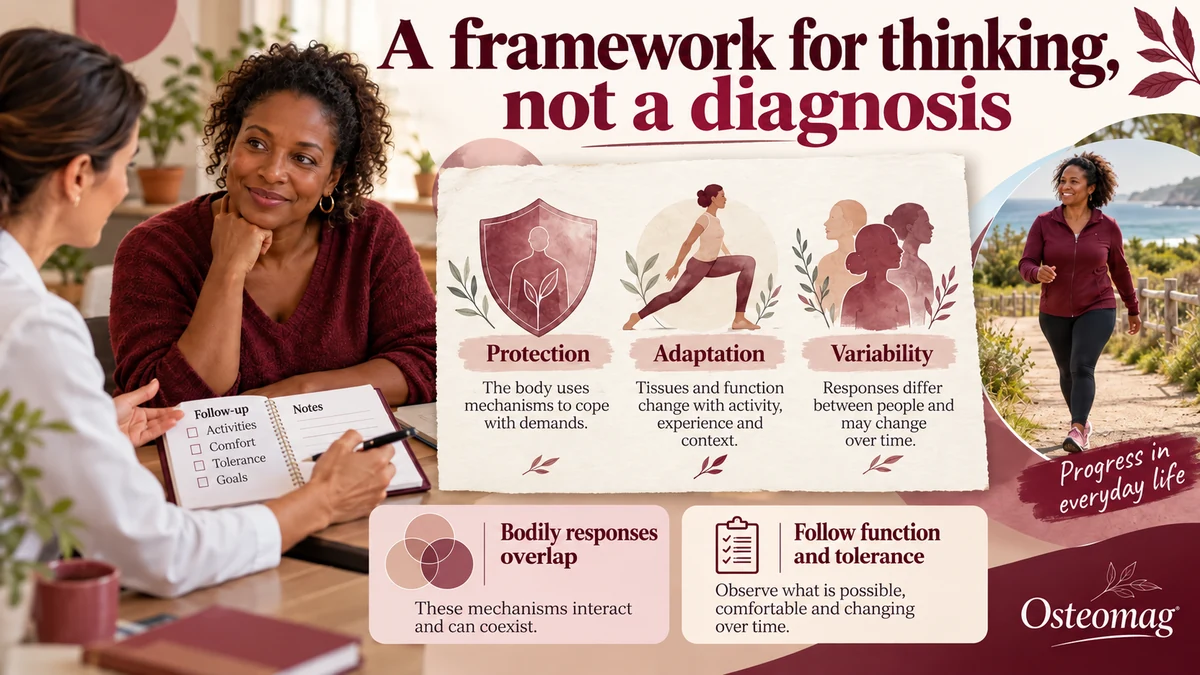
Again, caution is essential. It would be incorrect to claim that persistent pain is merely a “wrong prediction”. Peripheral, inflammatory, neuropathic, mechanical, metabolic and other mechanisms can coexist. Predictive processing does not replace diagnosis: it adds a possible level of explanation.
Expectations can increase or decrease pain
Placebo and nocebo effects are among the best-known demonstrations of the influence of context on pain. When someone expects relief, that expectation may contribute to reduced pain. Conversely, a negative expectation may increase sensitivity or amplify some sensations [2, 4, 10].
A meta-analysis of learned nocebo effects found moderate to large effects on experimental pain and itch. Effects were particularly marked when conditioning was combined with negative verbal suggestions [4]. These findings remind us that the words used in a consultation are not neutral.
Describing someone’s back as “fragile”, “worn out”, “out of place” or “unstable” may sometimes reinforce a worrying representation, especially when repeated. This does not mean that professionals should conceal diagnoses or minimise injuries. The aim is to communicate accurately without adding unnecessary threat that is unsupported by evidence.
We also learn about pain by observing others
Learning does not come only from personal experience. People learn a great deal by observing others. This principle also appears to apply to pain.
A systematic review with meta-analysis found that watching another person experience more or less pain could influence both the observer’s expectations and their pain ratings [5]. The effect on expectations was particularly large. These findings were mainly obtained in healthy participants and should not be directly applied to all clinical pain conditions. However, they show that the pain experience is sensitive to the social environment.
In everyday life, this may take several forms: a loved one’s painful experience, an alarming social media video, the account of someone met in a waiting room, or, conversely, watching someone gradually return to an activity with confidence.
Can uncertainty make pain feel more threatening?
Prediction works better when the environment is relatively stable. When sensations become unpredictable, the system must continually reassess what might happen. Experimental studies suggest that pain unpredictability influences expectations and some brain responses associated with anticipation [6].
Clinically, this idea may help explain why some variable pain experiences are so concerning. Pain that always appears after 20 minutes of walking is unpleasant but predictable. Pain that constantly changes location, intensity or trigger may be harder to interpret. Uncertainty can then become part of the experience of threat.
This does not mean that uncertainty causes pain. It may instead influence the attention, vigilance or apprehension associated with bodily sensations.
The predictive brain: an interesting hypothesis, not a universal explanation
Predictive processing is sometimes presented as a new theory capable of explaining almost all chronic pain. Using it in this way goes beyond the available evidence.
Recent reviews describe predictive coding as a promising framework for understanding the subjective nature of pain and how expectations may interact with sensory information [3]. An experimental study subsequently published in 2025 suggests that expectations mainly influence higher-level cognitive and emotional processes, without necessarily altering the earliest stages of sensory processing [7].
This distinction matters: the brain does not replace the body. It interprets information from the body and the environment. Pain can therefore be influenced by expectations while also being associated with a genuine injury, inflammation or nerve disorder.
What this changes in a consultation
The clinical value of these models is not to convince patients that their pain “comes from their brain”. That wording can be invalidating and scientifically reductive. Their value is to explain that the pain system can change and learn.
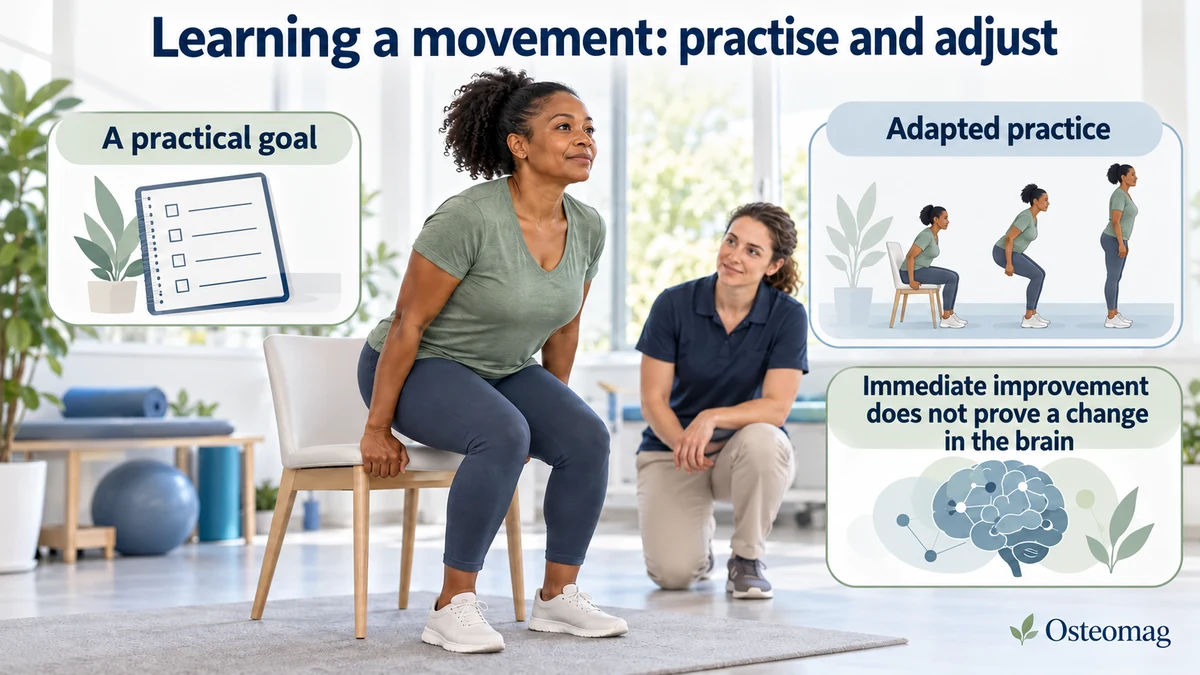
A consultation can aim to reduce unnecessary threatening information, clarify what is genuinely concerning and provide more predictable movement experiences. When a movement has been assessed as appropriate but has long been avoided, a gradual return may provide new information: it can be performed without the feared outcome.
This resembles rehabilitation approaches that focus less on “correcting” a structure and more on restoring capacity, confidence and movement options. The effect probably does not depend on a single psychological mechanism. Tissue loading, strength, sleep, activity, social context, learning and expectations may all contribute to differing degrees.
The role of osteopathy
For an osteopath, this knowledge invites reflection on what the consultation communicates as well as what the hands do. Touch, explanations, word choice and how a movement is introduced all contribute to the therapeutic context.
Research on physical interventions suggests that part of the short-term effect may relate to contextual or placebo factors, without implying that the entire treatment is “only placebo” [8]. Specific and contextual effects may coexist. Expectations and attention also require careful interpretation when considering experimental pain modulation [9].
A cautious clinical hypothesis can be proposed: a consultation that reduces unnecessary threat and improves understanding, predictability and confidence might support a different bodily experience. This hypothesis is compatible with research on expectations and learning. It does not establish that a particular technique “reprogrammes” the brain or “erases” a bodily memory.
What should be avoided?
- Claiming that all chronic pain is created by the brain.
- Using prediction to minimise an actual injury or disease.
- Promising that a change in thinking alone will eliminate pain.
- Presenting predictive models as a definitively proven theory.
- Interpreting a bodily response as proof of hidden psychological trauma.
The predictive framework is most useful when it broadens understanding without replacing the other dimensions of pain.
| Concept | What the evidence can support | What cannot be concluded |
|---|---|---|
| Expectations | They can influence experimental pain ratings [1, 2]. | They explain every person’s pain. |
| Observational learning | Other people’s experiences can influence expectations and pain in research settings [5]. | Every clinical pain problem is socially learned. |
| Predictive processing | A framework for investigating interpretation and anticipation [3]. | A diagnosis or proof that a lesion is irrelevant. |
| Clinical context | Specific and contextual effects may coexist [8]. | A particular osteopathic technique repairs or reprogrammes the brain. |
Key points
Pain depends on information from the body and on how the nervous system interprets it. Expectations, learning, attention and context can measurably influence the experience [1, 2, 5].
The idea that the brain “predicts” pain offers an interesting framework for understanding some phenomena of anticipation and protection. It must remain one scientific hypothesis among others, rather than becoming a new single explanation for every pain problem.
For Osteomag, that is precisely the value of this approach: recognising that the body and experience are inseparable without turning a useful theory into clinical certainty.
- [1] Atlas LY. How Instructions, Learning, and Expectations Shape Pain and Neurobiological Responses. Annu Rev Neurosci. 2023;46:167-189. doi:10.1146/annurev-neuro-101822-122427.
- [2] Lunde SJ, Rosenkjær S, Matthiesen ST, Kirsch I, Vase L. Conclusions Regarding the Role of Expectations in Placebo Analgesia Studies May Depend on How We Investigate It: A Meta-Analysis, Systematic Review, and Proposal for Methodological Discussions. Psychosom Med. 2024;86(7):591-602. doi:10.1097/PSY.0000000000001333.
- [3] Szigethy E, et al. Analgesia for the Bayesian Brain: How Predictive Coding Offers Insights Into the Subjectivity of Pain. Curr Pain Headache Rep. 2023. PMID: 37421540.
- [4] Thomaidou MA, Blythe JS, Peerdeman KJ, et al. Learned Nocebo Effects on Cutaneous Sensations of Pain and Itch: A Systematic Review and Meta-analysis. Psychosom Med. 2023;85(4):308-321. doi:10.1097/PSY.0000000000001194.
- [5] Meeuwis SH, Wasylewski MT, Bajcar EA, et al. Learning pain from others: a systematic review and meta-analysis of studies on placebo hypoalgesia and nocebo hyperalgesia induced by observational learning. Pain. 2023;164(11):2383-2396. doi:10.1097/j.pain.0000000000002943.
- [6] Pavy F, Zaman J, Von Leupoldt A, Torta DM. Expectations underlie the effects of unpredictable pain: a behavioral and electroencephalogram study. Pain. 2024;165(3):596-607. doi:10.1097/j.pain.0000000000003046.
- [7] Botvinik-Nezer R, et al. Expectation generation and its effect on subsequent pain and visual perception. PLOS Computational Biology. 2025;21:e1013053.
- [8] Hohenschurz-Schmidt D, Phalip J, Chan J, et al. Placebo analgesia in physical and psychological interventions: systematic review and meta-analysis of three-armed trials. Eur J Pain. 2024;28:513-531. PMID: 37985188.
- [9] Billens A, Van Oosterwijck S, Dhondt E, et al. The influence of expectations and attention on conditioned pain modulation: A systematic review and meta-analysis. Clin Psychol Rev. 2024;114:102517. doi:10.1016/j.cpr.2024.102517.
- [10] Rosenkjær S, Lunde SJ, Kirsch I, Vase L. Expectations: How and when do they contribute to placebo analgesia? Front Psychiatry. 2022;13:817179. doi:10.3389/fpsyt.2022.817179.
Educational information. New, progressive or unexplained pain, or pain associated with significant neurological, systemic or traumatic signs, requires appropriate medical assessment.