
Rebuild current capacity rather than immediately testing your previous level
Returning to an activity after several weeks off can be surprising. Someone who used to run 10 km comfortably, play tennis three times a week or garden regularly resumes at the same level—and pain returns almost immediately.
This is common. During a break, fitness, strength, endurance and the ability of tissues to tolerate loading may decrease. Yet the memory of previous activity remains intact. The problem often involves a mismatch between previous loading habits and current capacity.
What happens during a break?
The body adapts to what is asked of it. When regular activity stops, some adaptations gradually decline.
This phenomenon is called detraining.
Before attributing symptoms to a break, its reason must be understood: surgery, injury, illness, immobilization or a simple interruption. Necessary restrictions and follow-up remain the priority. The absence of pain at rest does not establish that an injury has healed.
It can affect:
- strength;
- cardiovascular endurance;
- coordination;
- tendon tolerance;
- muscle capacity;
- speed and power;
- confidence in certain movements.
Do you lose everything within a few weeks?
No. Adaptations do not all disappear at the same rate.
Detraining studies show that some strength gains may persist for several weeks or months, particularly after a long training history. [1]
However, capacity may still decrease enough for a previously easy load to become too demanding.
Do muscle mass and strength decline in the same way?
No.
A meta-analysis of training cessation in older adults shows that muscle mass may decrease over time, especially during prolonged interruptions. [2]
Neural and functional adaptations may also change. Someone can therefore feel weaker or less stable even before substantial muscle loss is visible.
A small study in older adults illustrates this distinction: after eccentric training, some functional gains persisted during the break while muscle changes regressed. This finding cannot be generalized to every activity. [3]
Why does pain return if the injury had healed?
Because healing and capacity are not synonymous.
A tissue may have repaired but be less prepared to immediately tolerate the previous activity volume.
After a break, immediately returning to heavy loading may provoke pain without necessarily causing a substantial new injury.
Do tendons lose capacity during a break?
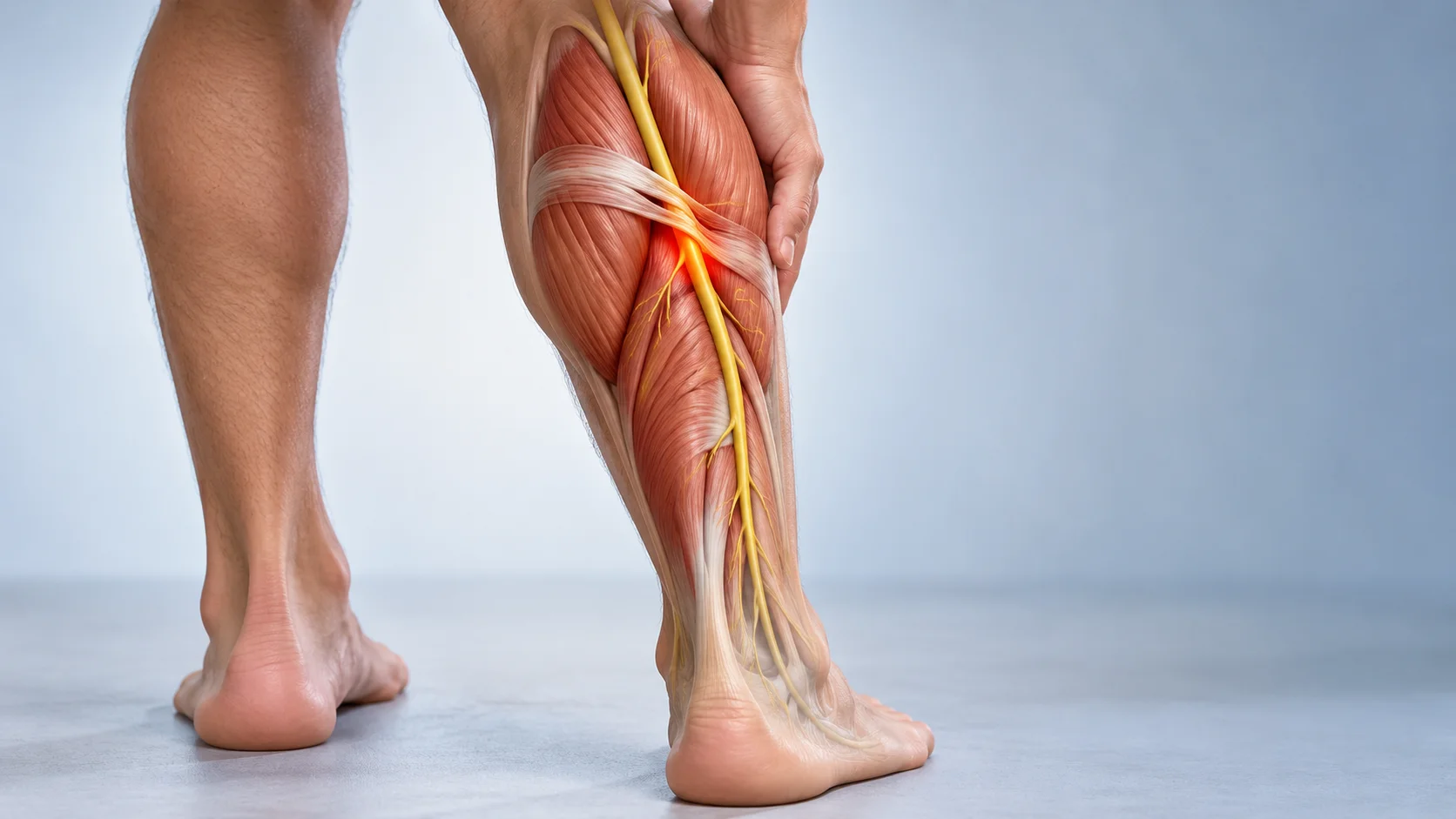
Tendons also adapt to loading. A prolonged reduction in activity may reduce the muscle-tendon unit’s capacity to tolerate substantial effort.
When someone abruptly resumes running, jumping or sports involving changes of direction, a tendon may become symptomatic again.
This is particularly common in Achilles, patellar or gluteal tendinopathy.
Why do the first sessions sometimes go well?
Pain does not always appear immediately.
Someone may resume a fairly intense session and feel fine during activity because of warming up and pain modulation.
Symptoms may return several hours later or the next morning.
This is why the response over the following 24 to 48 hours matters.
The classic mistake: resuming where you left off
Memory of the activity often encourages the same distances, weights or durations as before the break.
However, capacity may have changed.
An 8 km run that was easy before a six-week interruption may represent a very substantial load on returning.
Does acute loading matter?
Yes. A sudden increase in volume or intensity is often more problematic than steady progression.
Sports-loading models have attempted to quantify this difference using ratios between recent and habitual loading.
Recent research suggests that abrupt changes in loading may be associated with injury risk, but tools such as the acute-to-chronic workload ratio require caution because of methodological limitations and heterogeneous studies. [4] [5]
There is no perfect 10% rule
Increasing training by only 10% a week is a popular rule, but not a biological law.
Some people tolerate more; others need slower progression.
The person’s response remains more useful than a universal percentage.
No time threshold or pain score is a biological safety boundary. Next-day and 24–48-hour observations help monitoring but do not replace a diagnosis or individual restrictions. [6]
How should you resume after several weeks?
A reasonable strategy is to start below the previous level and increase gradually.
You can adjust:
- duration;
- distance;
- weight;
- number of sets;
- speed;
- weekly frequency;
- number of jumps or accelerations.
Not every variable needs reducing at the same time.
Example: returning to running
Someone who ran 30 km a week before a break does not necessarily need to return immediately to 30 km.
They can start with shorter outings, sometimes alternating walking and running, then increase according to the next-day response.
The aim is to rebuild tolerance, not immediately test the previous maximum.
Example: returning to the gym
After several weeks without strength training, resuming the same weights and number of sets may cause substantial soreness or recurrent pain.
Temporarily reducing total volume is often more useful than only reducing the weight.
Recovery speed varies; promising a return to the previous level after a few sessions is not justified.
Does muscle memory exist?
Human research has observed persistent epigenetic signatures after training. However, another trial did not show a clear retraining advantage in the previously trained limb. ‘Muscle memory’ remains a research area, not a guarantee of rapid recovery. [7] [8]
Someone with previous training may regain some capacities faster than a complete beginner.
Motor skills and some retained adaptations can support a return; their contribution varies with each person’s history.
However, this memory does not mean the body can immediately tolerate its previous load.
Why might pain appear in a different region?
After a break, movement strategy may change. Someone may have less strength or endurance and distribute loading differently.
Pain may then appear in a tendon, joint or muscle that was not previously troublesome.
This does not necessarily mean a ‘compensation’ has displaced a structure; it may simply reflect redistribution of loading.
| Stage | Question to ask | Possible adjustment |
|---|---|---|
| Before returning | Why was the activity interrupted? | Respect restrictions and medical advice. |
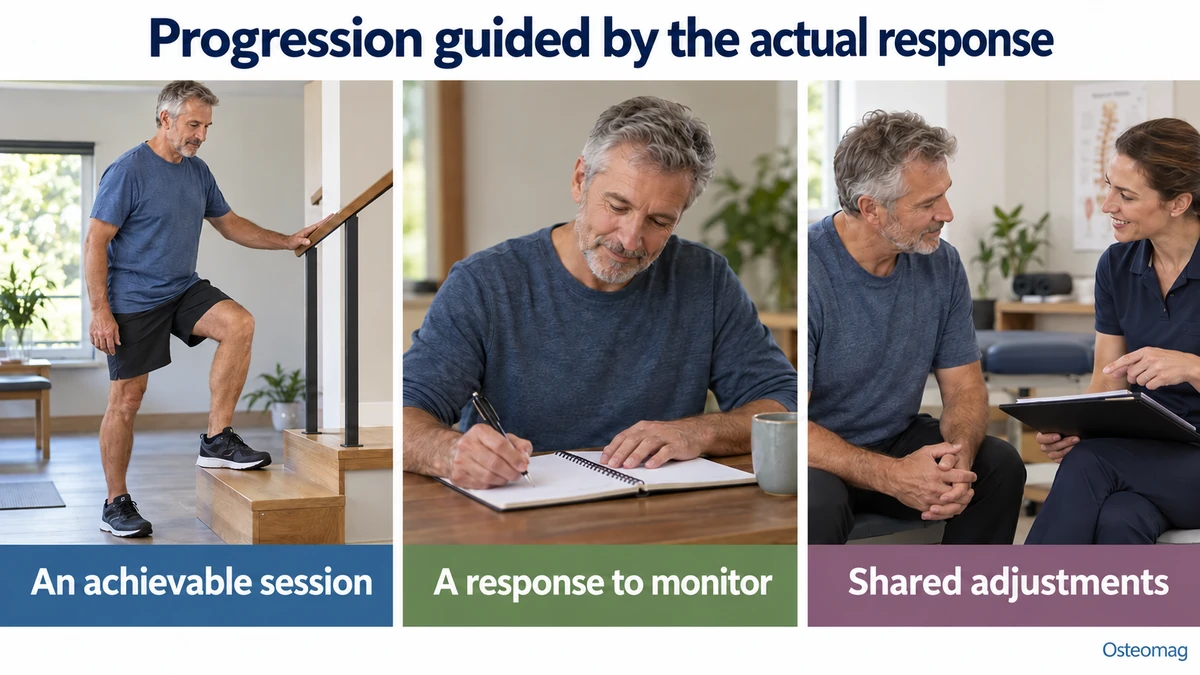
| First sessions | What dose is achievable today? | Reduce duration, volume or intensity according to context. |
| Monitoring | What happens afterwards and the next day? | Adjust gradually without seeking pain. |
| New or unusual symptom | Is there loss of strength, swelling or a systemic sign? | Seek assessment rather than attributing everything to detraining. |
Does fear of recurrence play a role?
Yes. Someone returning after a previous injury may monitor the area more closely and change how they move.
This vigilance is normal initially, but may reduce confidence and movement fluency.
A gradual return helps rebuild both physical capacity and confidence.
Pain on returning: should you stop immediately?
Not necessarily.
Mild, temporary pain may be compatible with returning to activity.
The main considerations are:
- its intensity;
- whether it changes technique;
- how long it lasts after activity;
- the next-day response;
- whether function improves or declines across sessions.
When should the dose be reduced?
Reducing loading is reasonable when:
- pain increases from session to session;
- it remains substantially worse for more than 24 to 48 hours;
- morning stiffness progressively increases;
- performance declines;
- the person starts substantially altering how they move;
- recovery becomes insufficient.
When should a new injury be suspected?
Sudden pain during effort with a snap, immediate loss of strength, rapid swelling, bruising or functional inability is more suggestive of a new injury.
This differs from pain that gradually increases after several sessions of resumed activity.
Does sleep affect the return?
Yes. Sleep affects recovery, pain perception and performance. [9]
Someone returning to intense activity while sleeping poorly may tolerate loading less well.
A return to activity must therefore be considered in the overall context: work, sleep, stress and other physical activities.
Does age change the strategy?
With age, recovery may be slower and detraining may substantially affect strength and function.
However, studies in older adults show that many training benefits partly persist after a break and can be rebuilt through resumed strengthening. [10]
It is therefore never too late to restart.
How long does it take to regain your level?
There is no universal time frame.
It depends on:
- the length of the break;
- the previous level;
- age;
- whether an injury is present;
- activity type;
- sleep and nutrition;
- consistency after returning.
After a short break, returning may be quick. After several months, a longer progression is often necessary.
Are rest days important?
Yes, especially at first.
A highly motivated person may want to ‘make up for lost time’ with several closely spaced sessions.
However, adaptation also occurs during recovery. Spacing some sessions apart may improve tolerance.
Should you only return to sport or activity once you are at 100%?
Not always.
A gradual return is often part of rehabilitation itself. [11]
The goal is progressive exposure to the actual demands of the activity, rather than waiting for theoretical perfection before any return.
Does pain mean all progress has been lost?
No.
Recurrent pain during a return does not necessarily mean being back at square one.
It may simply signal that current progression is too rapid.
A small load reduction followed by renewed progression is often enough.
Why are old injuries sometimes sensitive on returning?
A previously injured region may have less reserve or a specific tolerance that needs rebuilding.
The person may also pay closer attention to that area.
The goal is not indefinite protection, but progressively restoring sufficient capacity.
What is the role of osteopathy?
Manual treatment may help temporarily reduce pain or stiffness during a return to activity.
However, it does not replace the gradual rebuilding of capacity.
The most useful explanation is not that ‘something moved back into place’ or ‘shifted again’, but that loading needs to match current capacity.
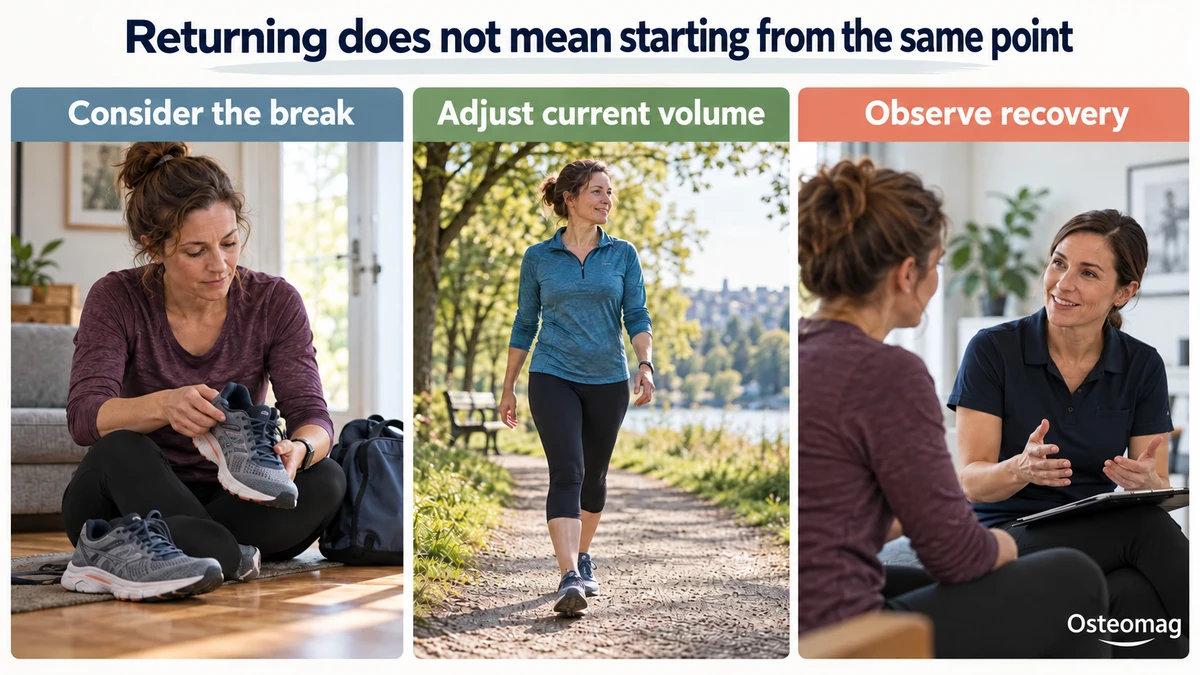
A simple four-step strategy
For many people, a return can follow four principles:
- start below the previous level;
- observe the response during activity and the next day;
- increase one variable at a time;
- reduce slightly if symptoms accumulate.
This approach is more flexible than a fixed rule and adapts to the person’s actual response.
When should you seek assessment?
Assessment is recommended if pain is accompanied by:
- sudden loss of strength;
- a snap with functional inability;
- substantial swelling;
- neurological symptoms;
- pain that progresses despite a reasonable load reduction;
- fever or systemic symptoms;
- chest pain or shortness of breath;
- an inability to resume activity gradually.
Conclusion
Pain that returns after several weeks off does not automatically mean an old injury has returned or a new injury has occurred.
One common possibility is that capacity decreased while the memory of the previous level remained intact. However, this is not the only explanation for recurrent pain; its pattern and evolution must remain compatible with that hypothesis.
The solution is generally to rebuild loading progressively: restart a little below the previous level, observe the response and increase step by step. The body may regain some previous capacities quickly, provided it has time to readapt.
References
- [1] Yang Y, Chen SC, Chen CN et al. Training Session and Detraining Duration Affect Lower Limb Muscle Strength Maintenance in Middle-Aged and Older Adults: A Systematic Review and Meta-Analysis. J Aging Phys Act. 2022;30(3):552-566. doi:10.1123/japa.2020-0493.
- [2] Grgic J. Use It or Lose It? A Meta-Analysis on the Effects of Resistance Training Cessation (Detraining) on Muscle Size in Older Adults. Int J Environ Res Public Health. 2022;19(21):14048. doi:10.3390/ijerph192114048.
- [3] Baxter BA, Baross AW, Ryan DJ et al. Effects of detraining on neuromuscular function and structural adaptations following once- or twice-weekly eccentric resistance training in older adults. Aging Clin Exp Res. 2024;36(1):177. doi:10.1007/s40520-024-02828-1.
- [4] Qin W, Li R, Chen L. Acute to chronic workload ratio (ACWR) for predicting sports injury risk: a systematic review and meta-analysis. BMC Sports Sci Med Rehabil. 2025;17(1):285. doi:10.1186/s13102-025-01332-x.
- [5] Impellizzeri FM, Tenan MS, Kempton T et al. Acute:Chronic Workload Ratio: Conceptual Issues and Fundamental Pitfalls. Int J Sports Physiol Perform. 2020;15(6):907-913. doi:10.1123/ijspp.2019-0864.
- [6] Escriche-Escuder A, Casaña J, Cuesta-Vargas AI. Load progression criteria in exercise programmes in lower limb tendinopathy: a systematic review. BMJ Open. 2020;10(11):e041433. doi:10.1136/bmjopen-2020-041433.
- [7] Seaborne RA, Strauss J, Cocks M et al. Human Skeletal Muscle Possesses an Epigenetic Memory of Hypertrophy. Sci Rep. 2018;8(1):1898. doi:10.1038/s41598-018-20287-3.
- [8] Psilander N, Eftestøl E, Cumming KT et al. Effects of training, detraining, and retraining on strength, hypertrophy, and myonuclear number in human skeletal muscle. J Appl Physiol (1985). 2019;126(6):1636-1645. doi:10.1152/japplphysiol.00917.2018.
- [9] Runge N, Ahmed I, Saueressig T et al. The bidirectional relationship between sleep problems and chronic musculoskeletal pain: a systematic review with meta-analysis. Pain. 2024;165(11):2455-2467. doi:10.1097/j.pain.0000000000003279.
- [10] Buendía-Romero Á, Vetrovsky T, Hernández-Belmonte A et al. Residual Effects of Physical Exercise After Periods of Training Cessation in Older Adults: A Systematic Review With Meta-Analysis and Meta-Regression. Scand J Med Sci Sports. 2025;35(1):e70010. doi:10.1111/sms.70010.
- [11] Ardern CL, Glasgow P, Schneiders A et al. 2016 Consensus statement on return to sport from the First World Congress in Sports Physical Therapy, Bern. Br J Sports Med. 2016;50(14):853-64. doi:10.1136/bjsports-2016-096278.