
Heart rate variability, breathing and touch: separating measured responses from demonstrated clinical benefits
The autonomic nervous system is often used to explain the effects of osteopathic care. A session is said to “stimulate the vagus,” “calm the sympathetic system” or “rebalance” the body. Some studies do observe physiological changes after manual care. However, a change in heart rate or heart rate variability does not demonstrate a lasting correction of overall autonomic function. [1]
Reliable information separates three levels: what is measured, what the measurement may mean and what the person actually gains in health or function. Relaxation can be welcome without a specific neural mechanism being established. Conversely, repeated faintness or difficulty tolerating standing needs medical assessment rather than an explanation based on tissue tension.
Understanding autonomic function beyond two opposing switches
The autonomic system contributes to regulation of the heart, vessels, glands and many organs. Its pathways are coordinated with the brain, brainstem, spinal cord and information from the body. Sympathetic and parasympathetic branches participate in continuous adjustments: they do not simply correspond to stress and relaxation. Their activity supports adaptation to changing circumstances rather than a permanent preference for one branch.
Sympathetic activity is essential for adapting to exercise and maintaining blood pressure when standing up. Parasympathetic pathways, including certain vagal fibres, contribute to cardiac modulation and several visceral functions. Their effects depend on the organ and situation; an increase in one branch does not always mean a decrease in the other. [9]
Breathing needs a further distinction. Brainstem networks generate its rhythm, respiratory muscles receive somatic motor commands and conscious control can change the breath. Autonomic pathways modulate aspects including the airways and cardiovascular interactions. Saying that “all breathing depends on the vagus” would therefore be inaccurate.
HRV: what heart rate variability measures
Heart rate variability, or HRV, describes variation in the intervals between beats. Rigorous physiological interpretation generally uses intervals between normal beats after checking the signal and artefacts. Average heart rate and its variability are different pieces of information: a slower heart does not necessarily have higher variability. [2]
RMSSD summarizes certain differences between successive intervals. Under appropriate conditions it provides information about cardiac vagal modulation, but it does not directly measure the entire vagus nerve, digestive organs or a global state of safety. Frequency-domain measures also require attention to breathing and the recording protocol. The LF/HF ratio is not a reliable measure of “sympathetic–parasympathetic balance.” [3] [9]
A watch often uses an optical pulse signal rather than an electrocardiogram. Movement, contact quality, irregular beats and algorithms can change the result. Scores from different devices or recordings of different lengths are not automatically comparable. An isolated value does not establish a diagnosis. Its meaning also depends on why and under which conditions the measurement was taken. [10]

Why does breathing change the results?
Heart rate naturally varies with the breathing cycle. Breathing rate and depth therefore influence several HRV measures, interacting with blood pressure regulation. During slow breathing, some respiratory oscillations can move into the low-frequency band: their presence does not demonstrate sympathetic activation. [3] [9]
A meta-analysis of voluntary slow breathing reports changes in vagally mediated indices, distinguishing recordings during breathing, immediately after one session and after repeated sessions. This distinction matters: a measurement during paced breathing does not necessarily describe a person’s usual state. A training-related response and a resting measurement answer different questions. [4]
When manual care is accompanied by slower breathing, lying down or prolonged rest, these factors may contribute to the observed change. To attribute an effect specifically to treatment, a study must control these differences as far as possible. A higher number after a session cannot, by itself, separate these explanations or show which component mattered most.
What the research supports
A 2024 systematic review of osteopathic techniques brings together autonomic and respiratory findings from varied protocols and populations. A 2026 synthesis of 50 manual therapy studies also describes different responses across interventions. These findings do not support one uniform autonomic response applicable to every session and every patient. [1] [5]
Another 2026 meta-analysis, focused on cardiovascular function, reports some immediate changes after osteopathic treatment. It nevertheless highlights insufficient data for assessing effects beyond one hour. A short laboratory response therefore establishes neither lasting correction of dysautonomia nor long-term improvement in cardiovascular health. [6]
Methodological quality matters as much as the direction of a result. Group size, a credible comparator, breathing, expectations and transparent analysis affect confidence in conclusions. A 2025 review of recent osteopathic trials identifies several trustworthiness concerns. This calls for assessing individual studies, without automatically accepting every positive finding or dismissing all care. [7]
Findings on craniosacral approaches likewise do not justify promises of vagal regulation or treatment of dysautonomia. A 2024 clinical meta-analysis does not find robust, generalizable benefits across the many indications examined; it should not be reinterpreted as a direct test of every proposed autonomic mechanism. Clinical outcomes and physiological hypotheses must remain distinguishable. [8]
Interpreting a change without exceeding the evidence
| Observation | Possible interpretation | Conclusion not established |
|---|---|---|
| Higher RMSSD after a session | Changed cardiac vagal modulation under these conditions | Rebalancing of the entire autonomic system |
| Lower heart rate | Rest, breathing, context or another physiological response | Treatment of a heart condition |
| Higher HRV during slow breathing | Changed cardiorespiratory coupling | Lasting correction of dysautonomia |
| Feeling relaxed | A subjective comfort benefit | Proof of specific vagus nerve stimulation |
| A lower watch score one morning | A reading requiring context and a signal quality check | Diagnosis of autonomic disease |
This distinction also helps protect against anxious monitoring. Comfort, sleep, activity tolerance and personal goals are more useful for following care than a constant search for the best score. A measurement should serve a clear purpose rather than become another source of worry.
Dysautonomia: symptoms, examination and differential diagnosis
Dysautonomia refers to disorders of autonomic regulation. Faintness when standing, a racing heart, sweating changes or digestive difficulties may lead to investigation, but these symptoms have many other causes. Low HRV cannot confirm dysautonomia, and high HRV cannot exclude it. The clinical pattern remains essential to interpretation.
Medical assessment may include symptom history, examination, heart rate and blood pressure lying down and standing, and an electrocardiogram. Depending on the presentation, the physician considers causes including anaemia, dehydration, arrhythmia and endocrine disease. Imaging is not a routine test for a complaint of “autonomic imbalance”; it addresses a specific suspicion. Additional investigations are selected for the question that needs resolving.
POTS is a medical syndrome defined by criteria combining orthostatic symptoms and a heart rate response, after excluding other explanations. Feeling a racing heart on standing is therefore insufficient. Canadian recommendations describe a structured assessment; manual care is not an established treatment for this syndrome. [11] [12]
Comfortable breathing: an option rather than an obligation
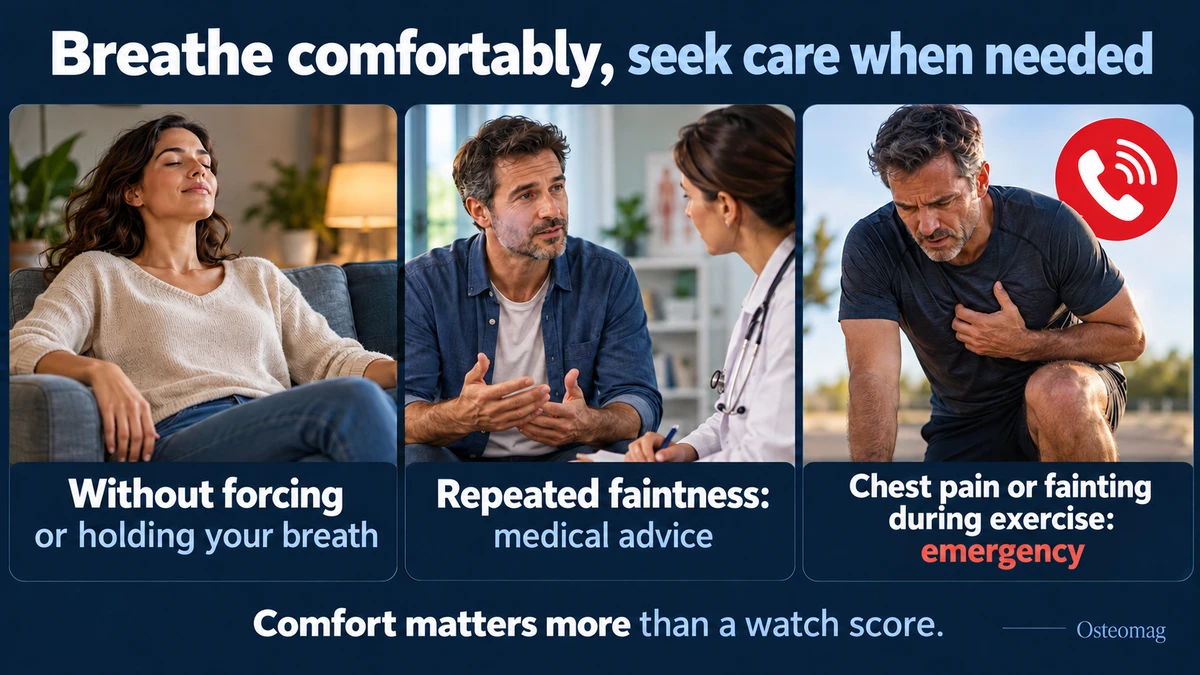
Someone who feels better when slightly slowing their breath may use this as a comfort strategy in a stable position, without forcing. The aim is not to fill the lungs maximally, hold the breath for a long time or achieve a target HRV number. Breathing slowly and breathing excessively deeply are different things. The exercise should remain easy enough to stop without difficulty.
If an exercise causes dizziness, tingling or air hunger, stop and return to usual breathing. New, severe or persistent symptoms need assessment rather than automatic attribution to anxiety. With known cardiorespiratory disease or recurrent faintness, exercise selection should be discussed with the healthcare team. Comfortable breathing does not replace investigation of unexplained symptoms.
The suitable rhythm depends on the individual. A few comfortable cycles and attention to how they feel can be enough to start, without imposing a universal pace. An app is not essential. The goal is greater everyday independence rather than completing an exercise at the expense of comfort or repeatedly checking a device.
The realistic role of osteopathic care and functional follow-up
An osteopath can adapt positioning, obtain consent, account for apprehension and offer comfortable touch within their professional scope. Supporting musculoskeletal symptoms may help some people move more comfortably. These goals should be described in their own right rather than attributed to an unmeasured autonomic correction. The person should understand what the session is intended to achieve.
An osteopath does not medically diagnose dysautonomia and cannot “feel” POTS or a vagal state in tissues. Any HRV measurement requires a reproducible protocol and does not replace medical examination. The practitioner must explain the tool’s limits and avoid labelling a person from a score. Temporary relaxation also cannot exclude an underlying disorder.
Follow-up can focus on a chosen activity, sleep comfort or symptom frequency, coordinated with other professionals. Activity progression depends on clinical status; someone with orthostatic intolerance should not simply be told to “exercise more.” When anxiety becomes overwhelming, referral to a mental health professional is appropriate; the osteopath is not acting as a psychotherapist. The care plan should respect both medical findings and the person’s priorities.
When is prompt medical care needed?
Loss of consciousness during exercise, chest pain, major breathlessness or palpitations with marked faintness require urgent assessment. Repeated fainting, falls or worsening tolerance of standing needs medical advice without waiting through a series of manual sessions. These symptoms deserve attention even when stress or changes in breathing are also present. [11] [12]
Explanations involving stress or autonomic function must not delay assessment. Once the situation is clarified, care may involve several professionals and progressive goals suited to the diagnosis. The plan follows clinical progress rather than a watch curve alone, and should be reviewed when symptoms change.
Key points
Breathing, rest and some manual interventions can change autonomic markers. Interpretation must distinguish cardiac modulation, perceived comfort and lasting benefit. Credible osteopathic care explains these limits, supports function and refers when symptoms require medical investigation.
Scientific references
- [1] Stępnik J, Czaprowski D, Kędra A. Effect of manual osteopathic techniques on the autonomic nervous system, respiratory system function and head-cervical-shoulder complex—a systematic review. Front Med. 2024;11:1358529. PubMed.
- [2] Laborde S, Mosley E, Thayer JF. Heart Rate Variability and Cardiac Vagal Tone in Psychophysiological Research—Recommendations for Experiment Planning, Data Analysis, and Data Reporting. Front Psychol. 2017;8:213. PubMed.
- [3] Billman GE. The LF/HF ratio does not accurately measure cardiac sympatho-vagal balance. Front Physiol. 2013;4:26. DOI.
- [4] Laborde S, Allen MS, Borges U, et al. Effects of voluntary slow breathing on heart rate and heart rate variability: A systematic review and a meta-analysis. Neurosci Biobehav Rev. 2022;138:104711. PubMed.
- [5] Biological effects of technique-specific manual therapy in healthy individuals and people with musculoskeletal disorders: a systematic review with meta-analysis. J Man Manip Ther. 2026. doi:10.1080/10669817.2026.2725751. PubMed.
- [6] Effects of osteopathic manipulative treatment on cardiovascular function: a systematic review and meta-analysis. Int J Osteopath Med. 2026. doi:10.1016/j.ijosm.2026.100813. DOI.
- [7] Sénéquier A, et al. Investigating the trustworthiness of randomized controlled trials in osteopathic research: a systematic review with meta-analysis. J Clin Epidemiol. 2025;111788. PubMed.
- [8] Amendolara A, Sheppert A, Powers R, et al. Effectiveness of osteopathic craniosacral techniques: a meta-analysis. Front Med. 2024;11:1452465. PubMed.
- [9] Quigley KS, et al. Publication guidelines for human heart rate and heart rate variability studies in psychophysiology—Part 1: Physiological underpinnings and foundations of measurement. Psychophysiology. 2024;e14604. DOI.
- [10] Guidelines for rigor and reproducibility of heart rate variability within human cardiovascular research. Am J Physiol Heart Circ Physiol. 2026. doi:10.1152/ajpheart.00041.2026. PubMed.
- [11] Raj SR, Fedorowski A, Sheldon RS. Diagnosis and management of postural orthostatic tachycardia syndrome. CMAJ. 2022;194:E378–E385. PubMed.
- [12] Raj SR, Guzman JC, Harvey P, et al. Canadian Cardiovascular Society Position Statement on Postural Orthostatic Tachycardia Syndrome (POTS) and Related Disorders of Chronic Orthostatic Intolerance. Can J Cardiol. 2020. PubMed.