Sleep, position and warning signs: interpreting night-time pain
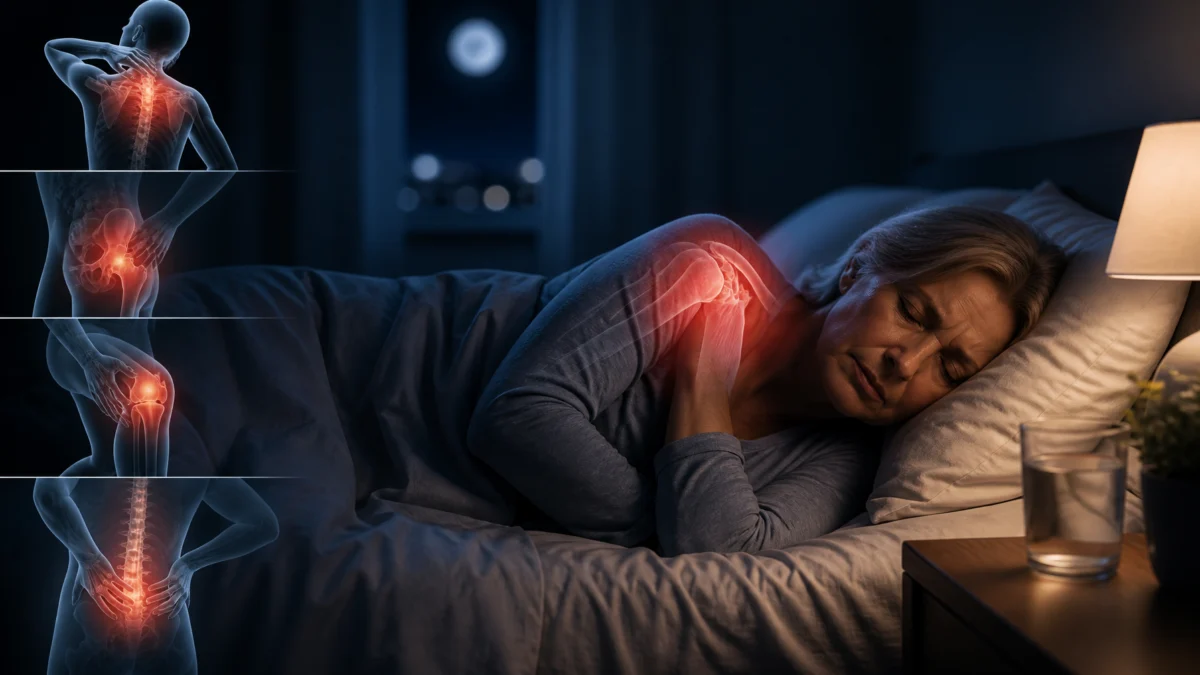
Why does pain sometimes seem much worse at night? Some people fall asleep fairly comfortably, then wake at 2 or 3 a.m. with a painful back, hip, shoulder or knee. Others find that pain is moderate during the day but becomes overwhelming as soon as they lie down.
Night-time pain has several possible explanations: a sustained position, immobility, osteoarthritis, inflammation, neuropathy, fragmented sleep or increased pain sensitivity. Less commonly, it may accompany a more serious illness. Context is therefore essential: pain at night is not automatically a ‘red flag’, but neither should it be dismissed when it is new, progressive or associated with other concerning signs.
New back pain in someone with current or previous cancer requires prompt contact with their medical team. If there is weakness, difficulty walking or new bladder or bowel problems, assessment becomes urgent. [1]
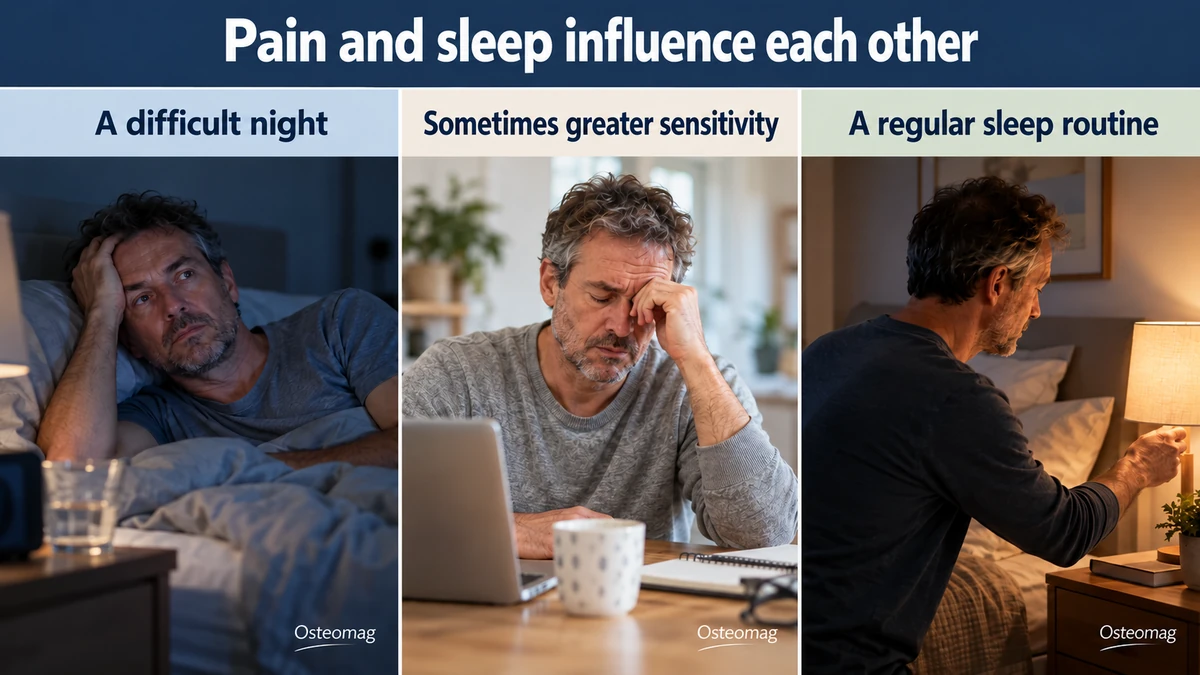
Why can pain become more noticeable at night?
During the day, work, travel, conversations and activity occupy our attention. At night, these distractions disappear. A sensation that has been present for several hours may therefore become much more noticeable.
This is not ‘all in your head’ in the sense of being imaginary. Attention genuinely influences pain perception. When there is less external stimulation, bodily signals may become more prominent.
Prolonged immobility plays a role
Sleep involves several relatively long periods in the same position. A sensitive joint or painful muscle region may become more uncomfortable after an hour or two without movement.
On waking, moving, walking or changing position may sometimes reduce symptoms quickly. This pattern is common in several musculoskeletal pain conditions and does not necessarily indicate a serious illness.
Can osteoarthritis hurt more at night?
Yes. Some people with knee or hip osteoarthritis report night-time pain, particularly when their condition is more symptomatic.
A recent meta-analysis of people with hip or knee osteoarthritis also shows a strong association between painful osteoarthritis and poor sleep quality. Pain can disrupt sleep, but poor sleep may also make pain more intense the next day. [2]
The relationship is therefore often bidirectional. [3]
Sleep genuinely influences pain
Evidence shows a prospective association between disturbed sleep and chronic musculoskeletal pain. A 2024 systematic review included more than 116,000 participants; its findings do not prove that one poor night’s sleep alone causes an individual’s future pain. [4]
Another review of day-to-day fluctuations shows that the quality of a night’s sleep often predicts next-day pain more strongly than the previous day’s pain predicts sleep quality. [5]
These statistical associations and experimental studies support the importance of sleep, without making it possible to predict an individual’s next-day pain precisely.
Why does poor sleep increase sensitivity?
The exact mechanisms are complex. Sleep loss can affect attention, mood, some neuroimmune functions and the systems that normally modulate pain.
Experimental studies suggest that insufficient sleep may reduce the nervous system’s ability to inhibit some painful signals. However, describing the nervous system as ‘dysregulated’ or ‘blocked’ would be oversimplified.
It is more accurate to say that sleep is one of the factors influencing pain sensitivity.
Is a poor sleeping position responsible?
Sometimes, but not always. A position that compresses a painful shoulder, holds the hip in rotation or places the spine in a poorly tolerated position may provoke symptoms.
However, there is no single universally ‘correct position’. Some people sleep better on their back, others on their side. Comfort and the ability to change position remain the main considerations.
A pillow or cushion between the knees may help some people, especially those with hip or pelvic pain, but this is not an absolute rule.
Shoulder pain at night
Shoulder pain associated with the rotator cuff, bursitis or osteoarthritis may be more troublesome at night, particularly when sleeping on the affected side.
A cushion beneath the arm or in front of the chest may sometimes reduce perceived tension. However, progressive strengthening and rehabilitation matter more in the long term than finding a perfect position.
Pain on the outside of the hip
Pain on the outside of the hip, often related to greater trochanteric pain syndrome or the gluteal tendons, may be very sensitive to compression at night.
Sleeping directly on the painful hip may increase local pressure. Sleeping on the other side with a cushion between the knees may reduce tension and compression for some people.
Low back pain at night
Mechanical low back pain may be more noticeable at night simply because a position is held for a long time, or because muscles and joints become more sensitive after a demanding day.
Night-time low back pain alone is not enough to conclude that a serious illness is present. Studies of red flags show that night pain, taken in isolation, has poor diagnostic accuracy for detecting cancer or another serious condition. [6]
Is night-time pain a sign of cancer?
It may be part of the clinical picture, but on its own, it is not a good screening test.
Reviews of low back pain red flags show that several traditionally taught signs, including night pain, have limited accuracy when used alone. [7]
For spinal malignancy, the factor that generally raises suspicion most is a personal history of cancer. Combining several factors—a cancer history, unexplained weight loss, progressive pain and lack of improvement—is much more informative than night pain alone. [8]
When does night-time pain become more concerning?
Seek assessment more promptly if the pain is: [9]
- new and progressively more intense;
- constant and little affected by position;
- associated with unexplained weight loss;
- accompanied by fever or unusual night sweats;
- present in someone with a history of cancer;
- associated with neurological weakness, substantial numbness or bladder or bowel control problems;
- present after significant trauma;
- associated with an unexplained decline in general health.
| Observed pattern | Useful question | Next step |
|---|---|---|
| Positional pain | Does changing position help? | Adjust comfort and monitor changes. |
| Repeated waking and fatigue | Is sleep becoming persistently disrupted? | Assess pain and insomnia together. |
| New pain with cancer, fever or a neurological deficit | Which associated signs are present? | Prompt medical advice; emergency assessment for an acute neurological deficit. |
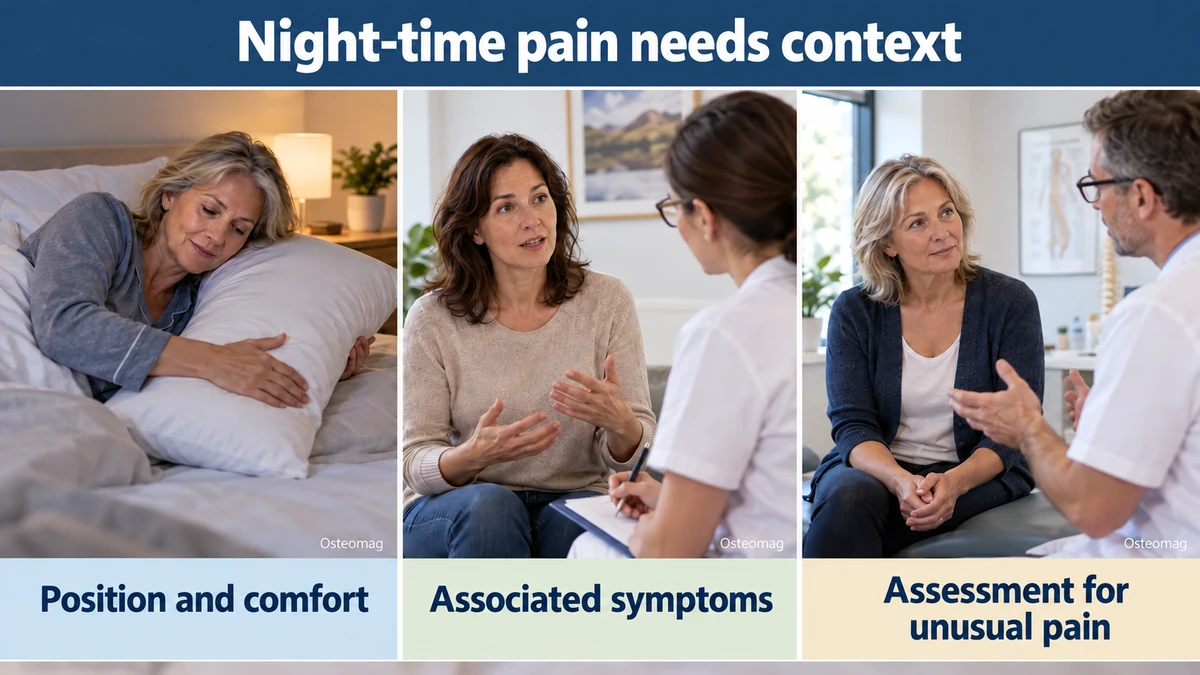
Inflammatory pain: often worse at rest
Some inflammatory conditions follow a different pattern from purely mechanical pain. Spondyloarthritis may cause night waking, prolonged morning stiffness and improvement with activity rather than rest.
Psoriasis, uveitis, inflammatory bowel disease or a family history may increase suspicion. [10]
Pain that repeatedly wakes someone in the second half of the night and improves on getting up should be discussed with a healthcare professional, especially in a relatively young person.
Neuropathy and night-time pain
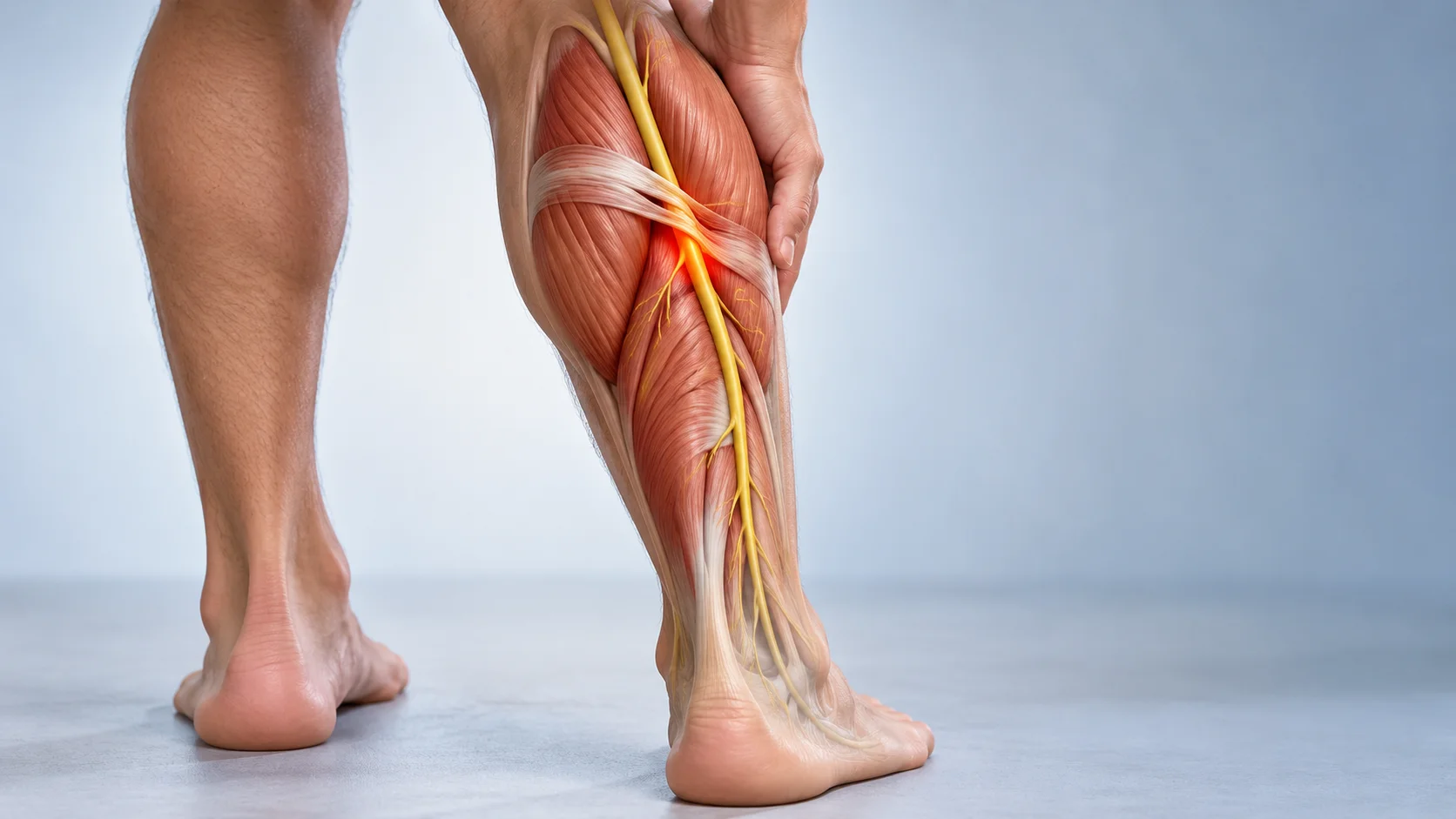
Nerve pain may also be more noticeable at night. Some neuropathies cause burning, tingling, electric-shock sensations or very hot-feeling feet while the person is at rest.
Symptoms may relate to diabetic neuropathy, nerve root involvement or other neurological conditions. Persistent nerve pain warrants a specific assessment.
Why can a lack of movement amplify nerve pain?
During the day, changing positions continually alters tension and pressure around nerves. At night, a sustained position may irritate an already sensitive area.
For example, someone with carpal tunnel syndrome may wake with a numb hand when the wrist remains bent for a long time.
Can stress make night-time pain worse?
Yes, indirectly. A stressful day may interfere with falling asleep, increase vigilance and make someone more attentive to bodily sensations.
Stress does not explain all pain and should not be used to psychologize a symptom. However, it can modulate sleep and sensitivity, especially when pain is persistent.
Osteoarthritis, inflammation and cancer-related pain: how can they be distinguished?
No single criterion is perfect, but some patterns can guide assessment:
- Osteoarthritis: pain often related to activity, stiffness after rest, and sometimes night pain when the joint is very symptomatic.
- Inflammatory disease: prolonged morning stiffness, night waking, improvement with activity, swelling or other inflammatory manifestations.
- Tumour-related pain: sometimes progressive, persistent, less dependent on position and associated with other contextual factors, particularly a cancer history or weight loss.
These patterns are guides, not diagnoses.
Should you change your mattress?
Not necessarily. A very worn or clearly uncomfortable mattress may contribute to the problem, but no material or firmness is ideal for everyone.
If pain is new but the mattress has not changed, avoid concluding too quickly that it is the cause. The mattress is one contextual factor among others.
Can a position ‘decompress’ the spine?
Some positions may feel more comfortable, but the idea of ‘decompression’ is often exaggerated. The spine normally tolerates substantial loads, and disc height changes naturally throughout the day.
A cushion under the knees when lying on the back, or between the knees when lying on the side, may reduce discomfort for some people without needing to describe this as ‘putting vertebrae back into place’.
The role of physical activity
Regular physical activity improves sleep for many people and is also an important intervention for several musculoskeletal pain conditions.
A completely inactive day may sometimes increase night-time stiffness. Conversely, an unfamiliar load or excessive effort can also increase symptoms.
The aim is therefore regular, progressive and appropriately adapted activity.
What can you do when pain wakes you?
If there are no contraindications, a few simple strategies can be tried:
- change position;
- make a few gentle movements;
- walk for a few minutes;
- use a cushion to reduce local compression;
- avoid spending a long time struggling with pain in the same position;
- note whether particular positions or daytime activities consistently affect the night.
Should you seek assessment if pain wakes you every night?
Yes, when awakenings recur, worsen or clearly affect daily life. Do not wait several weeks if the pain is new, unusual or associated with a warning sign.
Care can then address both the musculoskeletal problem and sleep quality.
What is the role of osteopathy?
Osteopathy may help with some musculoskeletal pain associated with stiffness or limited movement. A session may improve comfort and make returning to activity easier.
However, it must not dismiss new, progressive night-time pain or pain accompanied by systemic signs. A responsible practitioner must recognize situations requiring medical investigation.
Explanations such as ‘your body releases its tensions at night’ or ‘your night pain comes from circulating toxins’ should also be avoided. These mechanisms have not been demonstrated.
Sleep sometimes needs to become a treatment target
For someone with persistent pain, improving sleep can be part of care. This may include regular bed and waking times, morning light exposure, less late-day caffeine, physical activity and treatment for insomnia when present.
Significant chronic insomnia may benefit from cognitive behavioural therapy for insomnia, which has a strong scientific evidence base. [11]
Conclusion
Night-time pain may relate to position, immobility, osteoarthritis, nerve pain or poor sleep itself. It is common in several musculoskeletal conditions and is therefore not automatically a sign of serious illness.
Context is what matters. Isolated positional night pain is generally less concerning than progressive, constant pain associated with weight loss, fever, neurological symptoms or a cancer history.
The relationship between sleep and pain is also bidirectional: pain disrupts sleep, but poor sleep can in turn amplify pain. Effective care therefore benefits from addressing both when the problem becomes chronic.
References
- [1] National Institute for Health and Care Excellence. Spinal metastases and metastatic spinal cord compression. NICE guideline NG234. 2023.
- [2] Panigrahi A, Sahu P, Mohanty SS et al. Sleep disturbances and sleep quality among individuals diagnosed with osteoarthritis: a systematic review and meta-analysis. Front Med (Lausanne). 2025;12:1653047. doi:10.3389/fmed.2025.1653047.
- [3] Santos M, Gabani FL, de Andrade SM et al. The bidirectional association between chronic musculoskeletal pain and sleep-related problems: a systematic review and meta-analysis. Rheumatology (Oxford). 2023;62(9):2951-2962. doi:10.1093/rheumatology/kead190.
- [4] Runge N, Ahmed I, Saueressig T et al. The bidirectional relationship between sleep problems and chronic musculoskeletal pain: a systematic review with meta-analysis. Pain. 2024;165(11):2455-2467. doi:10.1097/j.pain.0000000000003279.
- [5] Goossens Z, Van Stallen A, Vermuyten J et al. Day-to-day associations between pain intensity and sleep outcomes in an adult chronic musculoskeletal pain population: A systematic review. Sleep Med Rev. 2025;79:102013. doi:10.1016/j.smrv.2024.102013.
- [6] Verhagen AP, Downie A, Maher CG et al. Most red flags for malignancy in low back pain guidelines lack empirical support: a systematic review. Pain. 2017;158(10):1860-1868. doi:10.1097/j.pain.0000000000000998.
- [7] Notarangelo G, Margelli M, Giovannico G et al. Diagnostic Utility of Red Flags for Detecting Spinal Malignancies in Patients with Low Back Pain: A Scoping Review. J Clin Med. 2025;14(20):7174. doi:10.3390/jcm14207174.
- [8] Downie A, Williams CM, Henschke N et al. Red flags to screen for malignancy and fracture in patients with low back pain: systematic review. BMJ. 2013;347:f7095. doi:10.1136/bmj.f7095.
- [9] Finucane LM, Downie A, Mercer C et al. International Framework for Red Flags for Potential Serious Spinal Pathologies. J Orthop Sports Phys Ther. 2020;50(7):350-372. doi:10.2519/jospt.2020.9971.
- [10] National Institute for Health and Care Excellence. Spondyloarthritis in over 16s: diagnosis and management. NICE guideline NG65. 2017.
- [11] Selvanathan J, Pham C, Nagappa M et al. Cognitive behavioral therapy for insomnia in patients with chronic pain – A systematic review and meta-analysis of randomized controlled trials. Sleep Med Rev. 2021;60:101460. doi:10.1016/j.smrv.2021.101460.