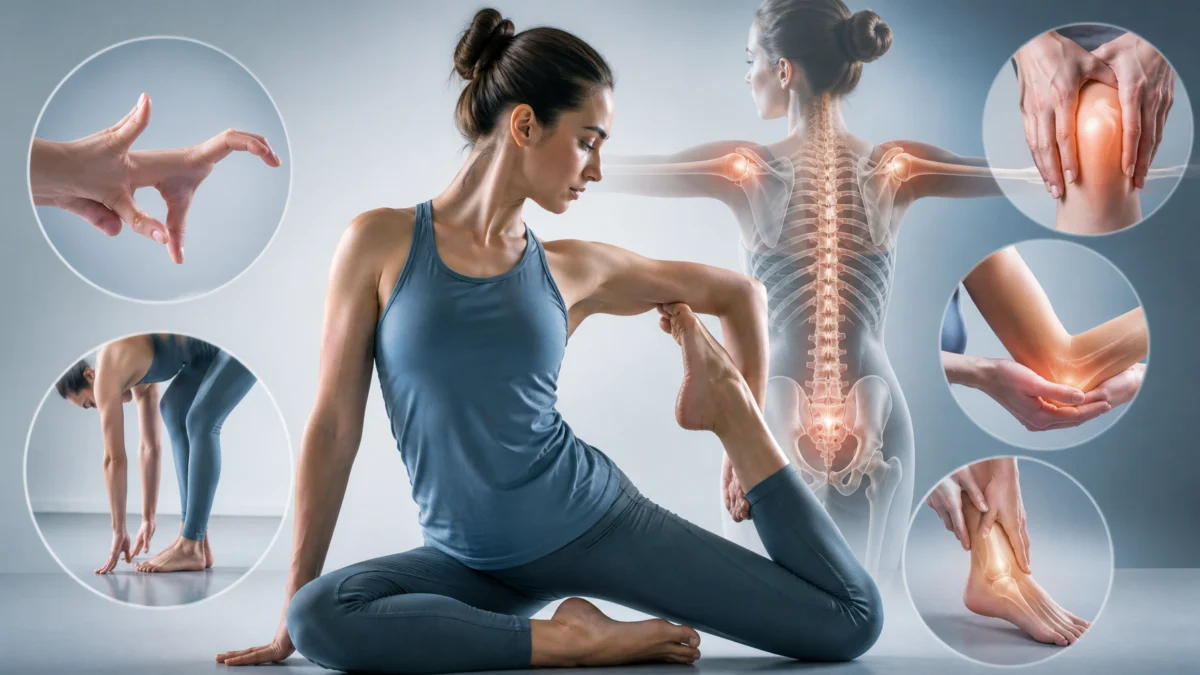
A large range of motion, instability and symptoms are not the same thing
Being very flexible is not necessarily a problem. Some people can place their hands on the floor, bend their thumbs a long way or hyperextend their knees without pain or limitation. In others, this extensive mobility comes with pain, instability, repeated sprains, subluxations or substantial fatigue.
The term hypermobility describes a joint range greater than average. However, asymptomatic flexibility must be distinguished from a clinical condition such as hypermobility spectrum disorder (HSD) or hypermobile Ehlers-Danlos syndrome (hEDS). Being very flexible does not automatically mean that joints are fragile or diseased.
What is a hypermobile joint?
A joint is described as hypermobile when it exceeds the range usually expected for the person’s age, sex, body build and context.
Hypermobility may be:
- localized to one or a few joints;
- peripheral, for example in the hands and feet;
- generalized, affecting several body regions.
It may be constitutional and symptom-free, or become clinically relevant when associated with pain or instability.
Is being flexible dangerous?
Not in itself.
Many hypermobile people have neither pain nor functional problems. Some sports and performing arts even naturally select highly flexible people.
Problems mainly arise when mobility exceeds the joint’s capacity for control, strength or tolerance.
Hypermobility and instability are not the same
A joint can have a large range of motion while remaining stable.
Instability refers more to difficulty controlling the joint, a feeling that it ‘gives way’, subluxations or dislocations.
A strong, coordinated, asymptomatic hypermobile person does not need treatment simply because they move beyond certain ranges.
What is the Beighton score?
The Beighton score is a clinical tool used to screen for generalized hypermobility.
It awards up to nine points based on several movements:
- little-finger hyperextension;
- the thumb touching the forearm;
- elbow hyperextension;
- knee hyperextension;
- placing both palms flat on the floor with straight knees.
It is simple and widely used, but does not measure every joint in the body.
Does a high Beighton score mean hEDS?
No.
The Beighton score is one component of screening for generalized hypermobility. It is not sufficient to diagnose hypermobile Ehlers-Danlos syndrome.
An hEDS diagnosis depends on a set of clinical criteria involving generalized hypermobility, systemic or family features, musculoskeletal complications and exclusion of other diagnoses.
Do thresholds change with age?
Yes. Joint mobility generally decreases with age.
Current hEDS criteria use a Beighton threshold of 5/9 in adults up to age 50 and 4/9 after 50. [1]
A recent meta-analysis of the general adult population also supports age-adjusted thresholds. [2]
These population-derived screening thresholds do not replace current hEDS diagnostic criteria. In children before biological maturity, the 2023 paediatric framework uses a Beighton score of at least 6/9 for generalized hypermobility; assessment for hEDS is revisited at maturity. [3]
Why does the Beighton score have limitations?
It does not directly assess several important joints, including the shoulders, hips, ankles or spine. [4]
Someone can therefore have substantial hypermobility in these regions yet receive a relatively low score.
Conversely, a high score does not necessarily mean that the joints are symptomatic.
The score must be interpreted within a broader examination.
What is a hypermobility spectrum disorder?
HSD encompasses people with hypermobility associated with clinically significant symptoms who do not meet the criteria for hEDS or another hereditary connective tissue disorder. [5]
HSD is not automatically a milder condition: pain and functional impact can be substantial even without meeting hEDS criteria.
Symptoms may include:
- recurrent joint pain;
- frequent sprains;
- subluxations;
- muscle fatigue;
- difficulty controlling certain ranges;
- pain after prolonged positions.
What is hEDS?
Hypermobile Ehlers-Danlos syndrome is a clinically defined hereditary connective tissue disorder.
Clinical descriptions of hEDS include hypermobility, instability, pain and sometimes skin or systemic features. None of these alone establishes the diagnosis, which also requires exclusion of other conditions.
Diagnosis must also exclude other hereditary or rheumatological conditions that may cause hypermobility.
Is there a genetic test for hEDS?
At present, no molecular test establishes an hEDS diagnosis. [6]
Unlike several other types of Ehlers-Danlos syndrome, no single confirmed gene is currently used in routine practice to diagnose hEDS.
Diagnosis therefore remains clinical.
Why should self-diagnosis be avoided?
Hypermobility is relatively common in the population.
Automatically linking fatigue, widespread pain or joint clicking to hEDS can lead to overdiagnosis.
Other causes must be considered: osteoarthritis, inflammatory diseases, neuropathies, endocrine disorders, deconditioning or common musculoskeletal pain conditions.
Are hypermobile joints more fragile?
They may be harder to control in some people, but ‘fragile’ can be a misleading word.
A hypermobile joint is not necessarily deteriorating.
The main clinical issues are often active control, strength, coordination and the ability to manage repeated loading.
Why do some people sustain more injuries?
A large range combined with limited control may increase the risk of certain sprains, subluxations or overload.
However, risk varies by joint, sport and individual. An older meta-analysis found increased knee injury risk in contact sports, without a demonstrated increase at the ankle. These findings do not mean that every hypermobile person will sustain more injuries. [7]
It would therefore be incorrect to say that every hypermobile person should avoid physical activity.
Is proprioception different?
Some studies suggest differences in proprioception or motor control in people with HSD or hEDS.
Proprioception is the ability to sense a joint’s position and movement.
Control, balance and precision exercises may therefore help when someone feels unstable.
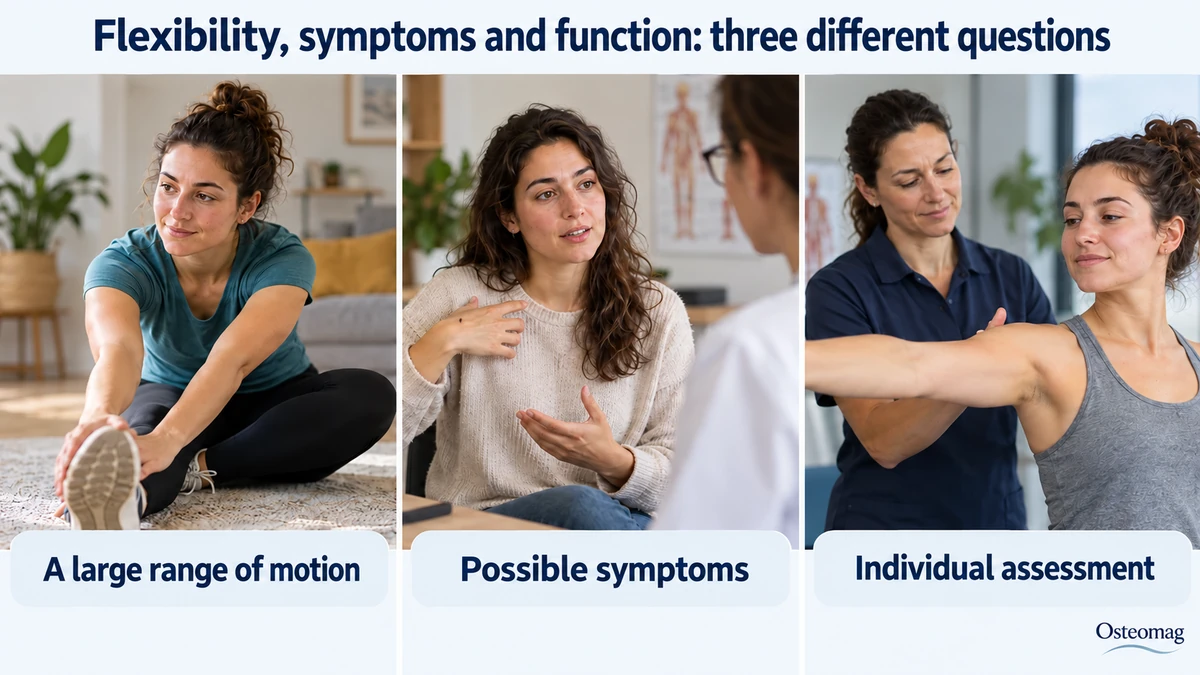
| Situation | What matters | Approach |
|---|---|---|
| Large range without symptoms | Preserved function | No treatment based on the score alone. |
| Large range with pain or instability | Impact and possible causes | Individual assessment and active progression. |
| Suspected HSD or hEDS | Full criteria and alternative diagnoses | Clinical assessment, not self-diagnosis from a photograph. |
| Tissue fragility or an unusual family history | Possible other connective tissue disorder | Specialist referral. |
Is strengthening important?
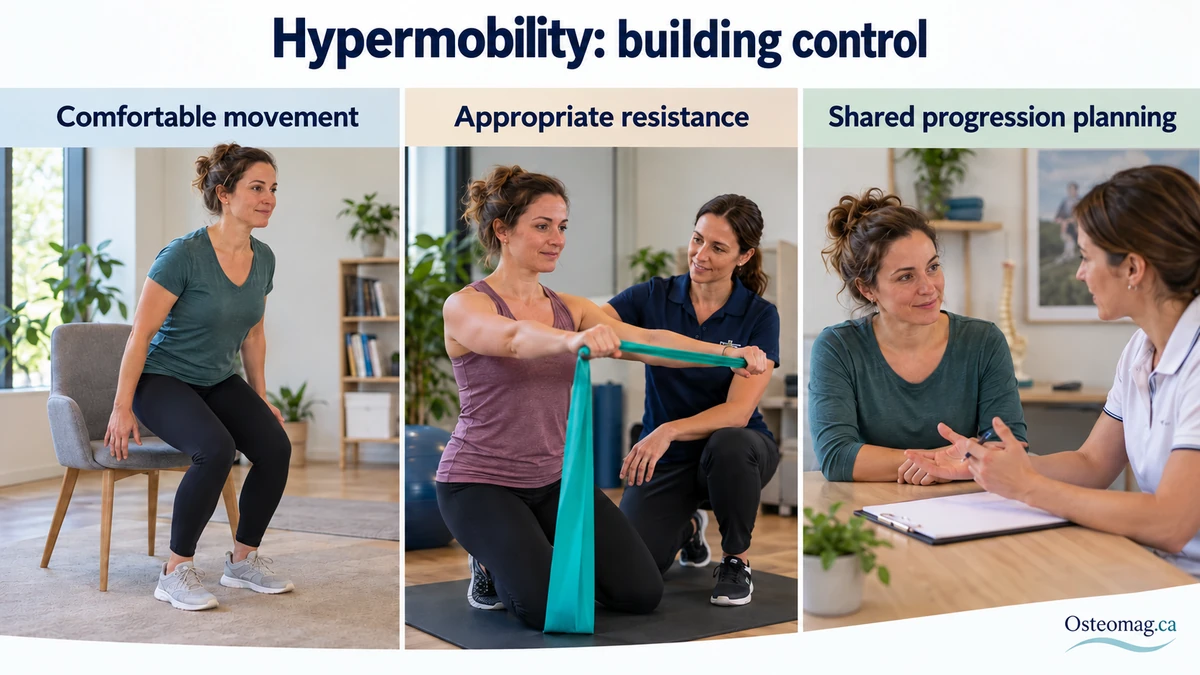
Yes. Reviews of rehabilitation for HSD/hEDS mainly support approaches based on therapeutic exercise and motor control training. [8] [9]
Strengthening may improve:
- active stability;
- strength;
- endurance;
- confidence;
- the ability to tolerate daily activities.
Should heavy weights be avoided?
Not necessarily.
A hypermobile person can progress towards substantial loads if technique, capacity and tolerance allow.
Progression must be gradual, especially when joints have previously been unstable or painful.
A trial in adults with HSD and shoulder symptoms suggests possible benefits from heavier, supervised strengthening. It involved a specific population and more transient muscle soreness or headaches; it does not justify heavy loading for everyone. [10]
The issue is not the weight itself, but a load poorly matched to current capacity.
Should all extreme ranges be avoided?
No, but it may help not to spend prolonged periods at end range when that position causes pain or instability.
A person can learn to control their full range rather than routinely ‘locking’ joints into hyperextension.
The aim is not to become stiff, but to gain control.
Stretching: useful or best avoided?
Stretching is not prohibited.
However, continually seeking greater range is not necessarily useful for someone who is already very mobile.
If a stretch provides relief without increasing instability, it can be retained. The goal should remain functional.
Why do some people nevertheless feel very stiff?
This is a common paradox: a hypermobile person may experience substantial muscle tension.
Muscles may increase their activity to stabilize very mobile joints. Someone can therefore have a large objectively measured range while feeling considerable subjective stiffness.
This feeling does not necessarily mean that more stretching is needed.
Shoulder pain and hypermobility
The shoulder is naturally very mobile. In some people with HSD/hEDS, multidirectional instability can make overhead activities or repeated movements difficult.
A recent systematic review of shoulder symptoms in hEDS/HSD reports improvements with several conservative interventions, while emphasizing the lack of robust studies. [11]
Exercise generally remains central to care.
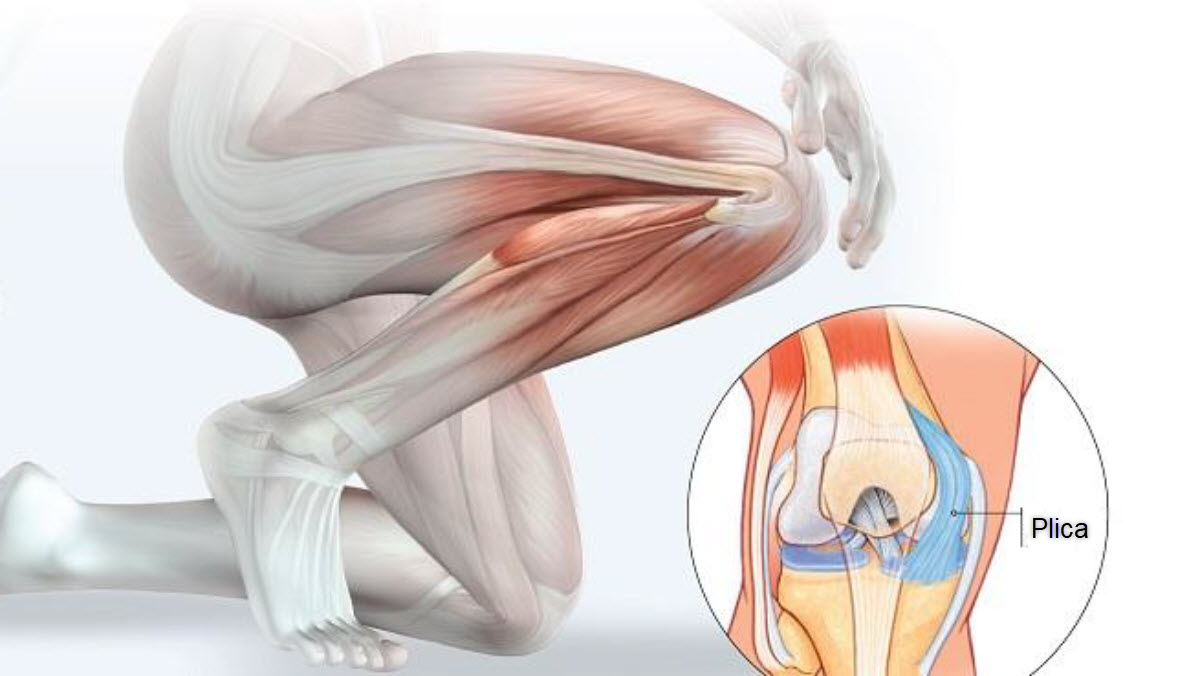
The knee and kneecap
Hypermobility may sometimes involve greater kneecap mobility or episodes of instability.
Quadriceps and hip strengthening, together with lower-limb control, are then often more useful than trying to ‘put the kneecap back into place’.
The ankle and repeated sprains
A very mobile person may experience frequent sprains.
Balance work, fibularis muscle strengthening, single-leg stance control and progressive return to sport are particularly important.
A brace may help temporarily during certain higher-risk activities.
Should splints be worn all the time?
Not routinely.
Orthoses may help particular joints or activities. Duration of use is decided individually: long-term support may be indicated and should not automatically be described as harmful. Active work is included where possible.
The choice depends on the degree of instability, pain and function.
Is manual therapy useful?
It may temporarily reduce pain or improve comfort.
However, seeking even more mobility is not always relevant for someone who is already hypermobile.
Available reviews provide more support for exercise and motor control than for manual therapy as the main intervention.
When should another connective tissue disorder be investigated?
Hypermobility associated with unusual signs warrants more specialized assessment.
Examples include:
- marked skin fragility;
- highly atypical scars;
- vascular or organ ruptures;
- frequent dislocations without trauma;
- a family history of severe vascular complications;
- unusual body features or systemic abnormalities.
These findings may point towards other types of Ehlers-Danlos syndrome or other hereditary disorders.
Is hEDS only a musculoskeletal condition?
No. Some people also experience fatigue, sleep problems, autonomic symptoms, digestive symptoms or pelvic symptoms.
However, these symptoms are nonspecific and may have many other causes.
They should be assessed separately rather than automatically attributed to hypermobility.
Why does physical activity remain important?
Inactivity reduces strength, endurance and confidence, which can make joints even harder to control.
A progressive programme may include:
- strengthening;
- motor control;
- balance;
- endurance;
- functional exercises;
- a gradual return to sport.
What is the role of osteopathy?
Osteopathy may contribute to comfort and management of some pain, but must not treat every hypermobile joint as ‘displaced’ or requiring repeated correction.
For a hypermobile person, manual treatment should be cautious and function-oriented.
Active strength and control work generally remain more important for long-term stability.
Language that helps rather than alarms
Telling someone ‘your joints are fragile and keep moving out of place’ can increase fear of movement.
A more useful explanation would be:
‘Your range is greater than average. The main aim is to improve your control and your ability to use that range comfortably.’
Conclusion
Hypermobility is not synonymous with disease. Many very flexible people are asymptomatic and need no treatment.
When accompanied by pain, instability or repeated dislocations, it may be part of a hypermobility spectrum disorder or, in some cases, hEDS.
The Beighton score is useful for screening but not sufficient for diagnosis. The most important question is not just how far a joint moves, but how the person controls that movement and functions.
The strongest strategy generally remains progressive: strength, motor control, endurance, activity adaptation and reassurance—without trying to turn a naturally flexible person into a stiff one.
References
- [1] Malfait F, Francomano C, Byers P et al. The 2017 international classification of the Ehlers-Danlos syndromes. Am J Med Genet C Semin Med Genet. 2017;175(1):8-26. doi:10.1002/ajmg.c.31552.
- [2] Tofts L, Pacey V, Williams CM et al. Generalized Joint Hypermobility in Adults: A Systematic Review With Meta-Analysis to Identify Data-Driven Cut-offs Using the Beighton Score. Arthritis Care Res (Hoboken). 2026;78(8):987-997. doi:10.1002/acr.70017.
- [3] Tofts LJ, Simmonds J, Schwartz SB et al. Pediatric joint hypermobility: a diagnostic framework and narrative review. Orphanet J Rare Dis. 2023;18(1):104. doi:10.1186/s13023-023-02717-2.
- [4] Malek S, Reinhold EJ, Pearce GS. The Beighton Score as a measure of generalised joint hypermobility. Rheumatol Int. 2021;41(10):1707-1716. doi:10.1007/s00296-021-04832-4.
- [5] Castori M, Tinkle B, Levy H et al. A framework for the classification of joint hypermobility and related conditions. Am J Med Genet C Semin Med Genet. 2017;175(1):148-157. doi:10.1002/ajmg.c.31539.
- [6] The Ehlers-Danlos Society. Diagnosis. Clinical criteria for hEDS and HSD; no routine diagnostic laboratory test. Accessed October 15, 2026.
- [7] Pacey V, Nicholson LL, Adams RD et al. Generalized joint hypermobility and risk of lower limb joint injury during sport: a systematic review with meta-analysis. Am J Sports Med. 2010;38(7):1487-97. doi:10.1177/0363546510364838.
- [8] Garreth Brittain M, Flanagan S, Foreman L et al. Physical therapy interventions in generalized hypermobility spectrum disorder and hypermobile Ehlers-Danlos syndrome: a scoping review. Disabil Rehabil. 2024;46(10):1936-1953. doi:10.1080/09638288.2023.2216028.
- [9] Buryk-Iggers S, Mittal N, Santa Mina D et al. Exercise and Rehabilitation in People With Ehlers-Danlos Syndrome: A Systematic Review. Arch Rehabil Res Clin Transl. 2022;4(2):100189. doi:10.1016/j.arrct.2022.100189.
- [10] Liaghat B, Skou ST, Søndergaard J et al. Short-term effectiveness of high-load compared with low-load strengthening exercise on self-reported function in patients with hypermobile shoulders: a randomised controlled trial. Br J Sports Med. 2022;56(22):1269-76. doi:10.1136/bjsports-2021-105223.
- [11] Higo A, Palmer S, Liaghat B et al. The Effectiveness of Conservative Interventions on Pain, Function, and Quality of Life in Adults with Hypermobile Ehlers-Danlos Syndrome/Hypermobility Spectrum Disorders and Shoulder Symptoms: A Systematic Review. Arch Rehabil Res Clin Transl. 2024;6(3):100360. doi:10.1016/j.arrct.2024.100360.