Connecting the person with their environment without confusing metaphor and evidence
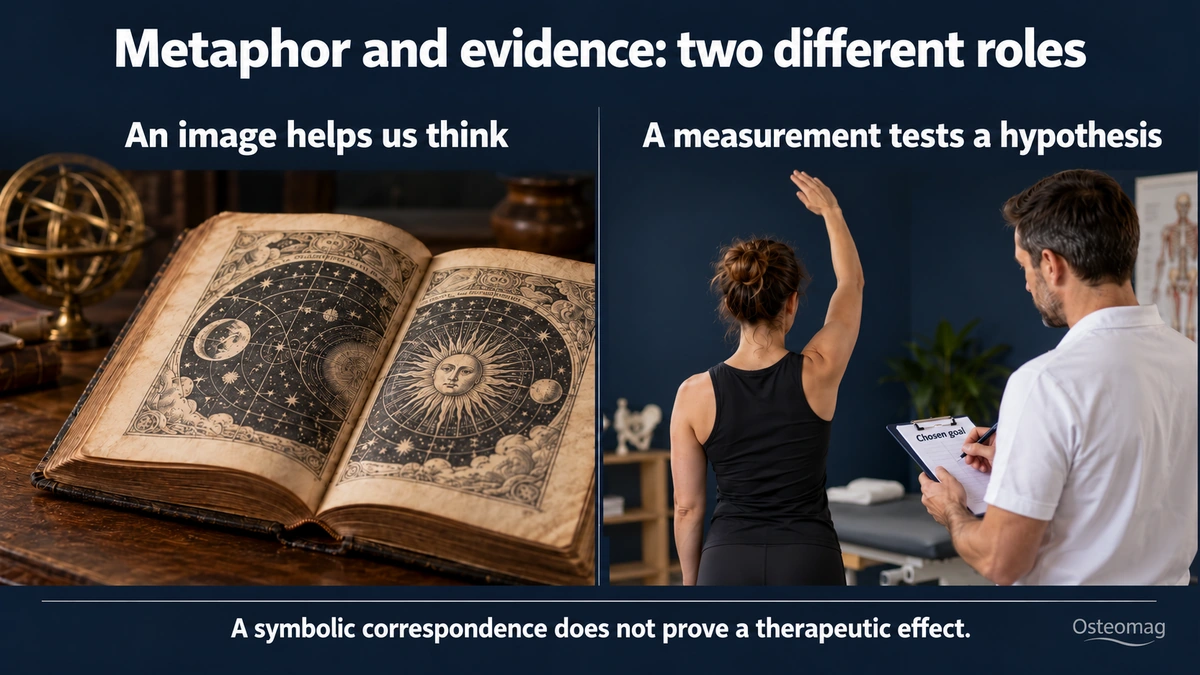
The words macrocosm and microcosm belong to a long history of representations of human beings. They suggest a correspondence between the greater world and the smaller world supposedly constituted by the body. This image can be evocative when reflecting on relationships between a person and their environment. It becomes misleading when presented as a physiological law or proof of a particular therapeutic ability.
In osteopathy, the idea of bodily unity may recall this older way of thinking. A conceptual resemblance is not, however, enough to establish a single historical origin. Documents, philosophical interpretations and current clinical knowledge must be distinguished. These three levels provide different information [1][2].
What do macrocosm and microcosm mean?
In historical usage, the macrocosm refers to the world or universe, while the microcosm represents a smaller world to which certain correspondences with the whole are attributed. Robert Fludd’s works from the early seventeenth century illustrate this tradition [1]. They belong to their intellectual context and are not modern physiology textbooks.
It would therefore be inaccurate simply to define the microcosm as microscopic details that an osteopath could examine with their hands. The concept represents a relationship between part and whole, not a method for measuring cells, tissues or organs.

This illustration is retained for its historical value. It documents a way of representing the world, not an experimental demonstration of the effects of touch.
Can it be called “the very source” of osteopathy?
Andrew Taylor Still’s writings allow study of his ideas about anatomy, nature and care [2]. They should be read as historical sources. Demonstrating a specific line of influence from an author or cosmology would require explicit documentary evidence, not merely vocabulary of unity or interconnection.
An analogy helps us think, not demonstrate
Comparing the body to a network can draw attention to interactions. Comparing it to a machine can illuminate certain mechanical constraints. Neither image describes all of human biology. A metaphor selects similarities and leaves differences aside; it becomes dangerous when that choice is forgotten.
For example, saying that the body seeks balance does not specify which parameter might be disturbed, how to measure it or which treatment would change it. To become a scientific hypothesis, an idea must be made precise and tested against observations. Evidence-based reasoning specifically requires connecting a decision with data, expertise and the person’s needs [3].
| Type of statement | Role | Requirement |
|---|---|---|
| Historical document | Understand an older representation | Verify its provenance and context |
| Metaphor | Help reflection on a relationship | Do not turn it into a diagnosis |
| Scientific hypothesis | Propose a testable explanation | Specify a measurement and accept refutation |
| Clinical decision | Choose a useful action for the person | Consider evidence, risks and preferences |
Homeostasis: a more precise physiological concept
Cannon’s work on homeostasis describes the organization of physiological regulation [4]. The term does not mean immobility or perfect symmetry. It refers to mechanisms that maintain certain internal conditions despite variations. Those mechanisms can be studied through measurements and experiments.
A physiological measurement is not the same as an impression of harmony. Pleasant care does not demonstrate improvement in every regulatory mechanism. A real concept does not automatically validate an intervention claiming to support it.
Interconnection does not mean a single cause
The body’s systems do interact, but this interaction does not justify attributing a symptom to any distant region. A hypothesis about a remote contribution must remain consistent with the history, examination and possible diagnoses. Clinical reasoning is not about finding a hidden chain at any cost.
Musculoskeletal guidelines prioritize patient-centered assessment, identification of warning signs and interventions adapted to function [5]. They do not require correcting every asymmetry to achieve a result. An observation can be real yet incidental to the problem prompting consultation.
The biopsychosocial model is not a cosmology
Engel’s model invites consideration of biological, psychological and social dimensions of health [6]. For example, it helps explain how pain influences activities and how living conditions influence opportunities for recovery. It requires no correspondence between the organism and the universe.
Nor does this approach attribute every pain to an emotion. It retains the need to examine tissues, functions and possible diseases. Its practical value is avoiding an overly narrow explanation while preventing a whole-person discourse from becoming so vague that it explains everything without being testable.
The lived and measured body can be studied together
A person may describe heaviness, tension or a feeling of low energy. These words express an experience that deserves attention. Interoception research shows that perception of internal states comprises several dimensions, including attention and interpretation [7].
The concrete meaning of the complaint then needs clarifying: is it pain, breathlessness, drowsiness or loss of strength? This avoids automatically translating the word energy into an invisible flow. Patients’ experiences and clinical measurements can complement each other without either replacing the other.
Why can palpation not examine a “microcosm”?
A hand can locate tenderness and guide movement. In low back pain, however, a review found variable reliability and important limitations for palpation of mobility or bony structures. These findings are not an identical judgment on every manual examination [8].
From that contact, the practitioner cannot infer tissue composition, the condition of an immune system or a person’s emotional history. It is more rigorous to describe the finding, then check whether it corresponds to a complaint and changes a useful decision.
Anatomical attachments do not prove visceral efficacy
Organs have anatomical relationships with surrounding tissues. This does not prove that their function can be diagnosed and normalized by palpating mobility. A 2018 systematic review found insufficient reliability and efficacy evidence in the studies it analyzed; that conclusion must remain tied to its scope and date [9].
Abdominal discomfort may require digestive or general assessment. The analogy of an interconnected whole must not lead to that step being ignored. Investigation of relationships between structures must remain a proportionate hypothesis, never a reason to delay a relevant investigation.
Sleep and activity offer more concrete connections
Relationships between sleep and pain are documented: pain can fragment nights and disturbed sleep can influence sensitivity [10]. Asking about sleep is therefore often more informative than searching for abstract harmony. It may also reveal a problem requiring separate assessment.
Exercise is another studied dimension. A Cochrane review supports its usefulness for some people with chronic low back pain [11]. This evidence concerns defined interventions and measured outcomes. It does not prove that cosmic balance has been restored or that identical activity suits everyone.
Considering the environment without promising to cancel its effects
Work, travel, housing and family responsibilities may limit rest time or opportunities to follow a program. A whole-person approach can simply mean asking what is feasible and adapting goals. The biopsychosocial model helps avoid isolating people from those constraints [6].
Manual care cannot, however, compensate for a harmful exposure or difficult social situation. Presenting the body as a resilient microcosm must not place all responsibility for health on the patient. Some difficulties require organizational changes, social resources or other professional skills.
How can a testable clinical hypothesis be formulated?
A hypothetical educational example: adapting a task might make painful stair climbing easier. Function and its progression are observed without immediately attributing pain to a single range of motion. A useful hypothesis must be open to challenge.
Conversely, asserting that general imbalance explains all pain provides no clear criterion for refutation. If the patient does not improve, the practitioner may add new imbalances instead of revisiting the model. Evidence-based practice specifically requires the ability to change an explanation when outcomes do not support it [3].
Why are success stories not enough?
A testimonial can be sincere without distinguishing the effect of care from natural progression or other treatments. An invented educational story must be identified as such: it is not evidence.
WHO guidance for chronic primary low back pain rests on studied interventions and measured outcomes, not restoration of internal harmony. Its scope does not automatically extend to all pain or every osteopathic method [12].
What place remains for the philosophy of care?
Philosophy can support reflection on listening, how the person is considered and the meaning they give to health. It need not be presented as physiology to have value. Patients may retain a personal spiritual representation without the practitioner using it as a diagnosis.
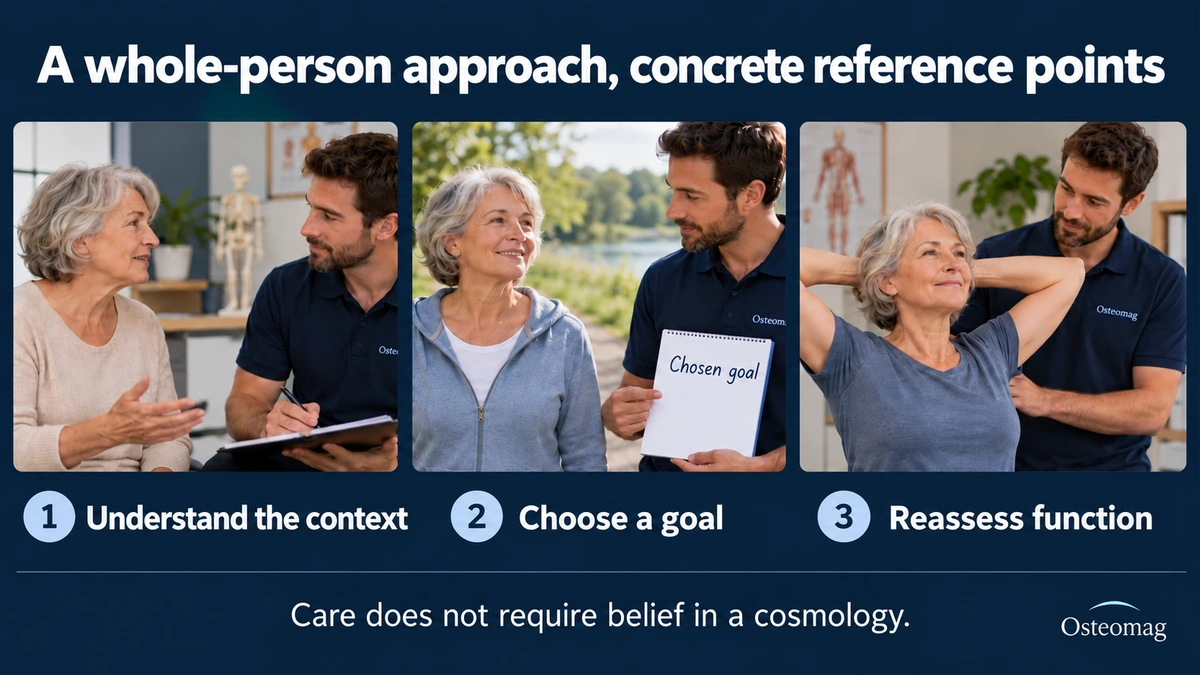
Respect for those who do not share that representation also matters. Care should not require belief in a cosmology. Choices can be discussed through concrete goals and understandable information, considering patients’ values without confusing belief and evidence [13].
Differential diagnosis and warning signs remain priorities
Pain may be musculoskeletal, neuropathic or associated with systemic disease. Progressive weakness, significant loss of sensation, fever, major trauma or a change in urinary control must not be explained by a lack of overall balance. They may require prompt medical assessment [5][12].
Reasoning must remain open even when a patient values a philosophical approach. Immediate improvement after contact does not exclude disease. Safety means not allowing a coherent story to override a clinical sign requiring another action.
Measuring independence rather than supposed harmony
Follow-up can address a chosen activity: walking, dressing, carrying an object or working with less discomfort. These reference points show whether care genuinely helps. They do not require patients to become perfectly symmetrical or recognize an energetic change.
When benefit remains insufficient, care should be adjusted, referred or stopped. Patients must be able to participate in that decision and understand the limits of care. Research on decision aids supports attention to knowledge and preferences, without promising that every shared decision guarantees a clinical outcome [13].
Conclusion: retain the metaphor, clarify the evidence
Macrocosm and microcosm offer a historical image of the relationship between human beings and their world. That image can nourish reflection on unity, environment and the meaning of care. It establishes neither a demonstrated single origin of osteopathy nor validation of its techniques.
Contemporary practice can embrace complexity without becoming vague: observe, formulate testable hypotheses, recognize warning signs, measure outcomes and respect choices. Philosophical heritage then invites reflection, while safety and efficacy remain questions requiring clinical data.
References
- [1] Fludd R. Utriusque cosmi maioris scilicet et minoris metaphysica, physica atque technica historia. Early seventeenth century. Work catalog record, Wellcome Collection. Historical source.
- [2] Still AT. Philosophy of Osteopathy. Kirksville, Missouri: A. T. Still; 1899. 268 p. Wellcome Collection. Historical source.
- [3] Sackett DL, Rosenberg WM, Gray JA et al. Evidence based medicine: what it is and what it isn’t. BMJ. 1996;312(7023):71-2. doi:10.1136/bmj.312.7023.71.
- [4] Cannon WB. Organization for Physiological Homeostasis. Physiological Reviews. 1929;9(3):399–431. doi:10.1152/physrev.1929.9.3.399.
- [5] Lin I, Wiles L, Waller R et al. What does best practice care for musculoskeletal pain look like? Eleven consistent recommendations from high-quality clinical practice guidelines: systematic review. Br J Sports Med. 2020;54(2):79-86. doi:10.1136/bjsports-2018-099878.
- [6] Engel GL. The need for a new medical model: a challenge for biomedicine. Science. 1977;196(4286):129-36. doi:10.1126/science.847460.
- [7] Khalsa SS, Adolphs R, Cameron OG et al. Interoception and Mental Health: A Roadmap. Biol Psychiatry Cogn Neurosci Neuroimaging. 2018;3(6):501-513. doi:10.1016/j.bpsc.2017.12.004.
- [8] Nolet PS, Yu H, Côté P et al. Reliability and validity of manual palpation for the assessment of patients with low back pain: a systematic and critical review. Chiropr Man Therap. 2021;29(1):33. doi:10.1186/s12998-021-00384-3.
- [9] Guillaud A, Darbois N, Monvoisin R et al. Reliability of diagnosis and clinical efficacy of visceral osteopathy: a systematic review. BMC Complement Altern Med. 2018;18(1):65. doi:10.1186/s12906-018-2098-8.
- [10] Finan PH, Goodin BR, Smith MT. The association of sleep and pain: an update and a path forward. J Pain. 2013;14(12):1539-52. doi:10.1016/j.jpain.2013.08.007.
- [11] Hayden JA, Ellis J, Ogilvie R et al. Exercise therapy for chronic low back pain. Cochrane Database Syst Rev. 2021;9(9):CD009790. doi:10.1002/14651858.CD009790.pub2.
- [12] World Health Organization. WHO guideline for non-surgical management of chronic primary low back pain in adults in primary and community care settings. Geneva: WHO; 2023. ISBN 9789240081789.
- [13] Stacey D, Lewis KB, Smith M et al. Decision aids for people facing health treatment or screening decisions. Cochrane Database Syst Rev. 2024;1(1):CD001431. doi:10.1002/14651858.CD001431.pub6.