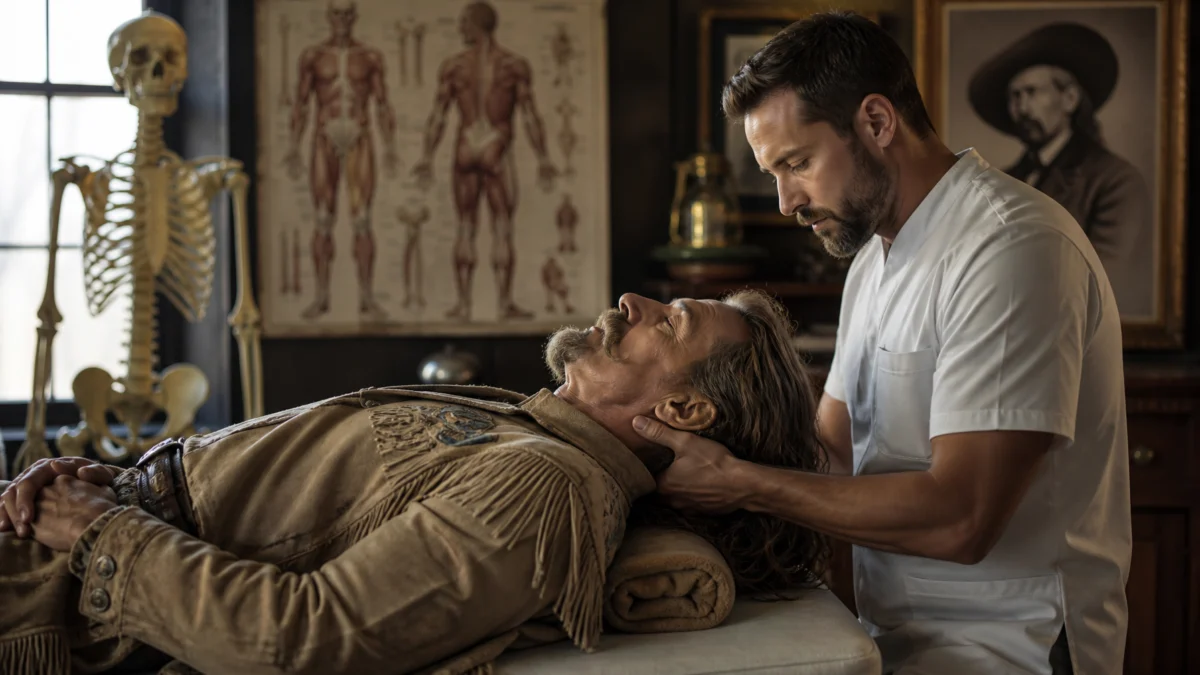
In the late nineteenth century, William “Buffalo Bill” Cody and Andrew Taylor Still lived in the same America of frontiers, war, social transformation, and fascination with the human body—one turned it into a worldwide spectacle, while the other made it the starting point of a new approach to healthcare
At first glance, Buffalo Bill and osteopathy seem to belong to two histories with very little in common. On one side stands William Frederick Cody, better known as Buffalo Bill, an enduring symbol of the American West: galloping horses, sharpshooters, scouts, buffalo hunters, cowboys, and enormous performances presenting a dramatized version of frontier life. On the other stands Andrew Taylor Still, associated with a much quieter world: that of the rural physician, anatomical observation, manual examination, and the search for a different way of understanding the human body. Yet when the two men are placed within their historical period, an intriguing parallel emerges. They were not simply inhabitants of two unrelated worlds. They represented very different responses to the profound transformations taking place in nineteenth-century America. There is no solid historical evidence establishing that Buffalo Bill and Still met or that Cody ever received osteopathic treatment. The connection explored here is therefore historical and cultural rather than biographical. What primarily links them is their era: an America rapidly redefining its frontiers, its medicine, and its understanding of the human body.
William Frederick Cody was born in Iowa in 1846. Andrew Taylor Still was eighteen years older, having been born in Virginia in 1828. Both men, however, experienced the realities of frontier America. Still spent important years in Missouri and later Kansas, where he joined his family in 1853. His father, Abram Still, was both a Methodist circuit preacher and a physician. Andrew therefore grew up in an environment in which religion, healthcare, physical labor, travel, and the uncertainties of frontier life were closely intertwined. He eventually became a physician himself and served during the American Civil War.
Buffalo Bill also spent part of his youth in Kansas after his family moved there from Iowa. He began working while still very young and became familiar with the demanding environment of the plains, transportation routes, and frontier settlements. Later, he worked in several roles associated with the expanding West, including as a scout and buffalo hunter, before transforming his frontier reputation into an extraordinary career in entertainment.
This geographic and historical proximity matters. The America in which Still and Cody grew up was very different from the modern United States. Distances were enormous, transportation could be difficult, physical work was demanding, and access to healthcare varied considerably. Horses were not recreational accessories; they were essential forms of transportation and labor. The body had to walk, ride, carry, build, cultivate, hunt, and sometimes fight. Injury, infectious disease, physical exhaustion, and death were far more visible in everyday life than they are for many people today.
The relationship with the body was therefore intensely practical. Before becoming the subject of sophisticated scientific analysis, the body was what allowed a person to survive, work, travel, and adapt to an often demanding environment.
The American Civil War was another defining experience for this generation. Andrew Taylor Still served on the Union side and encountered the realities of nineteenth-century medicine in a military context. The conflict exposed physicians and soldiers alike to traumatic injuries, infection, disease, and the considerable limitations of the treatments then available. Buffalo Bill, who was much younger, also served the Union near the end of the war and subsequently worked as a scout for the U.S. Army.
Their experiences were not identical, and it would be misleading to suggest otherwise. Yet both belonged to an American generation for whom war, physical hardship, transportation, injury, and the limits of the human body were not abstract concepts.
To understand the emergence of osteopathy, it is also necessary to remember the condition of medicine during the middle of the nineteenth century. Modern scientific medicine was still developing. Many concepts that now appear fundamental were either relatively new or had not yet been fully incorporated into everyday medical practice. Therapeutic options were limited, and some commonly used treatments could themselves produce significant harm.
Still gradually developed a profound dissatisfaction with aspects of contemporary medicine. That dissatisfaction became intensely personal following tragedies within his own family. In 1864, several of his children died during an epidemic of cerebrospinal meningitis, and another daughter died of pneumonia. These losses contributed to the questioning of contemporary medical practice that would shape the rest of his professional life.
Within this context, Still began developing the principles that would eventually become osteopathy. The year 1874 is traditionally associated with his formal articulation of this new approach. He placed considerable emphasis on anatomy, the organization of the body, and the musculoskeletal system.
Still’s concepts must, of course, be understood within their historical period. They should not simply be equated with contemporary biomedical knowledge. Some ideas associated with early osteopathy have subsequently been modified, abandoned, challenged, or reinterpreted as scientific knowledge has advanced. Nevertheless, Still’s history remains important because it reflects an attempt to think about the patient as something more than a collection of isolated symptoms.
While Still was gradually developing his ideas, Buffalo Bill was constructing a very different representation of the American body. In Cody’s world, the body became spectacle. Physical skill, horseback riding, shooting, speed, courage, and endurance were presented before enormous audiences. His famous Buffalo Bill’s Wild West, established in the 1880s, traveled widely throughout the United States and later internationally.
The performances presented a dramatic vision of the American West involving riders, sharpshooters, cowboys, military scenes, and Native American performers. Annie Oakley became one of the show’s most celebrated stars, while Sitting Bull participated in Buffalo Bill’s show for several months in 1885.
The Wild West, however, needs to be viewed with historical perspective. It was not a neutral reconstruction of frontier history. It helped create a mythology. The extraordinarily complex relationships among Indigenous peoples, settlers, the U.S. government, the military, and western expansion were transformed into dramatic scenes that audiences could easily understand.
Buffalo Bill therefore did more than display the physical abilities associated with frontier life. He helped transform the frontier body into an image, a narrative, and eventually an international cultural product.
This is where the comparison with osteopathy becomes especially interesting. Within the same period, two very different ways of looking at the body were developing in America.
In Buffalo Bill’s world, the body was highly visible. It rode, ran, shot, pursued, performed, and demonstrated its abilities before thousands of spectators. The body represented endurance, skill, action, and survival.
In Still’s world, the body increasingly became an object of clinical observation. Its anatomy was to be studied. Its movement could be examined. Its structures could be palpated. The relationships among its different parts became central to a new way of thinking about health and disease.
It would nevertheless be too simplistic to completely oppose these two worlds. Still was not merely a quiet philosopher contemplating anatomy, just as Cody was not simply a physical performer. Both men were also entrepreneurs.
Buffalo Bill understood remarkably early the power of spectacle, publicity, and mass communication. He transformed a frontier identity into one of the most recognizable public personalities of his generation.
Still faced a different challenge. He had to transform an unconventional medical idea into an organized profession. In 1892, he founded the American School of Osteopathy in Kirksville, Missouri, the institution that would become the foundation for formal osteopathic education.
The year 1892 is particularly revealing when these two histories are considered side by side. In Kirksville, Still was institutionalizing his approach and beginning to educate a new generation of practitioners. At approximately the same time, Buffalo Bill had already become an international celebrity.
His Wild West had crossed the Atlantic in 1887. During its stay in London, the production attracted enormous public attention, and Queen Victoria attended a performance. Subsequent European tours brought Buffalo Bill’s representation of the American West to audiences in France, Italy, Germany, Austria, Spain, and elsewhere.
Two very different American exports were therefore beginning to emerge. Buffalo Bill exported an image of America. Osteopathy would eventually export a distinctly American tradition of manual healthcare.
In both cases, something shaped by the social and cultural environment of nineteenth-century America eventually crossed the Atlantic. But the comparison should stop where the historical evidence stops. There is no reason to portray Buffalo Bill as an advocate of osteopathy or Andrew Taylor Still as belonging to the world of the Wild West. Their historical value lies precisely in the contrast.
That contrast also provides an opportunity to reflect on the place of the body at the end of the nineteenth century. Buffalo Bill presented audiences with a body capable of mastering an environment portrayed as dangerous and unpredictable. It was the body of the rider, hunter, scout, and sharpshooter. Its value seemed to be measured by what it could accomplish.
Still asked a different question: how does this body function, and what can be done when it suffers? Anatomy became an essential language. Observation and touch acquired increasing importance.
This history also invites us to avoid a common mistake when discussing the origins of osteopathy today. Respecting Still’s historical importance does not require us to consider every claim made in the nineteenth century scientifically valid in the twenty-first.
Medical science has changed enormously since the 1870s. Microbiology, medical imaging, pharmacology, neuroscience, pain science, epidemiology, and clinical research have transformed our understanding of health and disease. A credible contemporary osteopathy should therefore not attempt to reproduce Still’s nineteenth-century medicine literally. It can recognize its origins while accepting that explanatory models must evolve with knowledge.
The same principle can be applied to Buffalo Bill. We can recognize his historical importance and extraordinary ability to create an international spectacle without accepting his representation of the West as a complete historical record.
His performances combined history, entertainment, dramatization, heroism, and simplification. Buffalo Bill is therefore especially interesting because he demonstrates how a compelling story can eventually become so powerful that it begins to replace the more complicated reality from which it originated.
This lesson also applies to osteopathy.
Every profession develops stories about itself. Over time, certain expressions become familiar: “putting something back into place,” “realigning,” “releasing,” or “rebalancing” the body. Such expressions can sound intuitive, particularly when they are repeated from one generation of practitioners to another. Yet they can also become narratives that are considerably simpler than biological reality.
The human body is not a nineteenth-century mechanical device in which a few displaced components simply need to be returned to an ideal position. It is a living organism characterized by variability, adaptation, sensory processing, movement, and continuous interaction with its environment.
Perhaps the most valuable part of Still’s legacy is therefore not the preservation of every explanation he proposed during his lifetime. It may instead lie in his attention to the body as an integrated whole, his emphasis on clinical examination, and his willingness to look beyond the isolated symptom.
Contemporary osteopathy can preserve this curiosity while continually confronting its explanations with modern scientific evidence.
Buffalo Bill teaches us something similar, although in a completely different way: human beings need stories. His Wild West was so successful that it helped shape the international image of the cowboy and the American frontier for generations. Even today, a hat, a horse, and the silhouette of a cowboy are enough to evoke an entire world.
A representation became almost as influential as the history it claimed to portray.
Healthcare professions are not immune to the same phenomenon. They too can create powerful images of themselves. For osteopathy, one of the best ways to respect its history may therefore be not to protect a mythology, but to distinguish carefully between historical tradition, clinical observation, hypothesis, and current scientific knowledge.
Seen in this light, the comparison between Buffalo Bill and Andrew Taylor Still becomes more than an entertaining historical coincidence. It allows us to observe an America that, within only a few decades, profoundly transformed its relationship with territory, technology, entertainment, medicine, and the human body.
Buffalo Bill transformed the frontier into an international performance. Still transformed his dissatisfaction with the medicine of his time into a new school of thought and eventually an institution.
There is even a final remarkable coincidence between their lives. William F. Cody died in January 1917. Andrew Taylor Still also died in 1917. In the same year, America therefore lost two men born during the first half of the nineteenth century who had become, in radically different fields, recognizable figures of the frontier era.
One left behind a worldwide mythology of the American West. The other left behind a profession and a healthcare tradition that would continue to evolve long after his death.
Buffalo Bill and Andrew Taylor Still should therefore not be artificially connected through a meeting that history does not document. Their actual connection is more interesting.
They allow us to look at the same historical period through two different windows. Through the first, the body gallops before thousands of spectators and becomes a spectacular symbol of the American frontier. Through the second, the body is observed, palpated, studied, and questioned by a physician searching for another way to approach healthcare.
More than a century later, this comparison offers an important reminder for contemporary osteopathy: a tradition can have a history without becoming imprisoned by its past. Understanding Still requires returning to the America that shaped him, just as understanding Buffalo Bill requires distinguishing the historical West from the spectacle that made it famous.
In both cases, the story becomes more interesting when we learn to separate fact from legend.
And perhaps that is precisely where Buffalo Bill symbolically meets osteopathy: at the frontier between the stories we tell about the body and the reality of the body itself.