Understanding referred pain without confusing a nerve mechanism with organ disease
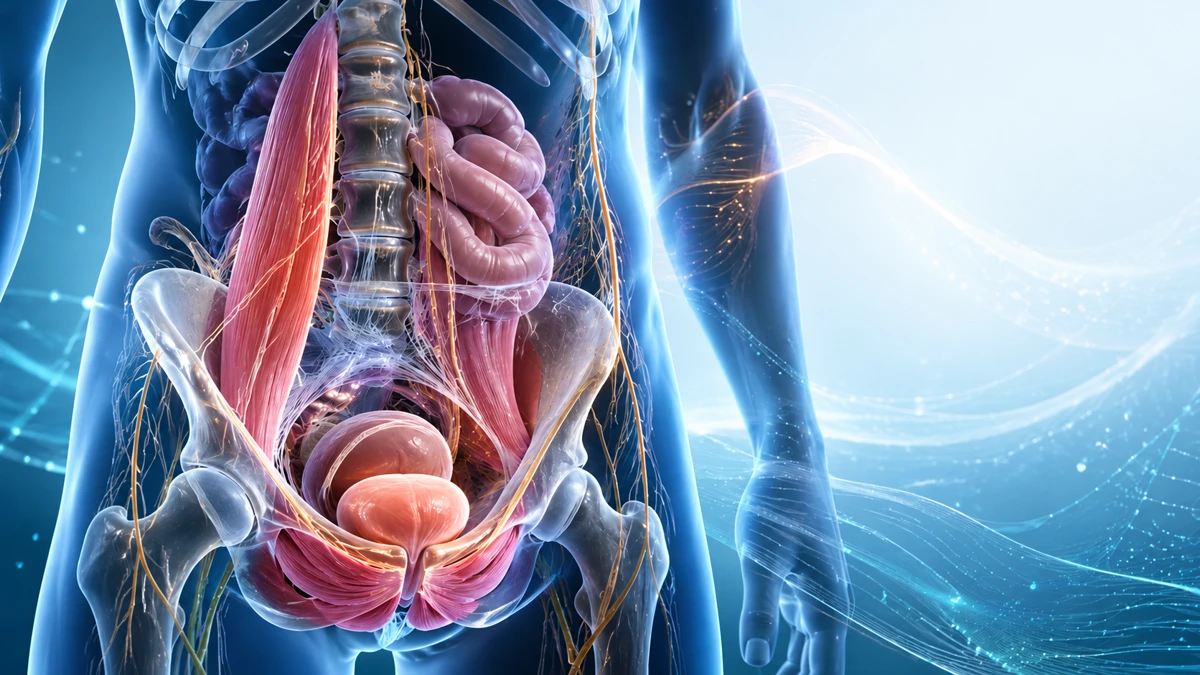
Abdominal or pelvic pain is not always easy to locate. The internal organs, muscles, skin and joints send signals to nerve networks that can overlap. This explains why pain from an organ can be felt in a musculoskeletal region, and why muscle pain can sometimes be mistaken for visceral pain [1] [2] [3] [4].
Science clearly supports referred pain, viscerosomatic convergence and sensitization. It also shows that a musculoskeletal component, particularly involving the pelvic floor, can contribute to some pelvic pain syndromes. However, this does not demonstrate that ‘fascial tension’ displaces an organ, causes visceral disease or that manual treatment of an organ directly restores its function [5] [6] [7].
Visceral and somatic pain: two systems that intersect
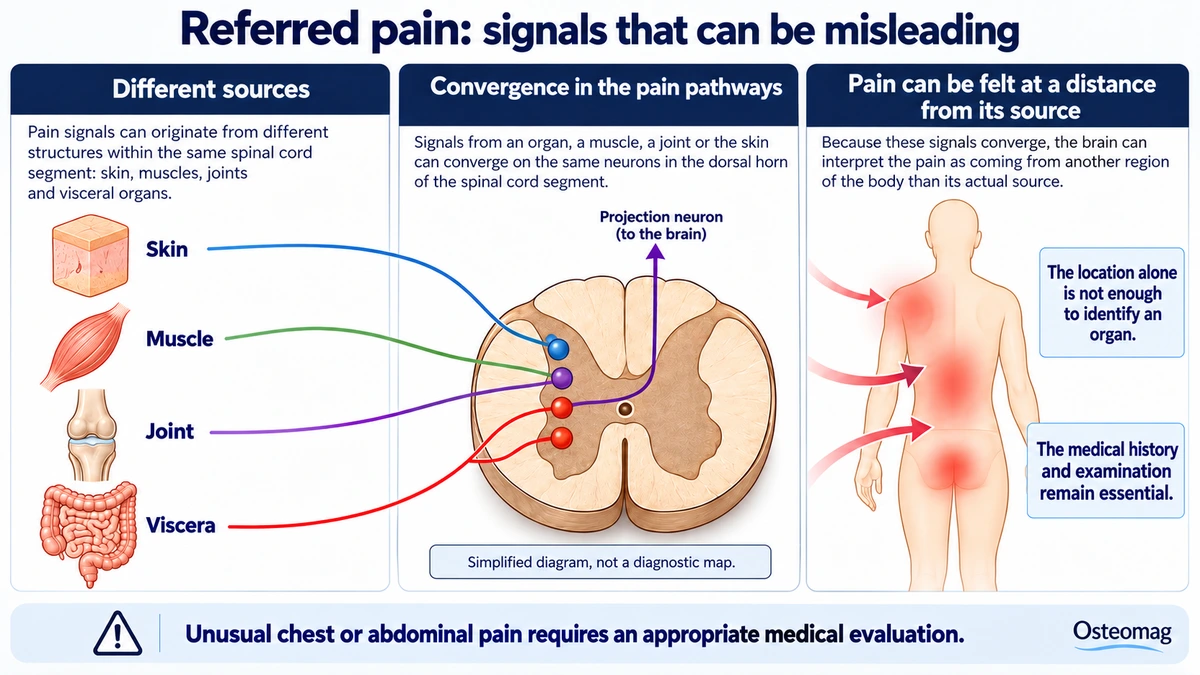
Visceral pain has distinctive characteristics. It is often more diffuse and less precisely localized than pain from skin or joints. It may involve autonomic responses—nausea, sweating or changes in bowel function—and be felt away from the affected organ [2] [3].
Convergence is an important explanation. Afferent signals from internal organs and somatic structures can converge onto shared neurons in the spinal cord. The brain therefore receives genuine nociceptive information, but does not always locate its source accurately [1] [2] [3] [4]. This is one proposed mechanism of referred pain.
The classic example is cardiac pain felt in the arm or jaw. Comparable phenomena occur in the abdomen and pelvis. Visceral disease can thus produce pain or hypersensitivity in somatic tissues, while somatic pain can sometimes mimic a visceral disorder.
What ‘viscerosomatic’ actually means
The term viscerosomatic does not mean that a muscle or fascia displaces an organ. It mainly describes neurological interactions between signals from internal organs and those from skin, muscles and other somatic tissues.
Persistent visceral stimulation can increase the sensitivity of neurons that also receive somatic information. This may contribute to hypersensitivity in the corresponding region. Conversely, musculoskeletal pain may maintain sensitivity in an already irritable area [1] [4].
These interactions help explain why some chronic pain becomes more widespread and why several tissues may feel painful when no single lesion explains the entire presentation.
Fascia matters, but should not be given unproven powers
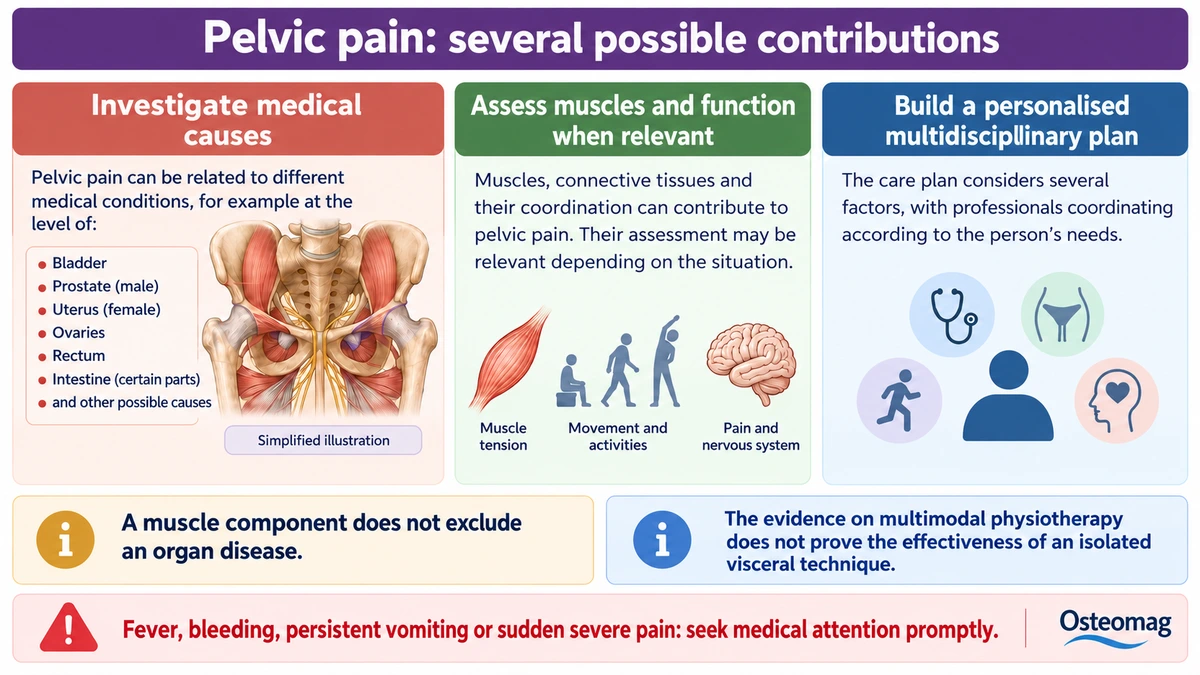
Fasciae are connective tissues that surround and connect muscles, nerves, blood vessels and many internal structures. They are innervated and contribute to force transmission and mechanical perception. Sensitive fascial tissue can therefore contribute to somatic pain.
However, anatomical continuity must be distinguished from clinical causation. Two structures being connected by connective tissue does not demonstrate that ‘fascial tension’ causes disease in the neighbouring organ. Abdominal, urinary, gynaecological and digestive pain must first be assessed for the appropriate medical causes.
In rigorous clinical care, fascia can be considered a musculoskeletal tissue that may contribute to pain and movement, but not a universal explanation for visceral symptoms.
The pelvic floor: where the evidence is more concrete
The pelvic floor is one of the best-documented examples of interaction between muscle function and symptoms sometimes perceived as ‘visceral’. Overactivity, poor coordination or pain in pelvic muscles can accompany some chronic pelvic pain syndromes, painful intercourse, urinary disorders or other pelvic dysfunctions.
A systematic review and meta-analysis published in 2025, covering 38 randomized trials and 2,168 women, concluded that multimodal physiotherapy reduced pain in the chronic pelvic pain syndromes studied, with high certainty in the short term and moderate certainty in the medium term [5]. This conclusion concerns multimodal programmes and a female population; it does not mean that a single manual technique accounts for the benefit on its own.
A 2025 clinical review also notes that specialized pelvic floor physiotherapy can be part of care for various pelvic dysfunctions, including some pain conditions, painful intercourse, constipation and incontinence [6].
These findings do not mean that all bladder, uterine, bowel or prostate pain is muscular. Rather, they show that the musculoskeletal system can be a genuine component of some complex pelvic presentations.
Psoas and abdominal pain: avoiding shortcuts
A review of the iliopsoas describes its anatomy and assessment in athletes with hip pain. It does not establish that treating this muscle changes organ function. Hip flexion, range of motion and movements that reproduce discomfort may guide a functional assessment without independently confirming the source of pain [9].
The psoas lies deep in the lumbar and retroperitoneal region. It contributes particularly to hip flexion and lumbopelvic function. Its location helps explain why pain from this region may sometimes be felt in the abdomen, groin or front of the hip.
However, there is no strong scientific basis for claiming that a ‘tight psoas’ directly disrupts the kidneys, bowel or bladder. Deep pain in this region should be assessed cautiously, because visceral disease can itself cause low back, abdominal or groin pain.
The psoas is therefore mainly important in the differential diagnosis: it may be a source of musculoskeletal pain resembling visceral pain, but should not become an automatic explanation.
Myofascial points and referred pain
Muscles can produce local or referred pain. Myofascial ‘trigger points’ are described as particularly sensitive areas within a muscle, but their definition, reproducibility on palpation and causal role remain debated.
It is reasonable to observe that contracting or palpating a painful muscle may reproduce some of a person's symptoms. It is less rigorous to conclude that a palpated nodule is the sole cause of a complex syndrome. Referred pain may involve several mechanisms, including convergence and central sensitization [4].
Sensitization: when pain becomes easier to trigger
In some persistent pain conditions, the nociceptive system becomes more reactive. A previously tolerable stimulus can become painful, and the sensitive area may expand. Sensitization does not mean that pain is imaginary: it describes a biological change in the processing of nociceptive information.
Chronic visceral pain can also involve somatic hypersensitivity in referred regions. This helps explain why someone living with a chronic pelvic or abdominal syndrome may have several sensitive muscle areas [1] [2].
When might a ‘visceral’ symptom have a musculoskeletal component?
| Observation | A cautious interpretation |
|---|---|
| Pain reproduced by movement or contraction | A musculoskeletal component becomes more plausible |
| Pain changed by position | May suggest a mechanical contribution without ruling out a visceral cause |
| Pelvic floor overactivity or pain | May contribute to some chronic pelvic syndromes |
| Reassuring medical investigations but persistent pain | An additional musculoskeletal assessment may be appropriate |
| Fever, bleeding, weight loss, vomiting or deterioration in general health | Medical assessment takes priority |
No manual test can guarantee that pain is ‘fascial’ or ‘visceral’. Diagnosis rests on the history, clinical examination, context and, when indicated, medical investigations.
A progressive, coordinated clinical approach
Assessment starts with the history: onset, progression and links with meals, bowel function, urination, the menstrual cycle, movement and sleep. General symptoms and risk factors are considered before hands-on work is proposed. Blood tests, urine tests, ultrasound and other imaging are not ‘fascia tests’; their selection responds to a medical suspicion. Reassuring results do not automatically prove a muscular origin [3] [10].
If a muscular pelvic component is plausible, specialized physiotherapy can assess coordination, load tolerance and function. Any intimate examination requires an indication, a qualified professional and explicit consent that can be withdrawn. Alternatives should be available for discussion. A sensitive muscle cannot reveal trauma or an emotion [6] [10].
The rehabilitation plan selects meaningful activities: walking, sitting more comfortably or resuming an avoided task. The dose is adjusted gradually, the response monitored and the situation reassessed if new symptoms develop. A 2025 review suggests a benefit from multidisciplinary care for female pelvic pain, with certainty varying between outcomes. This means coordinated care, not proof that one technique ‘releases’ all tissues [8] [10].
What role can osteopathy play?
Osteopathy can address musculoskeletal components of a presentation: abdominal wall pain, trunk mobility, breathing, the hip and pelvis, muscle tension and movement tolerance. It may also complement multidisciplinary care once important medical causes have been investigated.
However, evidence for visceral manipulation as a specific treatment remains weak. A systematic review and meta-analysis published in 2023, including five trials and 268 people with low back pain, found no statistically convincing improvement in pain, disability or function with visceral osteopathic techniques and emphasized the lack of high-quality studies [7].
The scope of this evidence must also be respected: the review concerned low back pain, not all digestive, urological or gynaecological diseases. It does not justify generalizing a benefit or concluding that visceral manipulation treats organ disease.
A responsible approach therefore does not claim to ‘release an organ’ or directly restore its function through palpation. It addresses what musculoskeletal care can actually target—pain, movement and function—while respecting diagnostic limits.
Abdominal pain should never be dismissed
The possibility of a musculoskeletal component must never be used to delay medical assessment. Seek prompt care when abdominal or pelvic pain is accompanied by:
- severe pain or sudden onset;
- fever or chills;
- persistent vomiting;
- blood in the stool or urine;
- urinary retention or a new inability to urinate;
- unusual gynaecological bleeding or significant pain during pregnancy;
- a new lump or swelling;
- unexplained weight loss;
- a significant deterioration in general health;
- pain that worsens rapidly.
Key points
There is a real relationship between visceral pain and the musculoskeletal system, but it is primarily neurological, perceptual and functional. Viscerosomatic convergence helps explain why organ pain can be felt elsewhere and why somatic tissues can become sensitive in a chronic visceral syndrome.
The pelvic floor provides a well-documented clinical example: in some patients, a muscular component contributes to pelvic pain and may respond to multimodal physiotherapy. However, claims that fascial tension directly causes organ disease or that visceral manipulation corrects organ function remain insufficiently demonstrated.
The best approach is to rule out important medical causes, recognize referred pain mechanisms and address musculoskeletal components when they are actually present.
Scientific references
- [1] Giamberardino et al. Referred muscle pain/hyperalgesia and central sensitisation. 2003.
- [2] Schwartz et al. Visceral pain. 2014.
- [3] Boezaart et al. Visceral versus somatic pain: an educational review of anatomy and clinical implications. 2021.
- [4] Jin et al. Referred pain: characteristics, possible mechanisms, and clinical management. 2023.
- [5] Starzec-Proserpio et al. Effectiveness of nonpharmacological conservative therapies for chronic pelvic pain in women: a systematic review and meta-analysis. 2025.
- [6] Francis et al. Pelvic floor physical therapy: Enhancing patient outcomes. 2025.
- [7] Ceballos-Laita et al. The effectiveness of visceral osteopathy in pain, disability, and physical function in patients with low-back pain. A systematic review and meta-analysis. 2023.
- [8] McReynolds et al. Effectiveness of Multidisciplinary Treatment Compared to Single Discipline Treatment of Female Chronic Pelvic Pain: A Systematic Review and Meta-Analyses. 2025.
- [9] Tramer et al. The Iliopsoas: Anatomy, Clinical Evaluation, and Its Role in Hip Pain in the Athlete: A Scoping Review. 2024.
- [10] European Association of Urology. EAU Guidelines on Chronic Pelvic Pain, management. 2026 edition.