
An educational model to distinguish from demonstrated mechanisms
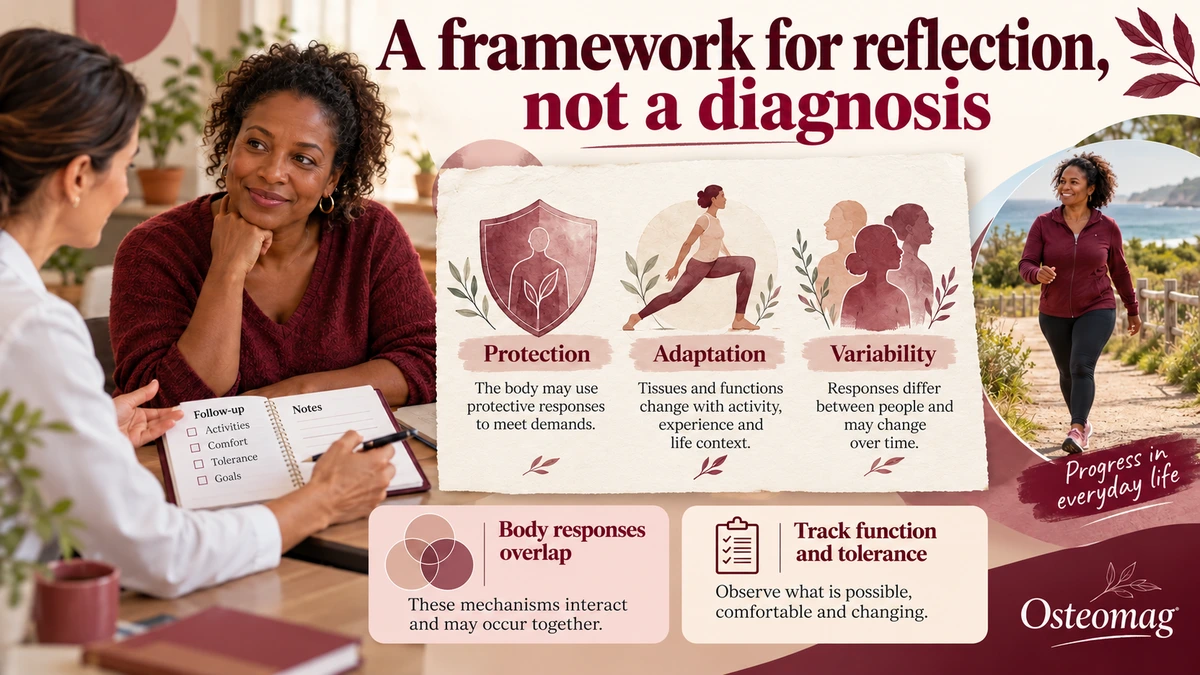
The words protection, adaptation, and variability can help when discussing movement and pain. They refer to real phenomena, but combining them into three successive phases does not establish a universal law of living organisms. No validated clinical examination can classify each person into one of these phases or guide care on this basis alone.
A useful explanation must distinguish what has been observed, what is proposed as a hypothesis, and what has been demonstrated. This article reviews the model’s concepts and places them within an accessible scientific framework: nervous system function, responses to loading, the experience of pain, and individualized rehabilitation. It also clarifies the limits of osteopathic care.
Key points
Protection, adaptation, and variability can serve as points of reference for discussion. These concepts overlap and do not constitute mandatory stages of healing. New or unusual pain should be assessed according to standard clinical criteria, rather than automatically interpreted as a protective phase.
Protection: one possible response, not the only explanation
Pain and nociception are not the same
Nociception is the nervous system’s processing of information related to potentially harmful stimuli. Pain is a personal sensory and emotional experience. It cannot be inferred directly from nerve activity alone or from the extent of an injury. Persistent pain remains real, even when imaging does not fully explain its intensity [2].
This distinction does not mean that all pain is harmless. The history, examination, and course of the condition remain essential. A fracture, infection, or neurological disorder cannot be ruled out by invoking a protective response. The explanation should be tailored after an appropriate assessment, rather than used to avoid one.
Movement can change in the presence of pain
A person may reduce their range of motion, shift their weight, or contract certain muscles more when a movement becomes painful. These adaptations vary depending on the task and the individual. The theory of movement adaptation to pain offers one way to understand these changes, without establishing an identical sequence for every situation [1].
Observed tension therefore does not prove that a tissue is restricted or that the body is following a predetermined phase. It may accompany discomfort, apprehension, exertion, or a temporary strategy. The examination primarily seeks to determine what is limiting function and which changes can be tried safely.
Adaptation: multiple systems, multiple timescales
The body continually adjusts its responses to activity, rest, and demands. The concept of allostasis notably describes physiological adjustments that make it possible to cope with demands. When certain responses are prolonged or repeated, their cost may become detrimental. However, this does not provide a diagnosis that can be made by palpation or a direct measure of stress based on muscle tension [3].
In movement, a task may become more difficult because its load increases, recovery decreases, or capacities have changed. The practical response is to examine these factors separately. A person resuming walking after a period of inactivity may require a different progression from someone with a recent injury.
The term “redistribution” can describe a change in weight-bearing or muscle activity. It does not demonstrate that migrating pain originates from an organ or from pressure shifting through the fascia. Symptoms that change location require reassessment; their significance should not be determined by the model alone.
Variability: knowing how to adjust rather than always moving more
Variability refers to differences between movements or repetitions. It may reflect the capacity to adapt, but also noise, fatigue, or difficulty with control. Research on motor variability shows that its meaning depends on the task and measurement method. “More variable” does not automatically mean “healthier” [4] [5].
Some movements require precision, while others require the ability to respond to a changing environment. The clinical goal is not to increase a presumed oscillation of the body, but to restore functional options: changing position, adjusting speed, or completing a task with less discomfort. Research measurements cannot be replaced by an impression obtained through palpation.
Sudden improvement can occur, as can a fluctuating course. It proves neither a phase transition nor structural healing. Follow-up should determine whether the improvement persists, whether it facilitates a useful activity, and whether new symptoms appear. The immediate experience matters, but it does not constitute the entirety of the evidence.
Interpreting the model through specific clinical questions
| Educational concept | Useful question | Limitation to respect |
|---|---|---|
| Protection | Which movement is difficult, and in what context? | Do not assume that all pain is benign |
| Adaptation | Have the load, recovery, or capacities changed? | Do not attribute pain that has shifted location to an organ without an assessment |
| Variability | Does the person have several movement options? | Do not seek greater variation at all costs |
| Follow-up | Is function improving in daily life? | An immediate effect does not demonstrate healing |
Assess before interpreting
Symptom history and examination
The practitioner asks about the onset of the condition, any possible trauma, its course, and its impact. They clarify which movements are difficult, any associated symptoms, and the person’s concerns. The examination then assesses relevant functions: strength, sensation, mobility, or walking, depending on the reason for the consultation. It is not intended to confirm a model category in advance.
The differential diagnosis depends on the region and context. Local discomfort may be musculoskeletal; pain accompanied by weakness, sensory disturbances, or systemic signs may require further investigation. Chest or abdominal pain should not be considered a mechanical redistribution without an appropriate assessment. Guidelines on persistent pain emphasize individualized assessment that can be revised as needed [10].
When to seek medical attention
New weakness, significant loss of sensation, or a sudden speech disturbance requires urgent referral. Chest pain with shortness of breath, significant trauma, fever with unusual pain, or rapid deterioration also requires prompt medical attention. A notable change in a known condition warrants reassessment.
What is the role of imaging?
Imaging addresses a specific clinical question, such as looking for a fracture or investigating a suspected disorder. It cannot visualize the model’s three phases. Its usefulness depends on the likelihood of a condition and the effect the result would have on management. A normal examination does not invalidate the experience of pain.
Conversely, an abnormality is not always sufficient to explain all symptoms. The findings are interpreted alongside the history and examination. In the presence of persistent pain, reassessment remains an option when the clinical picture changes. The label of “protection” must never prevent recognition of a new problem [2] [10].
Developing an appropriate rehabilitation plan
Start with an activity that matters
A specific goal is more useful than a promise of returning to an ideal phase. Walking to a chosen destination, working more comfortably, or resuming a family activity gives the program direction. The current difficulty, level of assistance, and time constraints are identified, and then a feasible first step is chosen.
Physical activity and exercise can contribute to the management of some chronic pain conditions. However, studies group together different situations and programs, with limitations in the certainty of the evidence. Their findings do not justify a uniform prescription or the idea that significant pain must be endured in order to progress [8].
A progression can modify the duration, frequency, or difficulty of a task. Changing one element at a time helps clarify the response. Prolonged worsening, excessive fatigue, or unusual symptoms should prompt an adjustment to the program. Fluctuations do not automatically mean failure, but they require careful observation.
Explaining without blaming
Understanding pain can reduce certain concerns and help facilitate discussions about activities. Research on pain neuroscience education has shown variable results, and it has often been studied as an adjunct to other forms of care. An explanation alone is not enough to eliminate a symptom or demonstrate that tissues are not at risk [6] [7].
The language used must remain consistent with the person’s experience. Referring to a sensitive system can be helpful; claiming that the brain “makes up” pain is misleading. Information is discussed, questions remain open, and the plan is developed together. The model must not become a new source of fear or create an obligation to think differently in order to recover.
Role of psychotherapeutic support
Anxiety, sleep difficulties, or fear of movement may accompany persistent pain. They do not indicate that the pain has an exclusively emotional origin. Psychological interventions, including certain cognitive behavioral approaches, may provide modest benefits in reducing the impact of chronic pain, depending on the circumstances [9].
If these difficulties are significant, referral to a psychotherapist can provide specific support. This complements the assessment and rehabilitation. Manual touch does not replace this work and cannot demonstrate the release of an emotional memory stored in tissue.
What is the role of osteopathy?
A consultation begins with a safety assessment and an understanding of the person’s goals. The osteopath explains the limits of their scope of practice, reviews relevant test results, and looks for pertinent musculoskeletal impairments. Any potential treatment is discussed after this stage, with consent that is freely given and may be withdrawn at any time.
Comfortable manual contact may be offered to help manage discomfort and facilitate a tolerable activity. Position, duration, and pressure are adjusted accordingly. The mechanisms of manual therapies remain partly uncertain; a beneficial effect does not confirm the phase model or any particular physiological transformation [11].
Osteopathic care plan
Check for signs requiring referral; select a measurable goal; explain uncertainties; offer tolerable treatment if relevant; reassess function; coordinate with rehabilitation. Continue only if the plan provides a meaningful benefit and remains compatible with medical needs.
Follow-up can compare an activity under similar conditions, record delayed responses, and assess independence. A lack of progress should lead to a reassessment of the hypotheses and options. The number of sessions is not determined by a sequence of presumed phases. The quality of care depends on caution, clarity, and outcomes that matter to the person.
References
- [1] Hodges PW et al. Moving differently in pain: a new theory to explain the adaptation to pain. Pain. 2011. Source
- [2] Raja SN et al. The revised International Association for the Study of Pain definition of pain: concepts, challenges, and compromises. Pain. 2020. Source
- [3] McEwen BS. Protective and damaging effects of stress mediators. N Engl J Med. 1998. Source
- [4] Stergiou N et al. Human movement variability, nonlinear dynamics, and pathology: is there a connection? Hum Mov Sci. 2011. Source
- [5] Harbourne RT et al. Movement variability and the use of nonlinear tools: principles to guide physical therapist practice. Phys Ther. 2009. Source
- [6] Wood L et al. A systematic review and meta-analysis of pain neuroscience education for chronic low back pain: Short-and long-term outcomes of pain and disability. Eur J Pain. 2019. Source
- [7] Watson JA et al. Pain Neuroscience Education for Adults With Chronic Musculoskeletal Pain: A Mixed-Methods Systematic Review and Meta-Analysis. J Pain. 2019. Source
- [8] Geneen LJ et al. Physical activity and exercise for chronic pain in adults: an overview of Cochrane Reviews. Cochrane Database Syst Rev. 2017. Source
- [9] Williams ACC et al. Psychological therapies for the management of chronic pain (excluding headache) in adults. Cochrane Database Syst Rev. 2020. Source
- [10] NICE. Chronic pain (primary and secondary) in over 16s: assessment of all chronic pain and management of chronic primary pain. NG193. 2021. Source
- [11] Keter DL et al. The mechanisms of manual therapy: A living review of systematic, narrative, and scoping reviews. PLoS One. 2025. Source