Understand anticipation, check safety and return to useful movements
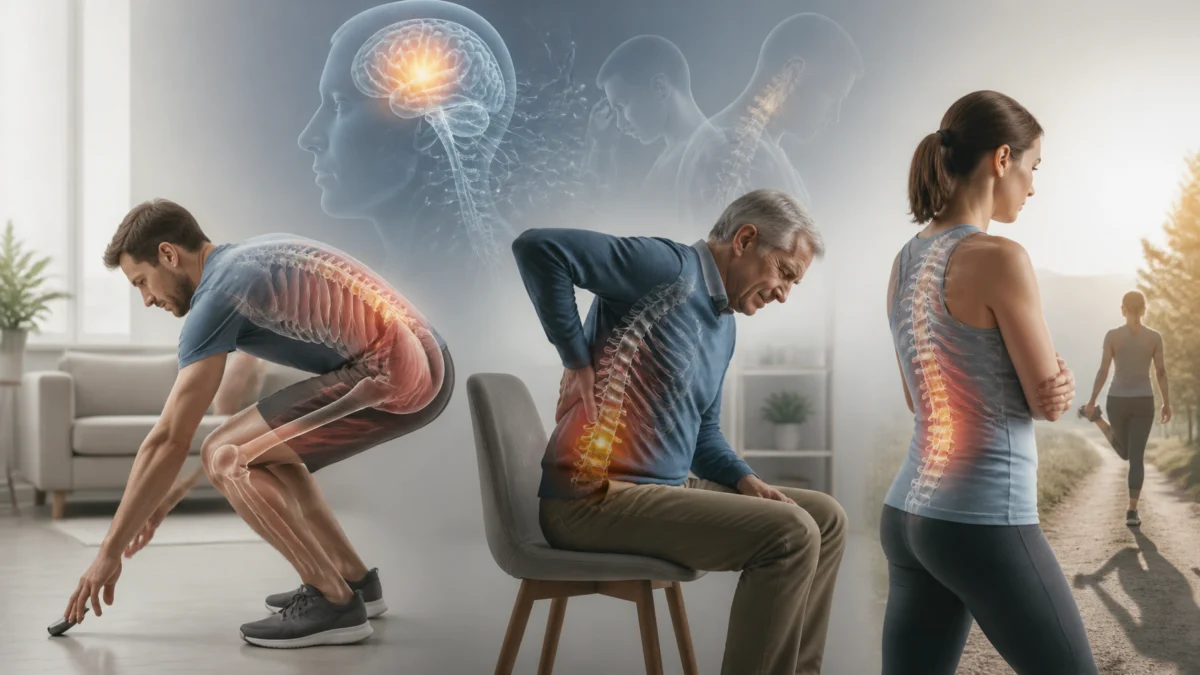
Someone bends to pick up an object and already feels apprehensive before the movement begins. Someone else braces their back before getting up from a chair. Another person has avoided a movement for months because it once caused severe pain, although their current condition might now allow an appropriately graded return.
This phenomenon cannot be reduced to “it is all in your head.” The brain and motor system use past experience to predict what might happen and prepare a response before action. Anticipation is a normal protective function, but it can become overly cautious. [1] [2]
Why does the body anticipate?
To act efficiently, the body cannot wait for an event to occur. It predicts the likely consequences of movement and prepares muscles, breathing and balance. This anticipation is essential when lifting a load, walking on unstable ground or catching an object. [2]
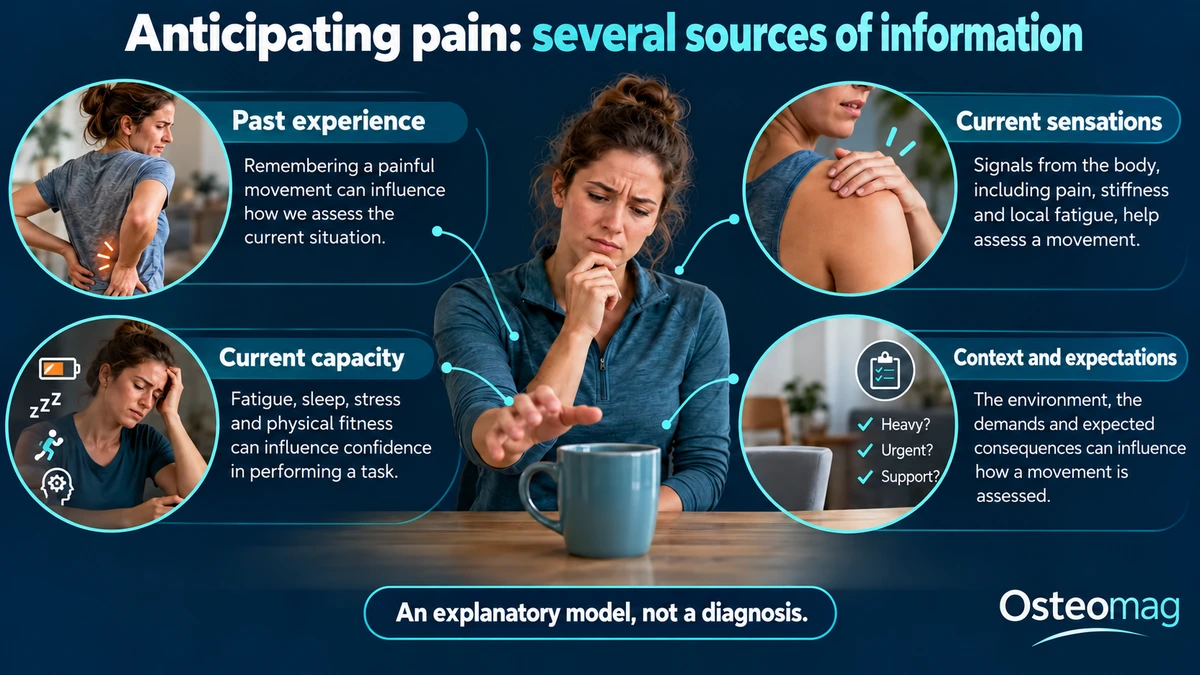
What changes after a painful experience?
A movement that previously caused significant pain may become associated with danger. When attempted again, the system may increase vigilance, slow the movement or recruit more of certain muscles even before pain appears. [1] [2]
Is this fear?
Sometimes, but not always. Fear of movement, called kinesiophobia in some contexts, describes excessive concern that movement might cause pain or further injury. However, someone may also adopt a cautious strategy without experiencing substantial conscious fear. [3] [4]
What research shows, and its limitations
A meta-analysis published in 2026 reports that measures of fear related to a specific task are more closely associated with certain spinal motor behaviours than general psychological measures. This supports asking “Which movement worries you?” rather than assuming that the person is generally anxious. [3]
Fear does not fully explain actual activity
The relationship is not straightforward. A 2025 meta-analysis covering many conditions found an overall association between fear of movement and lower physical activity, but the relationship varied between populations. In groups defined solely by pain, the association was not always statistically significant. [4]
Why avoid overly simple explanations?
Avoidance may be reasonable when tissue is recently injured, a fracture is possible or movement produces a neurological deficit. Before discussing fear, it is necessary to check that the movement is medically appropriate.
How can useful protection be distinguished from excessive protection?
Temporary caution can be appropriate during recovery. When it limits activities over time, tissue condition, capacity and expectations should all be assessed. Potentially disproportionate protection cannot be inferred from elapsed time or reassuring imaging alone. Assessment and appropriate movement trials help test this hypothesis.
Is anticipated pain imaginary?
No. Pain is a real experience even when anticipation influences it. Expectations, context and learning can modulate how sensory signals are processed. This does not mean that the person is inventing pain.
A real experience with multiple influences
Describing pain as exclusively “in the nervous system” can be misleading. All pain involves the nervous system, but it can also be associated with injury, inflammation, nerve irritation or other factors. It is more useful to explain that pain arises through a protective system integrating several kinds of information.
What is pain learning?
When a movement is repeated in a painful context, associated cues can themselves become predictive: a position, location, load or sensation. In learning models, these cues may contribute to an anticipatory response. New experiences can modify this learning, but it does not disappear instantly. [1]
A metaphor to use carefully
“Body memory” can be used as a metaphor, but becomes problematic if it suggests that a psychological memory is stored in a muscle or fascia. Sensorimotor learning, procedural memory and anticipation are more precise concepts. [1] [2]
Why might muscles contract more?
A protective strategy may seek to limit range or speed. In some people, this increases co-contraction around a region. However, there is no single muscular response to pain: motor control can adapt in many ways. [2]
Making a strategy more flexible
Co-contraction may increase stability in the short term. Sustained co-contraction can make some tasks more demanding, although this varies with the person and task. The goal is therefore not to eliminate all protection, but to recover the ability to increase or reduce it according to the situation.
Does pain during movement always mean that you should stop?
No, but it should not be ignored either. A mild, temporary increase may be acceptable in some rehabilitation programmes. Severe or progressive pain, or pain accompanied by weakness, loss of sensation or substantial swelling, calls for a different approach.
Clinical assessment: explore a movement without attributing all pain to fear
The interview clarifies the avoided movement, the feared consequence and symptom onset. The professional asks what changes with load, duration, sleep and context. Range of motion, strength, sensation and functional tolerance are examined according to the region involved. With the person’s agreement, an activity is observed, starting with an accessible version. Contracting before movement does not identify the cause.
Expected pain, experienced pain and confidence can be recorded separately, for example from zero to ten. These are follow-up measures, not diagnostic thresholds. A fear-of-movement questionnaire can complement the interview; it does not measure tissue strength or establish a psychological disorder. Associations in research do not demonstrate individual causality. [3] [4] [7]
Differential diagnosis and the role of imaging
Limitation may relate to recent injury, inflammation, nerve involvement, insufficient strength, substantial fatigue or several simultaneous factors. Medical assessment is required when these possibilities remain unexplained. For low back pain without warning signs, imaging is not routine; in specialist settings, it is considered when the result could change management. Normal imaging does not prove that fear causes the pain. [8]
| Observation | Useful question | Conclusion to avoid |
|---|---|---|
| Hesitation before movement | Which consequence is feared? | “The person is anxious” |
| Contracted muscles | How does this change with the task? | “The muscle stores a memory” |
| Pain at low load | Which assessment and progression are appropriate? | “There is no risk” |
| Improved confidence | Are strength and endurance improving too? | “Everything has recovered” |
What is graded exposure?
Graded exposure involves progressively returning to avoided movements or activities under controlled conditions. It may begin with a smaller range, lighter load or slower speed, progressing when the person finds that the task can be performed without disproportionate consequences. [6]
Teaching example: someone hesitates to pick up a basket. After checking precautions related to their condition, they may try a light basket on an accessible support. They observe the response during movement and over the following hours. If this version remains acceptable, they change one parameter: height, distance or load. A lasting or unusual reaction calls for reducing the dose and reviewing the programme. This example is not a prescription for every painful condition.
Reviews of persistent low back pain suggest that graded activity may offer benefits compared with minimal intervention, without consistently outperforming other exercise. Evidence for graded exposure is more limited. The method is selected according to goals and obstacles, without promising to “reprogramme” the brain. [6] [9]
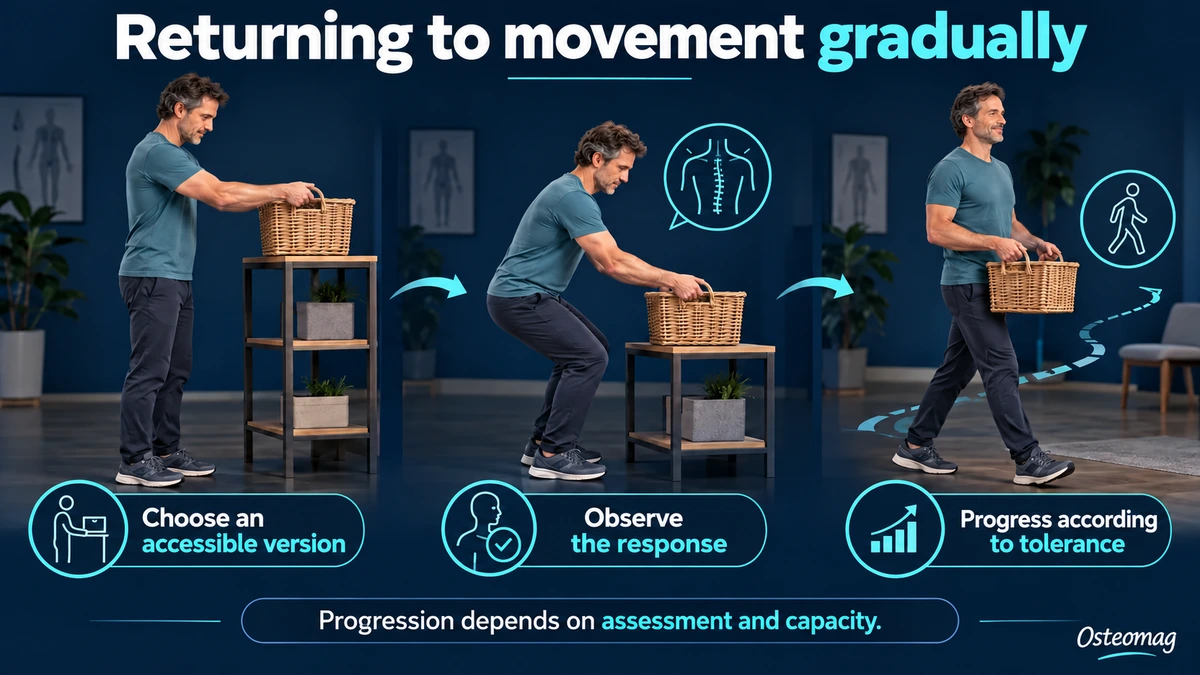
Compare expectation and experience
Saying “you can move” is not always enough. A practical experience can help compare what was feared with what actually happened. The person discovers that a movement may be performed with less pain or more control than expected.
Keep useful precautions
Not every precaution needs to be removed. A precaution can be useful, and even represent progress if it helps someone resume an activity. The aim is to make strategies more flexible, rather than impose abrupt exposure.
Why might movement variability help?
Practising a task in several ways may expand movement options: slightly changing position, speed, load or support. Variability must remain suited to the person’s capacity and should not become a succession of unnecessary challenges.
What is the osteopath’s role?
The osteopath may contribute by temporarily easing discomfort, exploring better-tolerated movements and supporting a gradual return to activity. Manual care then supports movement rather than claiming to correct a supposedly displaced structure.
Touch remains a choice
For some people, reassuring and predictable contact facilitates movement. For others, it increases vigilance. Its effect should be tested rather than assumed. The patient must retain the right to say that touch is not helping.
The osteopath does not make a medical diagnosis or act as a psychotherapist. Disabling anxiety, psychological trauma or major avoidance may warrant referral to a qualified psychologist or psychotherapist. Psychological approaches to pain can help some people, with generally modest average effects, as part of coordinated care. [10]
How can we speak without reinforcing fear?
It is better to avoid statements such as “your back is fragile” or “your pelvis is unstable.” A more useful explanation would be: “Your body seems to prepare extensively for this movement. We can look for a version that lets you perform it with more confidence and control.”
Pain education should answer the person’s questions and accompany practical goals. A general explanation does not by itself restore strength or treat an underlying condition. Education outcomes vary between studies; reassuring words must be consistent with assessment, without an absolute guarantee of safety. [11] [12]
Red flags: when to seek prompt assessment
Rapidly worsening pain, new weakness, substantial sensory loss, fever, unexplained weight loss, significant trauma or a major change in the usual symptom pattern require appropriate assessment before concluding that anticipation alone explains the problem.
Rapidly progressive weakness, new bladder or bowel control difficulties with low back pain, or loss of sensation in the perineum require urgent assessment. Chest pain with breathlessness must not be attributed to anticipation. A red flag is interpreted in context: the aim is proportionate referral, rather than anxious monitoring of every sensation. [8]
Confidence and capacity complement each other
Someone may feel more confident without having recovered strength or endurance. Progression must therefore consider both confidence and actual physical capacity.
How can progress be measured?
Range, speed, tolerated load, breathing, pain after activity and, above all, the ability to resume an important function can be monitored. Progress often means having more choices rather than an absolute absence of pain.
Conclusion
The body may anticipate pain because it learns to predict the consequences of movement. Fear can influence this anticipation, alongside experience, protection and current physical capacity.
The most useful clinical response is rarely to tell a patient to “stop being afraid.” Gradually creating sufficiently safe movement experiences is preferable, so that protection can become more flexible.
Scientific references
- [1] Raja SN et al. The revised International Association for the Study of Pain definition of pain. Pain. 2020. View source.
- [2] Hodges PW, Tucker K. Moving differently in pain: a new theory to explain the adaptation to pain. Pain. 2011. View source.
- [3] Homs AF et al. Task-specific vs general measures of pain-related fear relative associations with spinal motor behaviour: a systematic review and meta-analysis. Pain. 2026;167:258–272. View source.
- [4] Goubran M et al. Relationship Between Fear of Movement and Physical Activity: A Systematic Review and Meta-Analysis. Physical Therapy. 2025;105:pzaf050. View source.
- [5] Stanton TR et al. Feeling stiffness in the back: a protective perceptual inference in chronic back pain. Scientific Reports. 2017. View source.
- [6] Macedo LG et al. Graded activity and graded exposure for persistent nonspecific low back pain: a systematic review. Physical Therapy. 2010. View source.
- [7] De Baets L, Matheve T, Timmermans A. The Association Between Fear of Movement, Pain Catastrophizing, Pain Anxiety, and Protective Motor Behavior in Persons With Peripheral Joint Conditions: A Systematic Review. 2020. View source.
- [8] NICE. Low back pain and sciatica in over 16s: assessment and management. NG59. View source.
- [9] López-de-Uralde-Villanueva I et al. A Systematic Review and Meta-Analysis on the Effectiveness of Graded Activity and Graded Exposure for Chronic Nonspecific Low Back Pain. Pain Medicine. 2016. View source.
- [10] Williams AC de C et al. Psychological therapies for the management of chronic pain (excluding headache) in adults. Cochrane. 2020. View source.
- [11] Watson JA et al. Pain Neuroscience Education for Adults With Chronic Musculoskeletal Pain: A Mixed-Methods Systematic Review and Meta-Analysis. Journal of Pain. 2019. View source.
- [12] Vlaeyen JWS, Crombez G, Linton SJ. The fear-avoidance model of pain. Pain. 2016. View source.