How Foot Position, Forward Trunk Movement, Leg Strength, and Individual Movement Strategies Can Make Everyday Chair Transfers More Comfortable
Standing up from a chair seems simple—until your lower back hurts.
When back pain is present, an ordinary movement performed dozens of times each day can suddenly become uncomfortable. Getting out of a chair, lowering yourself onto a sofa, rising from the toilet, getting out of a car, or standing after a long period of sitting may all become movements that you begin to anticipate.
It is tempting to assume that there must be one correct technique capable of protecting the spine. Human movement, however, is more adaptable than that.
There is no universally perfect way to stand up or sit down. People naturally use different combinations of their feet, knees, hips, trunk, arms, and momentum according to their strength, mobility, body proportions, chair height, fatigue, and symptoms.
For someone experiencing low-back pain, the objective is therefore not to discover a rigid biomechanical rule. A more useful goal is to find a movement strategy that distributes effort comfortably and allows the person to remain active.
Small changes in foot placement, trunk position, chair height, use of the arms, and speed of movement can sometimes make a surprisingly noticeable difference.
Standing Up Is a Whole-Body Movement
Rising from a chair requires coordination between several parts of the body.
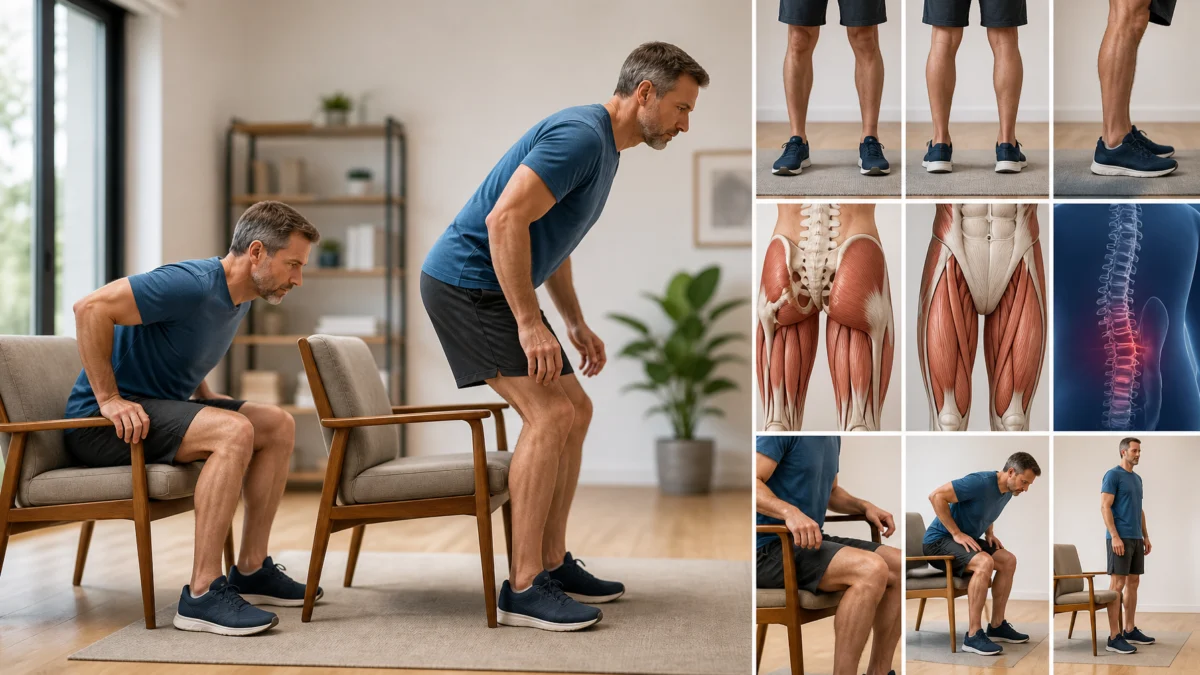
The feet provide a base of support. The trunk normally moves forward to bring the body’s center of mass toward the feet. The hips and knees then extend as the body rises.
The quadriceps and gluteal muscles contribute substantially, but they do not work in isolation. Muscles of the trunk and lower limbs coordinate continuously to control balance and movement.
This is important because back pain is sometimes accompanied by a tendency to think:
“I must keep my back perfectly straight.”
That is not necessarily required.
The lumbar spine is designed to move. Bending the trunk forward during a sit-to-stand movement is not automatically harmful. In fact, some forward movement of the trunk is normally part of getting up from a chair.
The question is not whether the spine moves, but whether the chosen movement is comfortable and appropriate for the individual.
Foot Position Can Change the Movement
Foot placement influences how we rise from a chair.
Moving the feet slightly backward toward the chair can make standing easier for many people because it changes the relationship between the body’s center of mass and the base of support.
A slightly wider stance may feel more stable for some individuals.
Others may naturally place one foot slightly ahead of the other.
Turning the feet slightly outward may also feel more comfortable depending on hip mobility, knee position, and individual anatomy.
These variations are not necessarily errors.
The original version of this article proposed intentionally redirecting the feet to force the body to recruit the legs instead of the lower back. That concept is better understood as a movement experiment rather than a universal biomechanical law.
Changing foot position does change the mechanics of the movement. But it does not simply switch the back “off” and the legs “on.”
The body continues to coordinate multiple muscle groups.
What matters clinically is whether a particular foot position makes the movement easier and more comfortable for that individual.
A Simple Sit-to-Stand Strategy
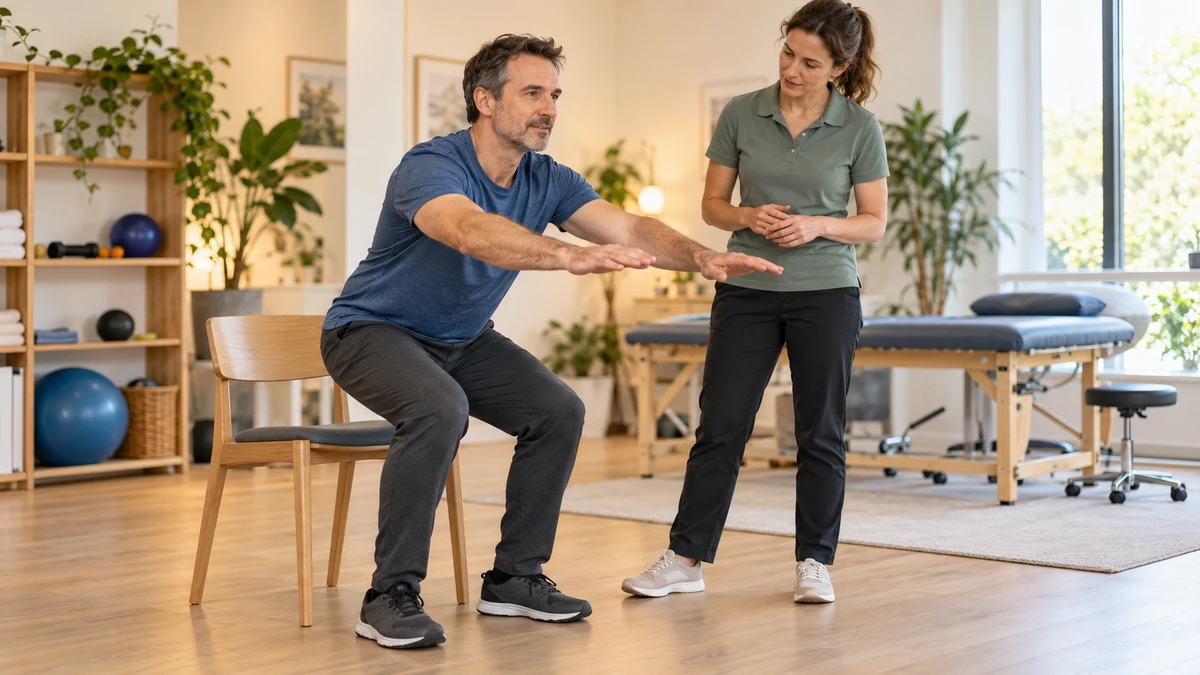
If standing from a chair is uncomfortable, try experimenting with the following sequence.
Move toward the front portion of the seat.
Place both feet firmly on the floor. Try bringing them slightly closer to the chair rather than leaving them far in front of you.
Allow your trunk to move forward comfortably.
Think of bringing your chest forward rather than trying to rise vertically from the beginning.
Then push through your feet and allow the hips and knees to straighten as you stand.
Do not rush.
If necessary, use the armrests or place your hands on your thighs for assistance.
Using your arms is not “cheating.” It is simply another way of distributing the physical demand.
Once the movement becomes easier, you can gradually experiment with using less assistance if that is useful to you.
Sitting Down Is Not Simply Standing Up in Reverse
Lowering yourself into a chair also requires coordination.
Begin by positioning yourself close enough to the chair that you do not need to reach backward excessively.
Place your feet where you feel stable.
Allow the hips and knees to bend while the trunk moves naturally.
Lower yourself at a speed you can control.
If necessary, use the armrests.
Some people with back pain try to remain extremely rigid while sitting down because they are afraid of bending their spine. This can make the movement feel more difficult.
A controlled movement does not require a completely immobile spine.
The objective is not rigidity.
It is confidence, control, and comfort.
What About the Psoas?
The psoas major is an important muscle connecting the lumbar region to the femur and contributing to hip flexion.
However, it should not be presented as the principal cause of difficulty when standing from a chair.
The original version of this article attributed considerable lumbar stress to excessive psoas activation during the movement. Human biomechanics are considerably more complex.
Many muscles contribute to sitting, standing, walking, bending, and stabilizing the body. Their activity changes according to the task and the strategy used.
A painful sit-to-stand movement therefore does not necessarily mean that the psoas is “too tight,” overactive, or pulling excessively on the lumbar spine.
This distinction matters because overly simple explanations can cause people to become unnecessarily worried about normal muscular activity.
Pain Can Change the Way We Move
When a movement hurts, people naturally adapt.
They may move more slowly, stiffen the trunk, push more strongly through one leg, use the arms, avoid certain ranges of movement, or shift their weight differently.
Some of these adaptations are temporarily useful.
The problem arises when a protective strategy becomes so rigid that the person begins to believe there is only one safe way to move.
Recovery often involves gradually restoring movement options rather than enforcing one perfect movement pattern.
For example, someone might initially use the armrests to stand comfortably. Later, the person may experiment with standing without the arms. Eventually, different chair heights and foot positions can be explored.
The objective is to expand what the body can comfortably do.
Chair Height Makes a Difference
Not every difficult sit-to-stand movement is caused by the back.
Chair height can dramatically influence the effort required.
A very low sofa requires considerably more hip and knee movement than a higher chair. A deep, soft couch can also make standing more demanding because the body begins farther from the edge and may sink into the cushion.
During an acute episode of back or lower-limb pain, temporarily choosing a slightly higher and firmer chair can make everyday life easier.
That is not avoiding movement.
It is adapting the environment while remaining active.
As symptoms improve, lower seating surfaces can gradually be reintroduced if desired.
Strength Matters Too
Standing from a chair depends partly on lower-limb strength.
If the quadriceps and hip muscles are weak, rising from a low chair requires greater effort.
Repeated sit-to-stand exercises can therefore serve not only as practice for daily movement but also as a simple strengthening exercise.
The appropriate dosage depends on the person’s condition.
For someone recovering from pain, beginning with a higher chair or using the arms may make the exercise more manageable. As strength and confidence improve, the chair can gradually become lower or arm assistance can be reduced.
Progression should be based on tolerance rather than an arbitrary standard of perfect form.
Stop Trying to Protect Your Back From Every Movement
One of the unintended consequences of back-pain advice is that people can become afraid of ordinary movement.
They may be told never to bend their back, always brace their abdominal muscles, keep the spine perfectly neutral, or perform everyday movements according to rigid instructions.
Although temporary modifications can certainly help during painful periods, the spine does not need to be protected from normal movement indefinitely.
The human back is built to bend, rotate, extend, and adapt to load.
For most people, the longer-term objective should be to recover movement capacity rather than continuously avoiding spinal motion.
That means gradually becoming comfortable with different ways of sitting, standing, bending, reaching, and moving.
A Psychocorporeal Dimension: Feeling the Movement Instead of Fearing It
There is also an important sensory dimension to this everyday movement.
When pain has persisted, a person may begin preparing for discomfort before movement even starts. The body may become more rigid, breathing may change, and attention may become concentrated on the painful area.
Rather than interpreting these reactions psychologically, they can simply be observed.
Where are your feet?
Can you feel their contact with the floor?
What happens when you move your trunk slightly forward?
Can you feel the legs beginning to contribute?
Does changing the position of one foot alter the movement?
Can you breathe normally while standing?
This type of exploration shifts attention away from the idea of performing the movement “correctly” and toward experiencing what the body is actually doing.
The objective is not relaxation at all costs.
It is availability: the ability to explore more than one movement strategy and select the one that is useful at that moment.
The Osteopathic Perspective
An osteopathic assessment of painful chair transfers should therefore involve more than examining the lumbar spine.
The practitioner can observe how the person approaches the chair, where the feet are positioned, how the trunk moves, whether the arms are used, whether one leg contributes differently from the other, and which variations change the symptoms.
Manual treatment may sometimes be incorporated to address discomfort or movement limitations, but the objective should not be to “put the lumbar spine back into place.”
Movement itself can become part of the assessment.
Try the movement.
Change one variable.
Try again.
Compare.
Perhaps moving the feet backward helps.
Perhaps a wider stance feels better.
Perhaps using the armrests changes everything.
Perhaps none of these variations matter and another factor needs to be considered.
This approach respects an important characteristic of the human body: adaptability.
When Back Pain Requires Further Evaluation
Most episodes of low-back pain are not caused by serious disease, but certain situations require medical evaluation.
Seek appropriate healthcare assessment when back pain is associated with significant trauma, progressive weakness in one or both legs, major changes in sensation, loss of bladder or bowel control, numbness around the saddle region, fever or systemic illness, unexplained weight loss, or severe and progressively worsening symptoms.
Persistent pain that significantly limits daily activities also deserves appropriate assessment.
Conclusion: There Is More Than One Way to Stand Up
Getting up from a chair and sitting down are ordinary movements, but they illustrate something fundamental about the human body.
Movement is adaptable.
There is no single foot position, spinal angle, or muscular sequence that everyone must reproduce perfectly.
When low-back pain makes these movements difficult, changing foot placement, moving closer to the edge of the chair, allowing comfortable forward trunk movement, using the arms, changing chair height, or strengthening the legs may all help.
The best strategy is not necessarily the one that looks biomechanically perfect.
It is the one that allows the person to move comfortably, confidently, and with progressively greater freedom.
The goal is not to teach the body one “safe” way to move. It is to help the body rediscover several ways to move.
References
- Janssen WGM, Bussmann HBJ, Stam HJ. Determinants of the sit-to-stand movement: a review. Physical Therapy. 2002;82(9):866–879. This review examines major factors influencing the sit-to-stand transition, including chair characteristics, foot position, muscular strength, and movement strategies.
- Riley PO, Schenkman ML, Mann RW, Hodge WA. Mechanics of a constrained chair-rise. Journal of Biomechanics. 1991;24(1):77–85. doi:10.1016/0021-9290(91)90328-K. This classic biomechanical study describes the different phases of rising from a chair and the importance of trunk movement and momentum transfer.
- Kawagoe S, Tajima N, Chosa E. Biomechanical analysis of effects of foot placement with varying chair height on the motion of standing up. Journal of Orthopaedic Science. 2000;5(2):124–133. doi:10.1007/s007760050139. The study demonstrates that foot position and chair height influence the biomechanical demands of standing from a seated position.
- Shepherd RB, Koh HP. Some biomechanical consequences of varying foot placement in sit-to-stand in young women. Scandinavian Journal of Rehabilitation Medicine. 1996;28(2):79–88. The findings demonstrate that foot placement influences body displacement and the movement strategy used when standing.
- Blache Y, Pairot de Fontenay B, Monteil K. The effects of seat height and foot placement on lumbar spine load during sit-to-stand tasks. Ergonomics. 2014;57(11):1687–1695. doi:10.1080/00140139.2014.948495. The authors found that seat height and anterior-posterior foot placement can modify estimated lumbar mechanical loading during the sit-to-stand movement.
- Demura S, Yamada T. Height of chair seat and movement characteristics in sit-to-stand by young and elderly adults. Perceptual and Motor Skills. 2007;104(1):21–31. doi:10.2466/PMS.104.1.21-31. This study highlights the influence of chair height on movement characteristics and the demands associated with standing from a seated position.
- Franke H, Franke JD, Fryer G. Osteopathic manipulative treatment for nonspecific low back pain: a systematic review and meta-analysis. BMC Musculoskeletal Disorders. 2014;15:286. doi:10.1186/1471-2474-15-286. This review evaluated available evidence concerning osteopathic treatment for nonspecific low back pain while emphasizing the importance of considering the methodological quality and limitations of the available studies.
- Hartvigsen J, Hancock MJ, Kongsted A, et al. What low back pain is and why we need to pay attention. The Lancet. 2018;391(10137):2356–2367. doi:10.1016/S0140-6736(18)30480-X. This review describes low back pain as a complex, multifactorial condition and provides a broader framework than explanations based exclusively on individual anatomical or biomechanical abnormalities.
- Foster NE, Anema JR, Cherkin D, et al. Prevention and treatment of low back pain: evidence, challenges, and promising directions. The Lancet. 2018;391(10137):2368–2383. doi:10.1016/S0140-6736(18)30489-6. The authors emphasize evidence-based management, continued activity when appropriate, and avoiding unnecessary medicalization of low back pain.
- World Health Organization. WHO guideline for non-surgical management of chronic primary low back pain in adults in primary and community care settings. Geneva: World Health Organization; 2023. These guidelines support an individualized, person-centered approach to chronic primary low back pain that may include education and exercise as part of care.