Comparing headache patterns, recognizing warning signs and choosing appropriate help
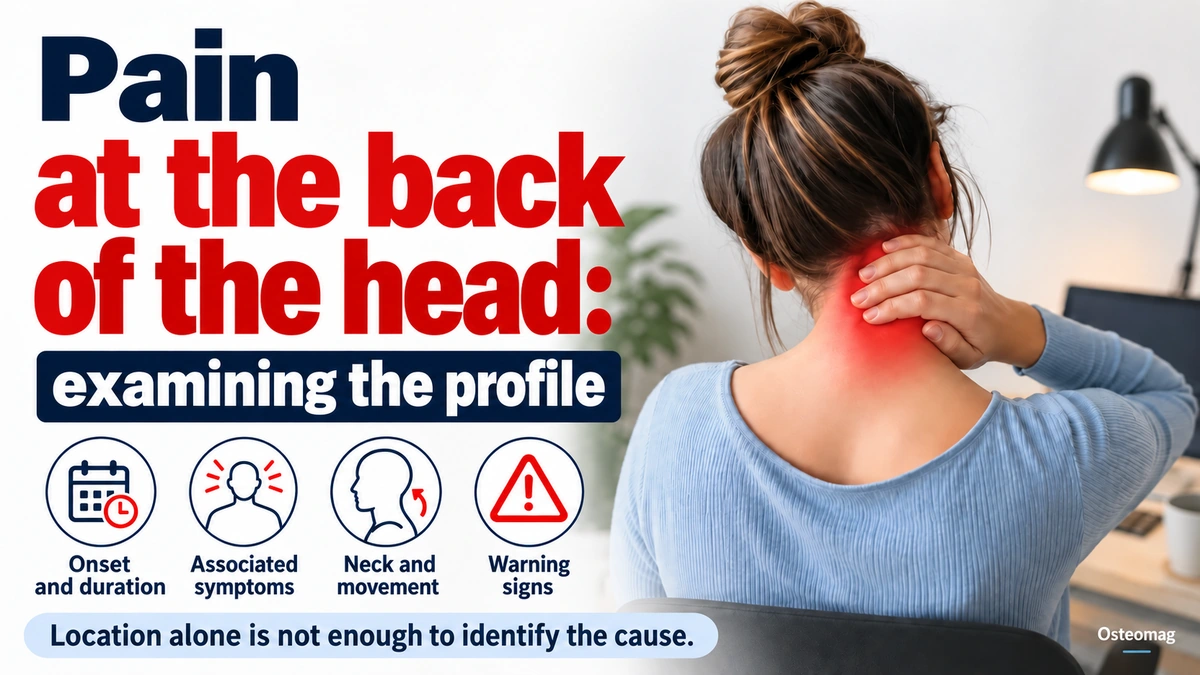
Pain at the back of the head is not a diagnosis. The occipital region can hurt in very different situations: migraine, tension-type headache, pain arising from the neck, occipital neuralgia, trauma or, less commonly, a vascular or neurological cause. Location helps guide assessment, but it is never enough to identify the cause.
In brief: longstanding, stable, reproducible pain is not managed like a sudden or unusual headache. A brief electric shock-like pain is more suggestive of occipital neuralgia; nausea and sensitivity to light or sound point more toward migraine; pain consistently reproduced by the neck may support a cervicogenic component. However, these patterns overlap and can coexist [1] [2] [3] [4] [5] [6].
1. Tension-type headache
Tension-type headache is a common primary headache. It is often described as pressure, tightness or a ‘band’ around the head. Pain may be felt in the forehead, temples, sides or back of the head. It is usually bilateral, mild to moderate in intensity and not normally aggravated by routine physical activity.
Despite its name, explaining it solely as ‘muscles that are too tight’ would be an oversimplification. Tenderness in the muscles of the head and neck may be present, but the mechanisms also involve pain processing in the nervous system.
2. Migraine
Migraine can be felt at the back of the head. It is not necessarily located at the temple or behind an eye. Neck pain is also extremely common among people with migraine: a meta-analysis estimated its frequency at approximately 77% in clinical populations [1].
Features more suggestive of migraine include moderate or severe pain, sometimes throbbing, worsened by activity, together with nausea, sensitivity to light or sound, and recurring attacks with a recognizable pattern. Pain in the neck therefore does not automatically mean that the headache originates there.
3. Cervicogenic headache
Cervicogenic headache is a secondary headache attributed to a cervical structure. Pain may begin in the neck or occipital region and then refer into the head. It is often one-sided and may be associated with reduced neck mobility or consistent reproduction of pain by particular neck movements or tests [2] [3].
Diagnosis does not rest on a single tight muscle, a ‘displaced’ vertebra or a tender spot. The clinical history and several consistent findings are needed. Recent reviews emphasize the overlap between cervicogenic headache, migraine accompanied by neck pain, and occipital neuralgia [2] [3].

4. Occipital neuralgia
Occipital neuralgia typically produces sharp, shooting, electric shock-like or stabbing pain in the distribution of the occipital nerves. It may travel from the base of the skull toward the top of the head, sometimes as far as the eye. Scalp tenderness or altered sensation may also be present [4] [5] [6].
A 2025 meta-analysis shows that presentations are most often unilateral, severe and sharp or stabbing, but remain variable. Coexisting migraine is common and can complicate diagnosis [4].
Diagnosis is clinical. In some cases, an occipital nerve block may contribute to diagnostic reasoning and relief. Conservative approaches are generally used first, but evidence remains limited and persistent cases may need specialist care [5] [6].
5. Musculoskeletal neck pain with referred pain
The joints, muscles and other tissues of the neck may become sensitive after overload, an unfamiliar activity, prolonged immobility or local irritation. Pain may remain in the neck or refer to the back of the head.
We should avoid automatically attributing this pain to ‘bad posture’. No single posture is inherently bad. Duration, lack of variation, total load and individual tolerance matter more. For many people, changing positions and moving regularly is more useful than searching for a perfect position.
6. Post-traumatic headache
A headache may develop after concussion, head trauma or sometimes neck trauma. Post-traumatic headache often resembles migraine or tension-type headache rather than a unique pattern. Under ICHD-3, it is classically defined by onset within seven days of the injury or recovery of consciousness [7].
A 2024 neurological review notes that these headaches resolve during the acute phase for many people, but persist for several months in some [7]. A new headache after trauma deserves medical assessment, particularly when accompanied by repeated vomiting, confusion, loss of consciousness, a neurological deficit or rapid deterioration.
7. Exercise-related headache
A headache may occur during or immediately after intense physical exertion. Primary exercise headache is a recognized and often benign condition, but this diagnosis should be made only after excluding certain secondary causes at a first presentation or when the pattern is atypical [8] [9].
A new headache triggered by exertion, especially if sudden or very severe, therefore deserves medical assessment rather than simply being attributed to neck tension.
8. Medication-overuse headache
In someone who already has migraine or other recurrent headaches, very frequent use of acute headache medication can contribute to headaches becoming more frequent. Medication-overuse headache usually presents as very frequent headache against a background of a pre-existing headache disorder [10].
The location may vary and is not limited to the back of the head. The main clues are headache frequency and repeated use of acute medication. Management should be discussed with a physician rather than abruptly stopping a prescribed medication without guidance.
9. Cervical artery dissection: rare, but important
Carotid or vertebral artery dissection is rare, but is an important cause of stroke, particularly in younger adults. It can occur without major trauma or with a minor mechanical trigger, through a complex interaction between individual, anatomical and mechanical factors [11] [12].
New and unusual head or neck pain can be part of the presentation. When it is accompanied by weakness, numbness, speech difficulties, double vision, marked imbalance, a drooping eyelid with a smaller pupil, or another neurological sign, urgent assessment is needed [11] [12].
For any manual care practitioner, new, unusual neck or occipital pain, or pain accompanied by neurological signs, should be a reason to stop treatment and refer for medical assessment rather than call it simple ‘neck tension’.
10. Other secondary causes to exclude
Less commonly, pain at the back of the head may be related to subarachnoid hemorrhage, infection, an intracranial lesion, a disorder of intracranial pressure or another medical condition. These situations cannot all be distinguished by location alone.
Screening approaches for secondary headache focus more on a change in pattern, sudden onset, age and context, systemic or neurological signs, and particular circumstances than on the precise place where the head hurts [13] [14].
A practical guide to possible presentations
| Presentation | Possible causes |
|---|---|
| Bilateral pressure or tightness | Tension-type headache, neck pain |
| Severe pain with nausea and sensitivity to light or sound | Migraine |
| Pain consistently related to neck movements | Cervicogenic headache |
| Electric shock-like pain, a sensitive scalp | Occipital neuralgia |
| Pain after trauma | Post-traumatic headache; exclude a secondary cause |
| New pain during intense exertion | Exercise headache; exclude a secondary cause |
| Very frequent headaches with repeated acute medication use | Medication overuse |
| New, unusual pain with a neurological sign | Possible vascular or neurological emergency |
When to seek emergency care
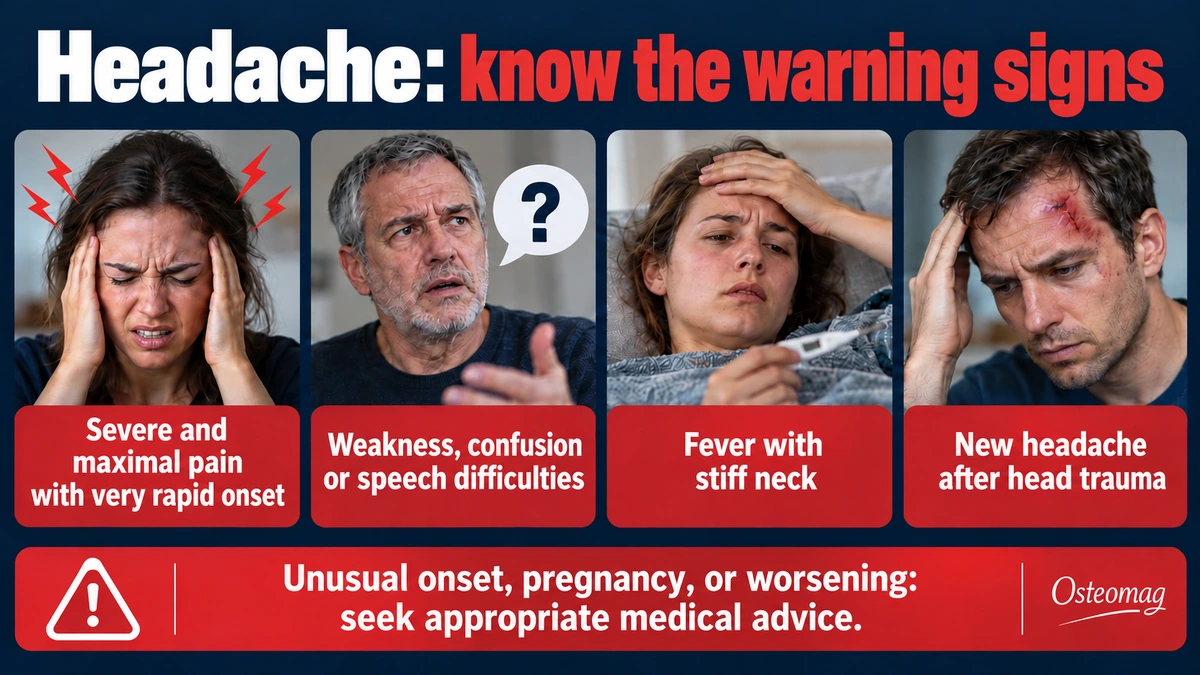
Seek immediate assessment or call emergency services when a headache is accompanied by any of the following:
- sudden pain reaching its maximum within seconds or minutes;
- weakness, substantial numbness, speech difficulties or confusion;
- loss of consciousness or a seizure;
- new double vision, severe imbalance or an unusual difficulty walking;
- significant fever with marked neck stiffness or a deterioration in general health;
- a new headache after significant trauma;
- a new headache during pregnancy or the postpartum period;
- a new type of headache in someone who is immunocompromised or has cancer;
- a clear and progressive change in a usual headache pattern;
- unusual neck or occipital pain associated with neurological signs.
What to do when there are no warning signs
For mechanical neck pain or an already familiar benign headache, a few simple principles may be helpful:
- change positions regularly instead of searching for perfect posture;
- gently resume neck movements within tolerable ranges;
- avoid prolonged immobility;
- take breaks during screen-based work;
- maintain regular, appropriately adapted physical activity;
- pay attention to sleep, hydration and regular meals;
- keep a headache diary when episodes recur;
- seek advice if the pattern persists, changes or becomes more frequent.
Exercise can be beneficial for several primary headaches, but available reviews do not identify a single protocol that is superior for everyone [15].
What place is there for osteopathy?
Osteopathy may have a role when a musculoskeletal neck component is plausible: painful limitation of mobility, muscle tenderness, discomfort related to movement or a need for gradual restoration of function.
Manual care should not, however, be presented as a universal solution for headaches. An umbrella review covering 31 systematic reviews concludes that exercise may benefit some primary headaches, whereas evidence on manual therapy is more heterogeneous and often limited by study quality [15].
For migraine, occipital neuralgia or recurrent headache, osteopathy may potentially complement wider care when a cervical component is present, but it does not replace diagnosis or condition-specific medical treatment when indicated.
For someone with new, highly unusual neck or occipital pain, or accompanying neurological symptoms, the priority is not manual treatment: it is medical assessment.
Key points
Pain at the back of the head may relate to tension-type headache, migraine, cervicogenic headache, occipital neuralgia, musculoskeletal neck pain, trauma, exertion or medication overuse. More rarely, it may signal an important vascular or neurological condition.
Location provides a clue, but the full pattern—onset, duration, associated symptoms, triggers and progression—is what chiefly guides appropriate diagnostic assessment.
Scientific references
- [1] Al-Khazali et al. Prevalence of neck pain in migraine: A systematic review and meta-analysis. Cephalalgia. 2022;42(7):663-673. doi:10.1177/03331024211068073.
- [2] Demont et al. Cervicogenic headache, an easy diagnosis? A systematic review and meta-analysis of diagnostic studies. Musculoskelet Sci Pract. 2022;62:102640. doi:10.1016/j.msksp.2022.102640.
- [3] Mathew et al. A Pain in the Neck: Occipital Neuralgia vs. Cervicogenic Headache vs. Migrainous Cervicalgia. Curr Pain Headache Rep. 2025;29(1):101. doi:10.1007/s11916-025-01419-7.
- [4] Melchior et al. Epidemiology and clinical features of occipital neuralgia: A systematic review and meta-analysis. Cephalalgia. 2025;45(2):3331024251317595. doi:10.1177/03331024251317595.
- [5] Deuel et al. Conservative Management of Occipital Neuralgia Supported by Physical Therapy: A Review of Available Research and Mechanistic Rationale to Guide Treatment. Curr Pain Headache Rep. 2024;28(12):1321-1331. doi:10.1007/s11916-024-01288-6.
- [6] Lefel et al. 11. Cervicogenic headache and occipital neuralgia. Pain Pract. 2025;25(1):e13405. doi:10.1111/papr.13405.
- [7] Schwedt et al. Posttraumatic Headache. Continuum (Minneap Minn). 2024;30(2):411-424. doi:10.1212/CON.0000000000001410.
- [8] Upadhyaya et al. Primary Exercise Headache. Curr Neurol Neurosci Rep. 2020;20(5):9. doi:10.1007/s11910-020-01028-4.
- [9] Osiowski et al. Epidemiology of Primary Exercise Headache: A Systematic Review and Meta-Analysis with Comparison between Clinic- and Population-Based Settings. Neuroepidemiology. 2026;:1-9. doi:10.1159/000549397.
- [10] Rizzoli et al. Medication-Overuse Headache. Continuum (Minneap Minn). 2024;30(2):379-390. doi:10.1212/CON.0000000000001403.
- [11] Doukhi et al. Headaches attributed to cranial and cervical artery dissections. J Headache Pain. 2025;26(1):28. doi:10.1186/s10194-025-01958-9.
- [12] Yaghi et al. Treatment and Outcomes of Cervical Artery Dissection in Adults: A Scientific Statement From the American Heart Association. Stroke. 2024;55(3):e91-e106. doi:10.1161/STR.0000000000000457.
- [13] Do et al. Red and orange flags for secondary headaches in clinical practice: SNNOOP10 list. Neurology. 2019;92(3):134-144. doi:10.1212/WNL.0000000000006697.
- [14] Viera et al. Acute Headache in Adults: A Diagnostic Approach. Am Fam Physician. 2022;106(3):260-268.
- [15] Varangot-Reille et al. Exercise and Manual Therapy for the Treatment of Primary Headache: An Umbrella and Mapping Review. Phys Ther. 2022;102(3):pzab308. doi:10.1093/ptj/pzab308.